Charge pump circuit failing

Thread Starter

bibaboeba

Joined Oct 30, 2025
8
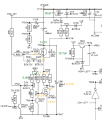
Hi! I am in need of some help on a defective course computer. This course computer is used to control the autopilot on a sailboat and it broke down while under way. Upon further investigation i found that the VIN+12V rail only carried 12V (instead of 24) with a Vin of 12v. It looks like the charge pump circuit that is supposed to generate the VIN+12V is failing. I found some schematics but can't figure out the problem. I hope some of you guys can help me a bit further with this issue. This is the part of the schematics that picture the charge pump circuit (in green and orange some measurements i have done). Many thanks in advance for the help!:
1761839504810.png
 

Thread Starter

bibaboeba

Joined Oct 30, 2025
8
I would check C31 and D45a for failure as those are part of the charge-pump circuit.
Also check TR15 and TR14.
I tested C31 and with a reading of 10.7uF (10uF capacitor) it seems fine. Also checked D45 and also works like it should. I struggle to test TR14 and TR15 in circuit. Any advice on what would be the best way to test them in this circuit?
 

Thread Starter

bibaboeba

Joined Oct 30, 2025
8
So you can put the multimeter in the AC mode and compare the CPUMP signal to the TP66 (TR14 drain) signal as a start.
On AC i measure 0V on CPUMP as well as on TP 66. on DC mode i do measure 0.7 volt on CPUMP but this can also come from the pull up resistor r35 i suppose?
 

crutschow

Joined Mar 14, 2008
38,316
On AC i measure 0V on CPUMP as well as on TP 66. on DC mode i do measure 0.7 volt on CPUMP but this can also come from the pull up resistor r35 i suppose?
Yes, the 0.7Vdc is the TR12a Vbe drop due to the current from R35.

No AC voltage would indicate that there may be no CPUMP signal.

What's the AC and DC voltage at TP62?
 

Thread Starter

bibaboeba

Joined Oct 30, 2025
8
Yes, the 0.7Vdc is the TR12a Vbe drop due to the current from R35.

No AC voltage would indicate that there may be no CPUMP signal.

What's the AC and DC voltage at TP62?
TP 62 shows 0.000VAC 10.7mVDC

I did test the AC and DC CPUMP on a working computer and found the following. On the working computer : 0.356VAC & 0.447VDC. On the failed computer: 0.000VAC and 0.719VDC. This seems to point on a missing CPUMP signal? I also measured C67 and found 0.0VDC. This is the watchdog capacitor. It looks like the microcontroller has failed? I checked the supply voltage and the microcontroller has a active voltage supply. Would there be other reasons why a microcontroller would fail that are testable/repairable?
 

Thread Starter

bibaboeba

Joined Oct 30, 2025
8
Adjecent information:

The microcontroller IC15, used in the Course Computers is a NEC V850 IA1 “Phoenix” device. This is a 32-bit architecture product with built-in Flash ROM, RAM, ADC, Timers, UARTs and PWM outputs. The device is clocked from a 3.6864MHz crystal, which is internally multiplied up by a factor of 10.

Watchdog Transistors TR67a and TR67b monitor the “health” of the microcontroller IC15. Drive pulses from the microcontroller on signal line WATCHDOG-DRIVE keep capacitor C67 charged up which maintains the output signal (WATCHDOG) in a high logic state. If the microcontroller crashes, the input signal WATCHDOG-DRIVE will cease, causing the output signal WATCHDOG to go low. This Output signal is fed into the H-Bridge control logic to shut it down in the event of any problem occurring. Link LK3 (normally not fitted) connects capacitor C67 to the 5V-DIG power rail, keeping it charged at all times. This is used for diagnostic purposes only.
 
From what you’ve described, a few common issues could be causing the charge pump to fail. Some possible causes include:

  • High ESR on the pump capacitor – This can reduce efficiency and prevent the capacitor from charging fully.
  • Incorrect switching frequency or duty cycle – The pump may not deliver enough charge if timing is off.
  • Excessive load – Drawing too much current can cause the output voltage to collapse.
  • Leakage – Capacitors or other components may leak charge, preventing proper voltage buildup.
It’s worth checking each of these factors step by step. Measuring the capacitor and output voltage under different conditions can help pinpoint the issue and guide the next fix.
 
Top