High Amperage with a Potentiometer - Circuit Design Needed

#12

Joined Nov 30, 2010
18,224
I am reluctant to spend a lot of time on an analog design because it's a kludge. Not only is it horribly wasteful of power, it can never match the quality of a PWM circuit for power delivery to the motor and getting it to adjust nicely will cost about as many parts as a PWM circuit.
 

BR-549

Joined Sep 22, 2013
4,928
There used to be way to control ac and dc motors in an analog manner, without pwm, in an efficient manner. It was called reactor or magnetic control.

This is old school, but extremely reliable.

Google "magnetic amplifiers". The hardware is simple. But be prepared to study and home brew transformers.

Real Steampunk.
 

Thread Starter

Michael Dougan

Joined Dec 4, 2016
10
I completely agree. Intentionally avoiding the best tool for a job puzzles me. I understand cost as a reason to do that, but in this case every other option will cost more than the proper tool.
I see what you're saying, but I'm still not sure I know how a system involving PWM such as a 555 circuit will operate without the use of large transistors such as the 2N3055 mentioned earlier.

Also, I looked at the 555 setup you gave earlier, and I will need to figure out how to adjust it for my adapter, instead of the 9v battery given. I must do more research on this sort of thing.
 

wayneh

Joined Sep 9, 2010
18,119
Ah, yes. This is where you learn about the MOSFET. It's a special kind of transistor that makes a very good switch, which makes a perfect complement to PWM. When turned on, it has a very low resistance and often needs no heat sink. It also requires only a voltage on its gate to hold it on, as opposed to a traditional BJT which requires current to stay on. Needing only a voltage allows a MOSFET to be controlled by a low power logic signal - a PWM pulse string for instance. (A high frequency signal requires more current to charge and discharge the gate capacitance, but this is not an issue at low speed switching.)

You can easily switch your motor's full current with a single MOSFET. You'll probably want a heat sink for good measure, but it won't need to be huge. You'll control the MOSFET with the 555 directly.
 

Thread Starter

Michael Dougan

Joined Dec 4, 2016
10
Ah, yes. This is where you learn about the MOSFET. It's a special kind of transistor that makes a very good switch, which makes a perfect complement to PWM. When turned on, it has a very low resistance and often needs no heat sink. It also requires only a voltage on its gate to hold it on, as opposed to a traditional BJT which requires current to stay on. Needing only a voltage allows a MOSFET to be controlled by a low power logic signal - a PWM pulse string for instance. (A high frequency signal requires more current to charge and discharge the gate capacitance, but this is not an issue at low speed switching.)

You can easily switch your motor's full current with a single MOSFET. You'll probably want a heat sink for good measure, but it won't need to be huge. You'll control the MOSFET with the 555 directly.
Cool! I like where this is going. (I've heard of MOSFETs before, but I wasn't aware of their significance.) I will definitely look into it.

Also: If I understand correctly, A MOSFET should only be controlled by PWM, not a potentiometer, because it only requires voltage, and providing amperage to control it would defeat the purpose.
Would that be a correct statement?
 

#12

Joined Nov 30, 2010
18,224
If I understand correctly, A MOSFET should only be controlled by PWM, not a potentiometer,
That's too narrow of a view. A mosfet can be used like a bipolar transistor in a lot of circuits. In fact, I pretend I'm designing with bipolar transistors because it's easier for me to think like that, and then install mosfets in the final version IF their best advantage is useful in that circuit. Sometimes it is, sometimes it isn't.
 

Thread Starter

Michael Dougan

Joined Dec 4, 2016
10
That's too narrow of a view. A mosfet can be used like a bipolar transistor in a lot of circuits. In fact, I pretend I'm designing with bipolar transistors because it's easier for me to think like that, and then install mosfets in the final version IF their best advantage is useful in that circuit. Sometimes it is, sometimes it isn't.
Perhaps they're more like a relay, then?
 

GopherT

Joined Nov 23, 2012
8,009
Perhaps they're more like a relay, then?
Yes, you can think of them as a elay but even relays need some current for the coil, these are like a 10nF capacitor that needs to be charged up and suddenly on with milliOhm resistance from drain to source.

Here is the easiest solution. Under $10 with shipping.

http://www.ebay.com/itm/6V-90V-15A-...923891?hash=item280aaedd33:g:czoAAOSwo6lWJufG

It looks pretty nice because it also has fuse protection and decent heat sinks (your motor may not generate too much heat at only 8A and you won't hit that unless you're stalling the motor with a major load.
 

Thread Starter

Michael Dougan

Joined Dec 4, 2016
10
Yes, you can think of them as a elay but even relays need some current for the coil, these are like a 10nF capacitor that needs to be charged up and suddenly on with milliOhm resistance from drain to source.

Here is the easiest solution. Under $10 with shipping.

http://www.ebay.com/itm/6V-90V-15A-...923891?hash=item280aaedd33:g:czoAAOSwo6lWJufG

It looks pretty nice because it also has fuse protection and decent heat sinks (your motor may not generate too much heat at only 8A and you won't hit that unless you're stalling the motor with a major load.
Yes, that really made sense to me, because of the emphasis on the word "switch" in wayneh's description earlier.

The device in the link seems like a good solution, if I ultimately do not end up building my own circuit.

(P.S. I love your profile pic!)
 

#12

Joined Nov 30, 2010
18,224
Perhaps they're more like a relay, then?
In this kind of circuit where the "go" signal and the load share the same ground, a mosfet makes a good, low resistance connection and can switch 100 times before a relay knows it's supposed to wake up. This stays true until you get to fairly big amps (like 50 to 75 amps) where the tiny legs on the mosfet and the copper traces on a circuit board start to be a limiting factor. I mean, come on, how do you attach 4 gauge wire to a mosfet so it complies with the National Electrical Code for a circuit over 60 amps? Theoretically, a couple of mosfets could run my air conditioner which uses a 76 amp start surge, but here in the lightening capital of America, I prefer a big, stupid relay for reliability.
 

GopherT

Joined Nov 23, 2012
8,009
In this kind of circuit where the "go" signal and the load share the same ground, a mosfet makes a good, low resistance connection and can switch 100 times before a relay knows it's supposed to wake up. This stays true until you get to fairly big amps (like 50 to 75 amps) where the tiny legs on the mosfet and the copper traces on a circuit board start to be a limiting factor. I mean, come on, how do you attach 4 gauge wire to a mosfet so it complies with the National Electrical Code for a circuit over 60 amps? Theoretically, a couple of mosfets could run my air conditioner which uses a 76 amp start surge, but here in the lightening capital of America, I prefer a big, stupid relay for reliability.
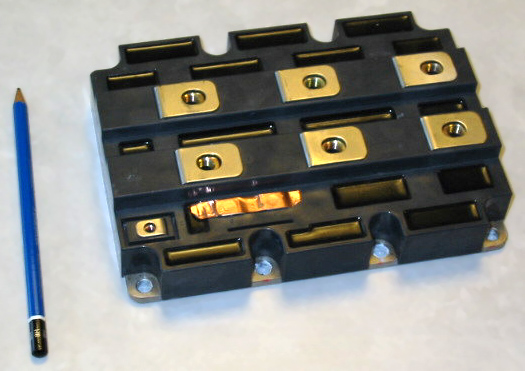
Even at low resistance ON state, the voltage drop across the MOSFET can be more than 0.7V for very high currents - more than you would get from a Bipolar transistor. In that case, the mosfet/BJT can be assembled into a darlington-like device, available in TO-220 to big modules - Insulated Gate Bipolar Transistor (IGBT). Some come with some nice lugs for bolting your crimped-on eyelet.


Plamen

Joined Mar 29, 2015
111
Hello!
I am trying to run a somewhat beefy motor using a power adapter that outputs 12 volts, 8 amps DC. I'd like to be able to vary the speed of the motor using a potentiometer, preferably around 10k ohm or 100k ohm. I need a circuit design to power my motor with the potentiometer.

I also want the circuit to use no microcontrollers, digital potentiometers, or PWM of any sort. I'd like it to contain more basic circuit components, like transistors, resistors, and possibly capacitors. And the only power source should be the aforementioned power adapter, and no separate power sources like batteries to provide signals to the transistor(s).

If someone could specify a circuit design, I would appreciate it greatly!


Hello!
I am trying to run a somewhat beefy motor using a power adapter that outputs 12 volts, 8 amps DC. I'd like to be able to vary the speed of the motor using a potentiometer, preferably around 10k ohm or 100k ohm. I need a circuit design to power my motor with the potentiometer.

I also want the circuit to use no microcontrollers, digital potentiometers, or PWM of any sort. I'd like it to contain more basic circuit components, like transistors, resistors, and possibly capacitors. And the only power source should be the aforementioned power adapter, and no separate power sources like batteries to provide signals to the transistor(s).

If someone could specify a circuit design, I would appreciate it greatly!
Plamen:
Your best option is a switching mode regulator (step down or aka Buck) for close to $5
http://www.ebay.ca/sch/i.html?_from...0.A0.H0.X10A+buck.TRS0&_nkw=10A+buck&_sacat=0

There are also dedicated DC motor speed controllers
http://www.ebay.ca/sch/i.html?_odkw....TRS0&_nkw=dc+motor+speed+controller&_sacat=0
 

Tonyr1084

Joined Sep 24, 2015
9,744
First, I 100% agree with PWM and a MOSFET. The nice thing about PWM and MOSFET is that the FET acts as an on / off switch in such a configuration. The PWM can vary it's duty cycle from 0% all the way up to 100%. Here's how that works: If the PWM is set to a duty cycle of 10% (on 10% of the time, off 90%) then the motor is seeing full power for only 10% of the time, meaning a 12 volt source would look like a 1.2 volt source. Increase the duty cycle to 50% and the power source appears like a 6 volt supply.

The benefit of such an arrangement is that the FET is either ON or OFF, where it wastes virtually no energy, thus, doesn't get hot. But if you try to use the FET in its resistive range then it has a LOT of heat to shed, meaning it becomes much less efficient. So the notion of using a pot to control a MOSFET is doable, it's certainly not the best way.

In keeping with your original question, there IS a solution, a Rheostat such as this one:
https://www.amazon.com/Ceramic-Wire...=UTF8&qid=1481387705&sr=1-8&keywords=rheostat
However, all that thing does is waste energy in the form of heat.

Back in the 1970's my fathers Ranchero headlight switch went faulty. I had to replace it - the pull knob type. It also had the feature of rotating it to control the brightness of the dash lights. It was a Rheostat. For a while I used that to control small motors (DC motors out of things like portable cassette players). Burned my fingers once or twice too. More recently, my wife's car got totaled. I scrapped a bunch of stuff out of it. Relays and light dimmers. The light dimmer was actually a PWM module. I doubt it would be big enough to control your motor, but I DID find such a thing.

Last thought: I've stripped several treadmills. Their drive motor is 130 VDC, and their control board is controlled by either PWM or by a potentiometer. Older ones had a slide potentiometer or a knob. The PWM type had selectable buttons that a microprocessor would determine the correct duty cycle for the control to speed up or slow down the motor. It would be nice to understand what it is you wish to do with your motor and how controlling its speed benefits your project. I replaced a defective 3/4 HP AC motor on my band saw with the 2 1/2 HP DC motor from a treadmill. And the DC motor is much smaller. I now have a variable speed band saw. Something I don't think any of the big name power tool manufacturers have ever considered. I find it useful for cutting plastic at lower speeds without all the melting. Now - watch! You're going to start seeing variable speed bandsaws on the market now that I've said that.

Well, I hope this is helpful. You can use the Rheostat or build a cheap and simple PWM circuit, which is what I'd do. OR if you need the high power, perhaps you'll find a free treadmill on CraigsList.

({[ I wonder if I can adapt the speed control module to act as a variable DC supply from zero volts to 120 VDC ]})
 
Last edited:

wayneh

Joined Sep 9, 2010
18,119
Excellent point about treadmill motors. A quick search of this forum will reveal how popular these are for projects. I watch craigslist everyday and I can assure you that free treadmills are available every day of the year. They're big and heavy but most of them contain a pretty nice motor with a digital controller.

Projection TVs are another big, heavy item I see every other day or so. Hot tubs about once a week. With some patience and skill, you could really find some cool junk to play with. Don't forget all the free TVs, computer and printers down at the electronics recycling dump. Or in my basement. o_O
 

Tonyr1084

Joined Sep 24, 2015
9,744
The main reason why I've scavenger'd so many treadmills is that they often contain lots of straight square stock tubes. Great for cutting up and welding into new projects. Just recently (this summer) I took an exhaust fan and a couple atomizer water nozzles and mounted it on a frame with wheels so I could roll it out to the back yard, hook up the hose and power the fan and get an out-door water vapor cooler.

Anyway, to the original poster, can you please enlighten us as to what you're goal is? What do you want the motor to do?
 
Top