Yes, it can be made to work like that. Though a low beta transistor like 3055 isn't the best for this kind of setup.do you think it would work for a setup like this?
I see what you're saying, but I'm still not sure I know how a system involving PWM such as a 555 circuit will operate without the use of large transistors such as the 2N3055 mentioned earlier.I completely agree. Intentionally avoiding the best tool for a job puzzles me. I understand cost as a reason to do that, but in this case every other option will cost more than the proper tool.
Cool! I like where this is going. (I've heard of MOSFETs before, but I wasn't aware of their significance.) I will definitely look into it.Ah, yes. This is where you learn about the MOSFET. It's a special kind of transistor that makes a very good switch, which makes a perfect complement to PWM. When turned on, it has a very low resistance and often needs no heat sink. It also requires only a voltage on its gate to hold it on, as opposed to a traditional BJT which requires current to stay on. Needing only a voltage allows a MOSFET to be controlled by a low power logic signal - a PWM pulse string for instance. (A high frequency signal requires more current to charge and discharge the gate capacitance, but this is not an issue at low speed switching.)
You can easily switch your motor's full current with a single MOSFET. You'll probably want a heat sink for good measure, but it won't need to be huge. You'll control the MOSFET with the 555 directly.
That's too narrow of a view. A mosfet can be used like a bipolar transistor in a lot of circuits. In fact, I pretend I'm designing with bipolar transistors because it's easier for me to think like that, and then install mosfets in the final version IF their best advantage is useful in that circuit. Sometimes it is, sometimes it isn't.If I understand correctly, A MOSFET should only be controlled by PWM, not a potentiometer,
Perhaps they're more like a relay, then?That's too narrow of a view. A mosfet can be used like a bipolar transistor in a lot of circuits. In fact, I pretend I'm designing with bipolar transistors because it's easier for me to think like that, and then install mosfets in the final version IF their best advantage is useful in that circuit. Sometimes it is, sometimes it isn't.
Yes, you can think of them as a elay but even relays need some current for the coil, these are like a 10nF capacitor that needs to be charged up and suddenly on with milliOhm resistance from drain to source.Perhaps they're more like a relay, then?
Yes, that really made sense to me, because of the emphasis on the word "switch" in wayneh's description earlier.Yes, you can think of them as a elay but even relays need some current for the coil, these are like a 10nF capacitor that needs to be charged up and suddenly on with milliOhm resistance from drain to source.
Here is the easiest solution. Under $10 with shipping.
http://www.ebay.com/itm/6V-90V-15A-...923891?hash=item280aaedd33:g:czoAAOSwo6lWJufG
It looks pretty nice because it also has fuse protection and decent heat sinks (your motor may not generate too much heat at only 8A and you won't hit that unless you're stalling the motor with a major load.
a mosfet would actually work well with a potentialmeter, better than a bjt.A MOSFET should only be controlled by PWM, not a potentiometer
In this kind of circuit where the "go" signal and the load share the same ground, a mosfet makes a good, low resistance connection and can switch 100 times before a relay knows it's supposed to wake up. This stays true until you get to fairly big amps (like 50 to 75 amps) where the tiny legs on the mosfet and the copper traces on a circuit board start to be a limiting factor. I mean, come on, how do you attach 4 gauge wire to a mosfet so it complies with the National Electrical Code for a circuit over 60 amps? Theoretically, a couple of mosfets could run my air conditioner which uses a 76 amp start surge, but here in the lightening capital of America, I prefer a big, stupid relay for reliability.Perhaps they're more like a relay, then?
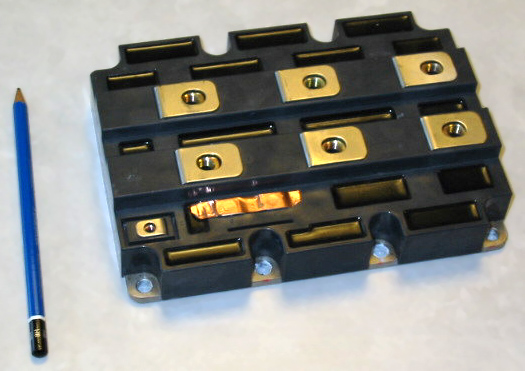
Even at low resistance ON state, the voltage drop across the MOSFET can be more than 0.7V for very high currents - more than you would get from a Bipolar transistor. In that case, the mosfet/BJT can be assembled into a darlington-like device, available in TO-220 to big modules - Insulated Gate Bipolar Transistor (IGBT). Some come with some nice lugs for bolting your crimped-on eyelet.In this kind of circuit where the "go" signal and the load share the same ground, a mosfet makes a good, low resistance connection and can switch 100 times before a relay knows it's supposed to wake up. This stays true until you get to fairly big amps (like 50 to 75 amps) where the tiny legs on the mosfet and the copper traces on a circuit board start to be a limiting factor. I mean, come on, how do you attach 4 gauge wire to a mosfet so it complies with the National Electrical Code for a circuit over 60 amps? Theoretically, a couple of mosfets could run my air conditioner which uses a 76 amp start surge, but here in the lightening capital of America, I prefer a big, stupid relay for reliability.

That certainly beats trying to solder those tiny legs to a 4 gauge wire!Some come with some nice lugs for bolting your crimped-on eyelet.
Hello!
I am trying to run a somewhat beefy motor using a power adapter that outputs 12 volts, 8 amps DC. I'd like to be able to vary the speed of the motor using a potentiometer, preferably around 10k ohm or 100k ohm. I need a circuit design to power my motor with the potentiometer.
I also want the circuit to use no microcontrollers, digital potentiometers, or PWM of any sort. I'd like it to contain more basic circuit components, like transistors, resistors, and possibly capacitors. And the only power source should be the aforementioned power adapter, and no separate power sources like batteries to provide signals to the transistor(s).
If someone could specify a circuit design, I would appreciate it greatly!
Plamen:Hello!
I am trying to run a somewhat beefy motor using a power adapter that outputs 12 volts, 8 amps DC. I'd like to be able to vary the speed of the motor using a potentiometer, preferably around 10k ohm or 100k ohm. I need a circuit design to power my motor with the potentiometer.
I also want the circuit to use no microcontrollers, digital potentiometers, or PWM of any sort. I'd like it to contain more basic circuit components, like transistors, resistors, and possibly capacitors. And the only power source should be the aforementioned power adapter, and no separate power sources like batteries to provide signals to the transistor(s).
If someone could specify a circuit design, I would appreciate it greatly!