High Amperage with a Potentiometer - Circuit Design Needed

MaxHeadRoom

Joined Jul 18, 2013
30,694
Hello!
I am trying to run a somewhat beefy motor using a power adapter that outputs 12 volts, 8 amps DC. I'd like to be able to vary the speed of the motor using a potentiometer, preferably around 10k ohm or 100k ohm. I need a circuit design to power my motor with the potentiometer.

I also want the circuit to use no microcontrollers, digital potentiometers, or PWM of any sort. I'd like it to contain more basic circuit components, like transistors, resistors, and possibly capacitors. And the only power source should be the aforementioned power adapter, and no separate power sources like batteries to provide signals to the transistor(s).

If someone could specify a circuit design, I would appreciate it greatly!
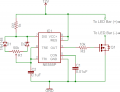
What is wrong with the 555 based PWM controllers for around $5-$10 on ebay, or build one such as http://www.discovercircuits.com/DJ-Circuits/simplepwm2.htm ??
Max.
 
Hello MG,
Bottom line is power. 12 volts 8 amps => 72 watts. So if the motor is not using it, you control circuit must be dissipating it. By the time you heat sink it and without OP-amp for feed back control, this my not be nice. Its a nice idea but not really practical with today's tech. Old ways you would use just a big rheostat.
 
Hell again,
Using LT_Spice on the circuit offered by #12 and a few small changes, it should work. All transistors available from digikey, about 12$ Contact me if you want more information.
 

jkwilborn

Joined Jan 26, 2016
32
I use some of the Chinese led strip lights that I control brightness with a simple 555 PWM circuit and a mosfet. This is much like what's been shown, but I think this is an 'easier' layout to read.

Started doing this when I found 3' led strips at the local store for about 20 bucks and the power supplies and such were way more than I wanted to spend. I can get a 5 meter roll of led's for about $8 bucks and then a 48 watt 12 v supply for about the same. Nice light for 16 bucks, but not variable in brightness. Most of the strips are 24 watts, they vary. I run, usually two of them and switch them with a circuit like I've appended. I have a few of these built up and always seem to find use for them. Hope this isn't too far off topic.
pwm-555-schematic.png
 

jkwilborn

Joined Jan 26, 2016
32
I don't use one. My old pcb's I built never had that either. Can't think of why it's there, bipolar background? The idea was a better view of the circuit. Somewhere I saw one that was animated and showed current flow direction change... Good learning circuit with it's faults and it's an actual schematic :O
 

jkwilborn

Joined Jan 26, 2016
32
I guess I don't know how to go about that in computation. Would you mind enlightening me? Too large? Is this related to gate capacitance? Or a link to where it's explained would be good {:eek:

Thanks...
 
I guess I don't know how to go about that in computation. Would you mind enlightening me? Too large? Is this related to gate capacitance? Or a link to where it's explained would be good {:eek:

Thanks...
Well, back to basics. A MOSFET gate is somewhat like a capacitor. Any time the voltage changes a current will flow and dependent upon the impedance of all the stuff connected, ringing may occur. Thus from practice, a 100 ohm series will almost always do the trick. On the non gate side of the resistor, assuming source is ground or close to it, consider a 1 meg to ground to always provide a dc level to the gate.

To large of a gate resistor can limit the charging current and the mosfet finds its self in the linear region. this is not good for a switching mosfet and can cause massive replacements
 

dannyf

Joined Sep 13, 2015
2,197
a mosfet's gate is essentially a capacitor. when it is switched on, the gate is essentially a short. so the first rule is to make sure that the driver stage isn't exceeding its current capability.

after that, things become a little bit more complex as you will need to estimate switching losses in the mosfet based on how long it takes the driver stage + mosfet to transit to/from its linear region. the driver here is the gate charge / gate capacitance, switching frequencies and load current / voltage to be switched.

In the case of a h-bridge, further complication comes in to use that gate resistance to program dead time.

for linear applications (not here), the gate stopper is more of a stability issue.
 

jkwilborn

Joined Jan 26, 2016
32
Thanks to both of you... I can look at it in more detail now that I know the 'technical term' for it is, although it wasn't earth shattering. I also assumed (?) that you really didn't use these devices in their linear region. I mean as a switch is the use here and you'd want to keep in that state for the shortest period. Thanks again.

Jack
 

tedstruk

Joined Oct 8, 2016
12
High power is so unpredictable. The more you have the more change there is of a grounding. the fact is that currents over 24v have a tendency to arc to any ground within 3". so you see with 20v, you are really pushing the envelope.
 

BR-549

Joined Sep 22, 2013
4,928
There are many variables and conditions for a spark.

I have seen long orange sparks many times when connecting a car battery. And short white ones too.

Am I the only one to witness this? I noticed sparks from car batteries at a very young age.

Have you ever seen a spark while jumping someone?
 

wayneh

Joined Sep 9, 2010
18,124
I have seen long orange sparks many times when connecting a car battery. And short white ones too.
That's not the spark arc per se, but the path of ejected particles similar to the "sparks" flying off a grinding wheel. It's actually hot shrapnel.

The comment above about arcing at 24V is counter to real-life experience. My outlets supply 120V AC and the conductors are what, 1/2" apart at most? Zero arcing.
 
Top