High Amperage with a Potentiometer - Circuit Design Needed

Tonyr1084

Joined Sep 24, 2015
9,744
There are many variables and conditions for a spark.
Sparks ain't Arc's. An arc I once witnessed was from the hub of one turboprop engine to the adjacent on a C130 Cargo Plane. The engines were running and the technician hooked a rope to the ground plug, got a good 30 feet away and then yanked the rope, pulling the ground plug away from the plane. That arc'd too. This was in a desert area on a warm and VERY dry day. Plenty of dust too. Electrostatic arc. Not a spark. You can get a spark from a AA battery, albeit a small one.

I agree - B S on Tedstruk.

I guess it's relative - what you call high voltage. To an ant I suppose 24 volts CAN be deadly. But to a planet the size of earth - well, I don't know how many volts stream to earth during the Aurora Borealis. But that's GOT to be "High Voltage".
 

BR-549

Joined Sep 22, 2013
4,928
I wasn't stating a law. I was trying to show that it would be hard to state a firm law. There are so many variables.
This is why we get un intended sparks. The properties of the media, or the impedance of both sides could change.
 

jkwilborn

Joined Jan 26, 2016
32
Yes, you are the only one who's ever seen that. :) More than likely what you saw was the effect of the current when you pulled the jumper OFF the connection, not when putting on the connection. Comment from wayneh... Ditto on the 120v AC plugs not arching.
 

Tonyr1084

Joined Sep 24, 2015
9,744
Interesting thing: I once saw a high speed video of sparks. They're actually not sparks they are sphere's of intensely glowing something. I say "Something" because I don't remember for sure what the moderator said it was. What appears to us in real time to be long trails of lighted energy are actually small sphere's.

Take a super bright LED and wavie it in front of your face. You'll see a long dash, but the actual source of the light is the chip emitting light.
 

MaxHeadRoom

Joined Jul 18, 2013
30,695
Just to clarify, current is measured in amps, not volts. And also, at least about 200,000 Volts are needed to produce a 3 inch electric arc in air:
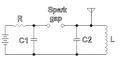
An example of a intentional continuous arc is for example a Plasma torch capable of cutting ~1/2" steel plate, the plasma is often initiated by a simple circuit principle used years many years ago, a spark gap transmitter.
Consisting of a supply a coil, spark gap and capacitor, called a pilot arc.
The object is to ionize the air to allow the 200vdc supply to then conduct to the steel plate via the air gap. The pilot arc is then switched off.
I have occasionally seen a relay carrying a high energy DC current produce a plasma when opening and the arc continue to conduct the current to the load whilst dissolving the contacts!
The bottom line is, once a plasma is started, and the air conducts, extra high voltage is not required
upload_2016-12-28_13-1-28.png

Max.
 
Top