High Amp Potentiometer for heating element in a still

Thread Starter

Brother Ruprecht

Joined Apr 26, 2019
6
Hi All,

I run a still - and produce my own alcohol at extremely high ABV for use in making extremely pure spirit for vodka and as a base for gin - don't worry I have a producers licence to do this and am fully legal.

At the moment we are using Home assistant to control certain aspects of the process - this includes coolant flow to the reflux and condenser chambers as well as controlling the power that is supplied to the boiler. This is needed during one particular process called "the spirit run" which requires us to stack the column in a controlled way.

At the moment the boiler has 2 2500W heating elements (which are basically resistors I guess) that we have plugged into 15amp SMART switches. This allows us to run Home Assistant scripts which respond to bluetooth probes we have in the column to control how much power is put into the boiler and thus allows us to control the rate at which the vapour in the column heats up.

The problem is that we can only turn the switch ON or OFF to the boilers - so we've got it on a 20 second cycle - if we want 50% power rate we have to turn the switch on for 10 seconds then off for 10 seconds - 25% power is on for 5 seconds off for 15 seconds etc. This, on average gives us the correct power - but we'd prefer it to be "smoother" - i.e. for 50% power, use a potentiometer to cut the voltage from 240 to 120 - thus reducing the power output from the heater element to 1750W constantly. This is for two reasons - one to make it smoother but also we're wearing out SMART switches with the constant on off we are doing.

So what I'm looking for is a potentiometer that is SMART - we need to be able to control it with wifi so our scripts in Home assistant will be able to control it dynamically. It needs to be able to cope with 15amps (3500W heating element). Has anyone got any ideas? I've scoured the internet and can't find anything that fits our needs.

Thanks in advance
Andy
 

crutschow

Joined Mar 14, 2008
38,322
A potentiometer is not a practical solution since it would need to dissipate and waste a lot of power.

One better solution it to use a duty-cycle controller which would turn the heating element on and off at a relatively faster rate, say a cycle rate of no slower than a few seconds.
Thus it could be on for 0.5s and off for 1.5s for 25% power.

Here's a discussion on several types of controllers.

Search for WiFi proportional heater/temperature controllers.
They can control a solid-state relay to switch the heater and eliminate the wear-out issues of mechanical relays.
 

ronsimpson

Joined Oct 7, 2019
4,647
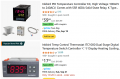
I use temperature controllers like this. Most of these will only handle 15A. They can drive a large relay that can do 100s of amps.
1726628373092.png
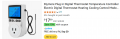
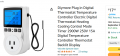
I have not used this type but it looks good.
1726628537373.png
 

Attachments

Ya’akov

Joined Jan 27, 2019
10,226
Welcome to AAC.

First, you need to stop and rethink your design. Home Assistant might "work" as a still controller but it was never designed for the purpose and so lacks essential things and 90+% of what it is designed to do is irrelevant. You are building up an enormous amount of technical debt as you work around the gaps.

Technical Debt is the idea that you have patched things in such a way, for expediency, that organic changes to the system—ones that are entirely predictable because of the requirements of your very specific application—will increasingly run into the limitations imposed by your workarounds.

This is not sustainable. You will develop a sort of secret knowledge of how to operate and troubleshoot this setup because of the baggage that will be nearly impossible to pass on without someone shadowing a knowledgable operator for an entire production lifecycle, and even then it will depend on how good that shadower is at picking up on the idiosyncrasies.

Repairability will also suffer because of the patchwork arrangement with dependency on specific components and operating system/HA features that may vanish or change in future versions breaking your system and requiring you to stay at some older version. All in all, this is just not good.

But you can move away from this approach by starting to use modular subsystems that could still be managed by the HA glue but that are not dependent on it. The current approach may seem "cheap" both in dollars and time but in the end that is false economy.

So, you have the chance to start now. You need a temperature controller for the boilers that can independently manage them. You want to control them digitally, so you need something that can be managed over some communication channel (e.g.: RS-232, RS-485, Ethernet, &c.). Critically, the controller must include independent safety features that will prevent a mistake in the controlling signals from resulting in a meltdown, explosion, or other catastrophic event.

The right way to control temperature is with a PID (Proportional Integral Derivative) controller. This is a relatively complicated device but the idea is not too difficult. The PID controller uses three methods to control the temperature and ensure it will not overshoot the target and will maintain it close to the set point:

Proportional—the controller responds in proportion to the gap between the setpoint and the actual temperature.​

Integral—the controller "watches" the difference between what the proportional term can produce and over time makes corrections to the power inputs to eliminate steady state errors that the faster proportional term can't eliminate.​

Derivative—the controller responds to the rate of change in the difference between the current and set point temperatures. It uses the past behavior of the system to avoid overshoot by "dampening" the system as it detects overly aggressive attempts at closing the current/setpoint gap which will lead to overshooting the setpoint.​
The PID controller is a pretty amazing piece of gear that you have the luxury of buying already built for you. It will manage the temperature in the boiler without you needing to concern yourself with the details. You can just tell it the set point and let it go on about its business.

The right way to control the power to the heating coils is PWM (Pulse Width Modulation). It is basically the same method you are already using but at a much different timescale. PWM uses frequencies ranging from hundreds to thousands of Hertz (cycles per second).

In PWM, a square wave is used with a fixed "time slot" of providing power. During that time, the power is either on or off, the duty cycle or percentage which is on time, determines the average power delivered. So, if the entire power capacity is 2500W and the duty cycle is 50%, then the power delivered is 1250W; 10% would yield 250W; and 90% 2250W—&c.

Combined with the PID controller, PWM will provide smooth and efficient temperature control.

The temperature sensors used for the controller will not be wireless. Sensors that are needed for safety reasons must not be based on consumer BT technology, this is just not OK. The thermocouples used on the controller will be wired to it with the controller resident in proximity to the actual boiler.

As far as overall process control, while HA is a great thing and can do all sorts of stuff, it is designed and developed for home automation not industrial process control. Yes, they are overlapping requirements but as I mentioned above, the overwhelming majority of HA's code has nothing to do with what you are applying it to; and the things that are applicable aren't designed for purpose—that are designed to turn lights and TVs on and off.

Can it be adapted? Surely. Should it be? Surely not. For an easier transition I would suggest considering Node-RED, which can be used with HA. Node-RED is very generic and provides a good combination of graphical and code-based configuration. You can create GUIs, including dashboards with gauges, and controls; and it cab be integrated with your current HA setup until you replace it by transitioning to Node-RED exclusively.

You might also want to investigate non-traditional PLCs (Programmable Logic Controllers) which are powered by Raspberry PI, Arduino, ESPxx, and other alternatives. PLCs are designed for industrial control and so have additional safety and reliability features.

Whatever you choose to do, best of luck. Be careful on the safety front—the patched and brittle system is an annoyance but an exploding boiler or burning building is something else.
 

Ya’akov

Joined Jan 27, 2019
10,226
The answers are right but It only matters what you're looking for is essentially a smart variable power controller that can handle high loads, which isn't commonly available off the shelf. However, a solution could be to use a solid-state relay (SSR) with phase angle control, which allows for smooth power adjustments.

Thanks
Phase angle control is a good strategy. It could be use with a typical 0-10V control, or a 4-20mA control. To get that control signal, a converter from PWM to either one is a possibility. PWM has the advantage of being readily producible by MCUs and MCU-based devices.

If MCU- or RPi-based PLCs were used, the conversion would probably not be necessary since I would expect them to natively output one or both of those. Either way, phase angle control using readily available SCR or SSR modules is good idea
 

Ya’akov

Joined Jan 27, 2019
10,226
Yes, I agree, you are right.
One interesting idea is to use low frequency PWM (~5Hz) synchronized to zero crossing as the trigger for phase angle control with a zero crossing SSR. It’s a custom solution (as far as I know) but in the end simpler than conversion to voltage or current.

Simpler in design, that is—probably not simpler to do since I‘ve never seen an off-the-shelf zero-crossing-locked PWM generator, and practically speaking you’d probably end up feeding that the unlocked PWM from an MCU and it would become just another converter.

Still, with a zero crossing detector as an input on an interrupt an MCU could do it pretty easily while still handing PID.
 

Janis59

Joined Aug 21, 2017
1,894
However that is a sad fact that even the highly modern Omron self-learning adaptive PID controller may not EVER get better accuracy that some 5 C even if writte 0.1 C. If want better, then only method is to set heater voltage NEAR to the wished temperature and THEN the PID controller may gain 0,5 C or some cases even 0.1 C accuracy. Thus, if resistor indeed is very bad choice, the thyristor or triac based dimmer bay be best chice, however, thinking on high power and your poor neighbours in the street bloke, it MUST be the zero-crossng type of dimmer. Circuits are full internet.
 

MisterBill2

Joined Jan 23, 2018
27,186
Twenty years ago I designed a high temperature test stand that needed several gallons of oil to be kept at 250 degrees. I was able to control that heat and hold the temperature within + and - ONE DEGREE "F. " by using time switched heating. The cycle time was two seconds and so every two seconds the heating would either stay on or switch off. Yes, it used a solid state relay and an electromechanical contactor for safety backup, controlled by a mechanical thermostat switch. And every bit was wired because wireless links are not at all suitable for any life-critical function.
"Y" is totally correct in every bit of his suggestions. Time proportional control with thermocouple temperature sensing is the most reliable for rugged applications. Other wired temperature sensors can also work well in a "gentler" environment.
 

SolarJake

Joined Mar 15, 2025
1
Welcome to AAC.

First, you need to stop and rethink your design. Home Assistant might "work" as a still controller but it was never designed for the purpose and so lacks essential things and 90+% of what it is designed to do is irrelevant. You are building up an enormous amount of technical debt as you work around the gaps.

Technical Debt is the idea that you have patched things in such a way, for expediency, that organic changes to the system—ones that are entirely predictable because of the requirements of your very specific application—will increasingly run into the limitations imposed by your workarounds.

This is not sustainable. You will develop a sort of secret knowledge of how to operate and troubleshoot this setup because of the baggage that will be nearly impossible to pass on without someone shadowing a knowledgable operator for an entire production lifecycle, and even then it will depend on how good that shadower is at picking up on the idiosyncrasies.

Repairability will also suffer because of the patchwork arrangement with dependency on specific components and operating system/HA features that may vanish or change in future versions breaking your system and requiring you to stay at some older version. All in all, this is just not good.

But you can move away from this approach by starting to use modular subsystems that could still be managed by the HA glue but that are not dependent on it. The current approach may seem "cheap" both in dollars and time but in the end that is false economy.

So, you have the chance to start now. You need a temperature controller for the boilers that can independently manage them. You want to control them digitally, so you need something that can be managed over some communication channel (e.g.: RS-232, RS-485, Ethernet, &c.). Critically, the controller must include independent safety features that will prevent a mistake in the controlling signals from resulting in a meltdown, explosion, or other catastrophic event.

The right way to control temperature is with a PID (Proportional Integral Derivative) controller. This is a relatively complicated device but the idea is not too difficult. The PID controller uses three methods to control the temperature and ensure it will not overshoot the target and will maintain it close to the set point:

Proportional—the controller responds in proportion to the gap between the setpoint and the actual temperature.​

Integral—the controller "watches" the difference between what the proportional term can produce and over time makes corrections to the power inputs to eliminate steady state errors that the faster proportional term can't eliminate.​

Derivative—the controller responds to the rate of change in the difference between the current and set point temperatures. It uses the past behavior of the system to avoid overshoot by "dampening" the system as it detects overly aggressive attempts at closing the current/setpoint gap which will lead to overshooting the setpoint.​
The PID controller is a pretty amazing piece of gear that you have the luxury of buying already built for you. It will manage the temperature in the boiler without you needing to concern yourself with the details. You can just tell it the set point and let it go on about its business.

The right way to control the power to the heating coils is PWM (Pulse Width Modulation). It is basically the same method you are already using but at a much different timescale. PWM uses frequencies ranging from hundreds to thousands of Hertz (cycles per second).

In PWM, a square wave is used with a fixed "time slot" of providing power. During that time, the power is either on or off, the duty cycle or percentage which is on time, determines the average power delivered. So, if the entire power capacity is 2500W and the duty cycle is 50%, then the power delivered is 1250W; 10% would yield 250W; and 90% 2250W—&c.

Combined with the PID controller, PWM will provide smooth and efficient temperature control.

The temperature sensors used for the controller will not be wireless. Sensors that are needed for safety reasons must not be based on consumer BT technology, this is just not OK. The thermocouples used on the controller will be wired to it with the controller resident in proximity to the actual boiler.

As far as overall process control, while HA is a great thing and can do all sorts of stuff, it is designed and developed for home automation not industrial process control. Yes, they are overlapping requirements but as I mentioned above, the overwhelming majority of HA's code has nothing to do with what you are applying it to; and the things that are applicable aren't designed for purpose—that are designed to turn lights and TVs on and off.

Can it be adapted? Surely. Should it be? Surely not. For an easier transition I would suggest considering Node-RED, which can be used with HA. Node-RED is very generic and provides a good combination of graphical and code-based configuration. You can create GUIs, including dashboards with gauges, and controls; and it cab be integrated with your current HA setup until you replace it by transitioning to Node-RED exclusively.

You might also want to investigate non-traditional PLCs (Programmable Logic Controllers) which are powered by Raspberry PI, Arduino, ESPxx, and other alternatives. PLCs are designed for industrial control and so have additional safety and reliability features.

Whatever you choose to do, best of luck. Be careful on the safety front—the patched and brittle system is an annoyance but an exploding boiler or burning building is something else.
Ya'akov-
I just signed up for an account for the sole purpose of showing you some appreciation. I have the utmost respect for people that will say, "That's nice. But here is how it's done."
When it comes to things like boilers, it's just cool to say what you did. And I think that's simply awesome.
Looking forward to seeing you around the forums!
 

JohnSan

Joined Sep 15, 2018
121
As others have said, avoid phase angle power control as it creates a lot of electrical noise.
It's likely to be a problem for your neighbours and may also cause problems for yourself.

I use HA to control the temperature of wine fermenting and then holding a wine rack storage temperature.
I don't know how your HA scripting works, but I use HA+ESPHome with an ESP32 running a PID controller.

The output of the PID is usually 'Slow PWM', set on a 10 or 20s cycle for example, as you have presently.
But there is another option called 'Sigma-Delta' output, which is somewhat better.

https://esphome.io/components/output/sigma_delta_output

My case is a hobbyist, but I have help from both Mr Heath and Mr Robinson.
If yours is too, depending on your skills and you wish to retain HA, maybe go the HA + ESP32 route.
The ESP32 will sit on your present Wifi network and be controlled from HA.
You would need to construct a power interface for an output to drive two triacs.
Depending on your skill levels, take a look at this device ' MOC3603 ' which is actually mentioned on here in another thread.

https://forum.allaboutcircuits.com/...r-motor-driver-triacs-getting-damaged.205714/

The triac would be changed, but there are thousands of different types available to suit your power requirements.
It provides a simple interface.

However, if yours is a commercial venture, I would suggest moving to a commercially available controller.
 

MisterBill2

Joined Jan 23, 2018
27,186
Certainly the suggestion of adjusting the heater voltage, as J59 suggested, will greatly reduce the cycle deviations, and certainly having a constant feedback of temperature and a rapid response will also reduce the deviations. I doubt that the data rate of those wireless links is fast enough. There are serious limitations in the home temperature control hardware, which is probably set to control a room temperature.
 

Ian0

Joined Aug 7, 2020
13,097
One interesting idea is to use low frequency PWM (~5Hz) synchronized to zero crossing as the trigger for phase angle control with a zero crossing SSR. It’s a custom solution (as far as I know) but in the end simpler than conversion to voltage or current.

Simpler in design, that is—probably not simpler to do since I‘ve never seen an off-the-shelf zero-crossing-locked PWM generator, and practically speaking you’d probably end up feeding that the unlocked PWM from an MCU and it would become just another converter.

Still, with a zero crossing detector as an input on an interrupt an MCU could do it pretty easily while still handing PID.
You don't actually need to synchronise the PWM to the mains if you use zero-crossing SSRs. The dither that you get from not having a complete number of mains cycles per frame will add (slightly) to the resolution.
 

schmitt trigger

Joined Jul 12, 2010
2,027
Ian; the dithering idea is actually very good.
As long as there are whole cycles and not half cycles, to prevent a DC component of the output waveform.
 

Ian0

Joined Aug 7, 2020
13,097
Ian; the dithering idea is actually very good.
As long as there are whole cycles and not half cycles, to prevent a DC component of the output waveform.
For a resistive heater which is not supplied by a transformer, a DC component will not cause a problem, especially as it will be transitory.
 
Maybe I'm over-simplifying, but it seems to me that the TS is getting away with PWM with a frequency of just 0.05 Hz and this control system does the job except that it leads to failure of the on/off relay.

A suitable high voltage high current TRIAC should work. I'd argue, this is more of a state machine control system than PID. And if an on/off period of 20 seconds is actually working, switching on and off just an order of magnitude faster should bring a significant improvement.
 
Top