Facebook
 Google
 GitHub
 Linkedin

I am trying to diagnose a circuit failure at my workplace designed by one of my coworkers for driving a particular Tubular Motor that will be part of an automation system in a bioclimatic pergola installation. The motor specs are as follows:

and the circuit schematic for the Tubular Motor driving circuitry is this:
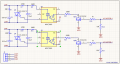
AC-MOTOR-1 and AC-MOTOR-2 nets are going to an MCU onboard and are controlled by 3.3V IO pins. J9 is a screw terminal for connecting the motor. The neutral wire is always connected to the motor, and two live wires determine the spinning direction. TRIACs are there for connecting one of them to the live wire to turn the motor in either direction.
The driver can start, change direction, and stop the motor over 1000 cycles without abrupt behavior or excess heating, but there are adjustable mechanical limit switches inside the motor for limiting the travel distance. Sometimes, when the motor hits one of those switches and stops like that, one or two of the TRIACs become damaged and continuously conductive, which renders them useless.
From what I can observe, the circuit should have MOVs in parallel with each TRIAC according to ST's design documents, but my coworker apparently skipped that detail. I also noticed that the optotriac circuit is looking a little off, but I am not sure if that is causing this issue. The circuit works normally after changing the TRIACs with new ones, and nothing else seems to be affected by this issue.
I tried adding a MOV with clamping voltage around 600-700V, and this is probably big for T405 TRIAC, but that was the only one I had at the moment. This helped, but only to some extent. TRIAC survives a couple of times after hitting switches, but it still gets shorted eventually and doesn't seem reliable at all yet. I also tried adding a bigger TRIAC BTA16, but again, this seems to be helping a little, but only to some extent, and the fault rate is still quite high and not ready for a demo.
I am asking for any suggestions for what might be the reason for this problem and things I can try for further diagnosis or if there is anything off with the schematics or with the particular motor in question.
and the circuit schematic for the Tubular Motor driving circuitry is this:
AC-MOTOR-1 and AC-MOTOR-2 nets are going to an MCU onboard and are controlled by 3.3V IO pins. J9 is a screw terminal for connecting the motor. The neutral wire is always connected to the motor, and two live wires determine the spinning direction. TRIACs are there for connecting one of them to the live wire to turn the motor in either direction.
The driver can start, change direction, and stop the motor over 1000 cycles without abrupt behavior or excess heating, but there are adjustable mechanical limit switches inside the motor for limiting the travel distance. Sometimes, when the motor hits one of those switches and stops like that, one or two of the TRIACs become damaged and continuously conductive, which renders them useless.
From what I can observe, the circuit should have MOVs in parallel with each TRIAC according to ST's design documents, but my coworker apparently skipped that detail. I also noticed that the optotriac circuit is looking a little off, but I am not sure if that is causing this issue. The circuit works normally after changing the TRIACs with new ones, and nothing else seems to be affected by this issue.
I tried adding a MOV with clamping voltage around 600-700V, and this is probably big for T405 TRIAC, but that was the only one I had at the moment. This helped, but only to some extent. TRIAC survives a couple of times after hitting switches, but it still gets shorted eventually and doesn't seem reliable at all yet. I also tried adding a bigger TRIAC BTA16, but again, this seems to be helping a little, but only to some extent, and the fault rate is still quite high and not ready for a demo.
I am asking for any suggestions for what might be the reason for this problem and things I can try for further diagnosis or if there is anything off with the schematics or with the particular motor in question.