How can I increase the minimum self-maintaining voltage of a coil relay to 230VAC?

Thread Starter

pub1980

Joined Aug 26, 2009
3
As the title of the topic says, I have the following relay:
https://www.tme.com/us/en-us/detail...-electromagnetic-relays/omron/mks3pi-5-ac230/
which has a nominal coil usage voltage of 230VAC.
The voltage range at which it operates is between 100 VAC and 230 VAC, the interval in which the coil is self-maintaining (closed contacts).
My question is how could I increase the minimum voltage from 100V to 200V, so that when I apply a voltage to the relay coil lower than 200V, its contacts will no longer remain closed, but open? Do you have any idea how I could do this? Please.
 

ronsimpson

Joined Oct 7, 2019
4,660
I think you want the relay to open up below 200V. (might not understand)
The way I read the data sheet the relay must hold to 30% of rated voltage. (25% at 50hz) It must close above 80% of rated voltage.
From experience the release voltage of a relay is not accurate.
I have a variable voltage transformer. I can make any ac voltage from 0 to 250V. I connect the relay to the output of the transformer and find the close voltage and the release voltage. They are probably not where you think they are. Maybe 180 & 70V but could be much different.
I know if a way of moving the 70V to 200V but that will also move the close voltage to 540V.
If I understand right, you need the relay to close above 180 but open back up below 200V. There is just not enough room in between the two voltages.

There are other ways.
 

MisterBill2

Joined Jan 23, 2018
27,315
Really, it is very simple to either have the relay (option #1) drop out when the coil voltage drops below 200 volts, OR (option #2), to not operate with a coil voltage below 200 volts. But it is quite a bit more complex to achieve both functions. THAT will require a voltage sensing circuit, which is a lot more complex that just a single series resistor of a calculated value.
That website demands that I accept cookies, which I refuse, and so it makes it quite challenging to read.
Adding a simple series resistor will allow either option #1 operation mode or #2 operation mode.
 

Thread Starter

pub1980

Joined Aug 26, 2009
3
Thank you all for the answers.

So, it matters less in my case if it is 180V or 200V. Therefore, if the voltage on the coil exceeds 200V, the relay energizes and closes contacts. If the voltage on the coil drops below 200V, the relay opens its contacts. This is what I would like that relay to do, if possible.

Changing the relay coil as suggested by a user above is out of the question. I mean, I better look for another relay!!!
 

crutschow

Joined Mar 14, 2008
38,401
One way is to get a relay with a low voltage DC coil (e.g. 12-24Vdc) and control the coil with a comparator circuit that detects the AC voltage level.
Is that something you could do?

Otherwise you could get a voltage sensing relay (example).
 

ronsimpson

Joined Oct 7, 2019
4,660
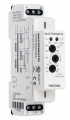
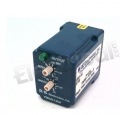
This relay is not right but gives you an idea of what is on the market. Search for Voltage Monitor Relay or Voltage Sensing Relay.
I way some DC relays that have knobs for on voltage and hold voltage.
Voltage Monitor Relay, SPDT, 80-150VAC ...VWKE120A relay

1720204368894.png
VWKB-120A-2
1720204628790.png
 

Ian0

Joined Aug 7, 2020
13,112
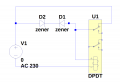
If you have a spare set of contacts on the relay, you could switch a pair of back-to-back zeners in series with the coil, to reduce the voltage across the coil.Screenshot from 2024-07-06 07-49-39.png
 
Last edited:

panic mode

Joined Oct 10, 2011
4,931
suppose he uses 110VAC coil relay and series resistor. then window between operate/release voltage is halved. one can play that game again and go to 24VAC relay to get the window even tighter. but... series resistor would have to handle the excess voltage and the lower the relay coil voltage the more voltage is across resistor. and at the same time relay needs higher current... not a fun option.

110mA and 200V drop is 20W. that is a lot of heat to dissipate...

comparator circuit will need PSU, PCB and all the parts, design time...

not to mention that for industrial application, the circuit would need to pass inspection.
i do not see any of this being cheaper or more convenient than using product designed for exactly this.
 

MisterBill2

Joined Jan 23, 2018
27,315
My suggestion was aimed for a hobby-class, one-off application. the series resistor could satisfy EITHER of the requirements, NOT BOTH, as I stated rather bluntly. For any commercial application the question would not have been posed.

The answers I provided were based on the information provided, which was not much. Understand THAT!! If a TS has already decided what the answer is, by not stating the whole explanation, this is the sort of answer that they get, along with assorted guesses.
Almost without exception, the better the actual requirements are stated, the better the answers will be. By "better" I mean more completely applicable, and usually less complex.
 
Top