Transistors in series increase wattage rating of said transistor?

Thread Starter

AriK48

Joined Nov 7, 2025
32
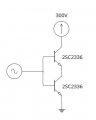
I want to put transistors in series to increase the voltage they can handle. The transistors I want to put in series are 2SC2336 (datasheet below). I was wondering if I put transistors in series on top of the voltage increasing, does the max wattage rating also increase?
 

Attachments

Last edited:

Papabravo

Joined Feb 24, 2006
22,065
I want to put transistors in series to increase the voltage they can handle. The transistors I want to put in series are 2SC2336 (datasheet below). I was wondering if I put transistors in series on top of the voltage increasing, does the max wattage rating also increase?
That is unlikely to work since they are not biased properly.
 

ronsimpson

Joined Oct 7, 2019
4,660
should I use transistors to switch a high voltage MOSFET instead?
Yes.
Transistors are not used much now. There is an art to using them. Using two is complicated.
Post what you are thinking of.
Most ICs now day are built for driving MOSFETs. You can run faster which reduces the size of transformers, inductors and capacitors.
 

Thread Starter

AriK48

Joined Nov 7, 2025
32
Yes.
Transistors are not used much now. There is an art to using them. Using two is complicated.
Post what you are thinking of.
Most ICs now day are built for driving MOSFETs. You can run faster which reduces the size of transformers, inductors and capacitors.
At the moment I don't really have anything to post because not being able to use transistors in series changes things, plus I did testing on a lower voltage circuit and it didnt go well so prob going to make another thread for the next problem as it's not just a "transistor" problem.
 

BobTPH

Joined Jun 5, 2013
11,482
What voltage and power are you talking about? IGBTs are often used for high voltage and high power applications.
 

MrAl

Joined Jun 17, 2014
13,680
I want to put transistors in series to increase the voltage they can handle. The transistors I want to put in series are 2SC2336 (datasheet below). I was wondering if I put transistors in series on top of the voltage increasing, does the max wattage rating also increase?
Hi,

I guess other members made this clear now. You can do it, but not like your schematic.
The key point is that the bases have to have voltages that are relative to their emitters, and each of these will be different as one will be higher than the other, and it could be much higher.

Another point is that the base circuits are somewhat balanced such that they drive the transistors in a very similar way. That's so that no one single transistor has to ever handle a voltage greater than its specified rating (such as Vce).

I actually did this too for a CRT television high voltage output stage. I must have used something like 4 transistors. It was only for testing though if it worked, I had intended to buy the right transistor to replace the one that burnt out. It worked, so I bought the transistor. It was around $20 USD that's why I wanted to test it first.

Now that I look back, that's not the only thing that blew out in that television. Some time before that one of the input rectifier diodes blew out and had to be replaced. It was an RCA TV, I think it was 19 inch.
 

ronsimpson

Joined Oct 7, 2019
4,660
Today I took 100s of pounds of old schematics to the dump, thinking no one will ever ask about this again, and here we are.
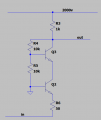
This is a high voltage amplifier using two stacked transistors. (This is not how we did it in switching power applications.)
The transistors are some special 1500V low current transistors we used in CRT monitors years ago. This is a dynamic focus amplifier.
Resistor values are all wrong. Just there to make a point. Not real values.
Here is a common Base amplifier. Gain = R3/R6 Out can be any voltage from near ground to almost 2000V.
Input is from ground to a negative level.
The key is R4 & R5 which makes a voltage that is 1/2 of Vout for the Base of Q3 and thus Q2-C.
1762699949243.png
We had this in production for years. Probably made millions. (no more than millions)
 
Top