hFE function in my cheap-o multimeter

ian field

Joined Oct 27, 2012
6,536
I bought this extremely affordable multimeter for about $7.00 dlls to keep with me at all times while on the road:


And I couldn't help but notice that it has an hFE function in its dial that I hadn't heard of before... I naturally did some googling before posting my question here (I don't like getting rapped by my peers) ... and found out that this thing supposedly reports a transistor's gain value.

Question: Isn't a transistor's gain a function that is particular to each model and not a fixed value? And if it is, what does the number reported by the MM represent, and is it of any practical use?
My experience with those hasn't been encouraging. even silicon power transistors can have enough leakage to give a false high gain reading - Germanium; forget it!.

Peak atlas do a decent 3-terminal semiconductor analyser, there's bound to be competitors.

Apparently; the latest Peak has USB to display curves on a PC.
 

dl324

Joined Mar 30, 2015
18,344
I suffered from the belief that any two transistors intended to be identical and produced on a single piece of silicon were matched.
There's always the possibility of in-die variation and random defects. For transistors in close proximity with topologies that are designed to be less sensitive to in-die variation, matched yield can be very high.
 

Thread Starter

cmartinez

Joined Jan 17, 2007
8,782
The squarewave/PWM setting though...?
My bad, Sinus... that squarewave thingy on the multimeter is a signal generator (whose output frequency depends on the particular MM's model), as Jony130 just said. I did some googling around, and found out that my MM is also known as the DT830D model. Its user manual briefly explains that characteristic.
 

MrChips

Joined Oct 2, 2009
34,841
I tested the hFE function on a B+K 2904B DMM.
Basically, they are setting IB = 10μA and measuring the collector current.

VCE = 3V
VBE = 0.68V
IB = 10μA
IC = typical 2.40mA for a readout of hFE = 240

I tested this with various 2N3904 NPN transistors with hFE ranging from 100 to 250.
I compared the results against that obtained with a transistor curve tracer and got matching results.
 

MrChips

Joined Oct 2, 2009
34,841
Another way of looking at this, they are measuring the conductance of any device connected across the C and E test leads using a 3V source.

If the resistance is 1k-ohm, i.e. conductance = 1milli-mho the reading is 300
If the resistance is 3k-ohm, i.e. conductance = 0.333milli-mho the reading is 100

Hence conductance = reading/300 in milli-mho.
 

panic mode

Joined Oct 10, 2011
5,008
I recall testing this on couple of meters a while ago. The issue is that "measured gain" had nothing to do with base current. It show values even with base not connected or if transistor is shot through or has significant leakage current. In my opinion this is total garbage and misleading, it is absolutely unusable... but that is just my opinion....
 

MrChips

Joined Oct 2, 2009
34,841
I recall testing this on couple of meters a while ago. The issue is that "measured gain" had nothing to do with base current. It show values even with base not connected or if transistor is shot through or has significant leakage current. In my opinion this is total garbage and misleading, it is absolutely unusable... but that is just my opinion....
kinda, like, yes and no.

If the transistor is good, you get an indication of current gain beta.

If the base contact is open, and the collector-emitter looks like a 1kΩ resistor, you get hFE = 300.
If the collector-emitter looks like 3kΩ, you get hFE = 100.
In both cases the transistor is no good.

Edit: Now that I think of it. If the base contact is open, you will get zero collector-emitter current and the reading will be 0.
If the collector-emitter is shorting, the meter will show OL, which stands for outta luck.
 

ian field

Joined Oct 27, 2012
6,536
I recall testing this on couple of meters a while ago. The issue is that "measured gain" had nothing to do with base current. It show values even with base not connected or if transistor is shot through or has significant leakage current. In my opinion this is total garbage and misleading, it is absolutely unusable... but that is just my opinion....
Current is current - on germanium transistors; the leakage current will be more than the collector current induced by the test Ib of most testers.

Many years ago; a Radio constructor magazine project was a transistor tester that could null out leakage before measuring gain.

Some silicon power transistors have enough leakage to confuse the testers incorporated into DMMs.
 

#12

Joined Nov 30, 2010
18,224
Some silicon power transistors have enough leakage to confuse the testers incorporated into DMMs.
I used to design in that range, and I can tell you I never considered an "off the shelf" tester. I went straight to designing and building test fixtures specifically for the job. I was lucky that I was working in a factory where I could order anything I wanted.
 

panic mode

Joined Oct 10, 2011
5,008
kinda, like, yes and no.

If the transistor is good, you get an indication of current gain beta.

If the base contact is open, and the collector-emitter looks like a 1kΩ resistor, you get hFE = 300.
If the collector-emitter looks like 3kΩ, you get hFE = 100.
In both cases the transistor is no good.

Edit: Now that I think of it. If the base contact is open, you will get zero collector-emitter current and the reading will be 0.
If the collector-emitter is shorting, the meter will show OL, which stands for outta luck.

That is completely useless to me. I cannot think who it would be useful for. The whole point in testing transistor is to know if it is good. Displaying "results" even if transistor is not good, not connected or connected incorrectly or if wrong component is connected is completelm garbage.
 

MrAl

Joined Jun 17, 2014
13,711
Hi,

Try shorting the base to the emitter and see that something changes. If nothing changes then something must be wrong with the transistor.

I always assumed that i had to test the base emitter junctions and base collector junctions with the diode function, but then again a simple test setup is more conclusive as follows. Note these are only basic tests anyway.

Using a small plugboard (solderless breadboard) for NPN we can connect emitter to ground, 10k resistor from +Vcc to base, and maybe 1k resistor from collector to +Vcc. We then measure voltage from collector to ground and it should read some low voltage like 1v or less. We then disconnect the 10k resistor and see that the collector voltage rises. If the collector base leakage is high enough we will have to connect the 10k from base to ground to see the collector votlage rise up close to +Vcc.
So this test does not really consider the gain itself, but makes sure the transistor can function as a basic transistor by making sure it can turn on and off.

An experiment with the original meter shown in this thread would be to disconnect the base lead only and short it to the emitter lead and see if the 'gain' goes to some high value or some low value. It probably depends on the meter which way it will go, but if it goes to a high 'gain' for an open circuit then you know the transistor turned off properly, after it had shown a lower gain before that. You may not even have to disconnect the base lead from the tester, just short it to the emitter.

So with an actual meter, try disconnecting the base (or not) and shorting it to the emitter and see what changes. If nothing changes, something must be wrong with the transistor.
 

MrChips

Joined Oct 2, 2009
34,841
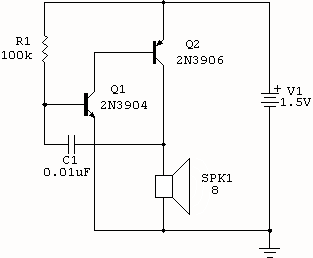
This is my basic all purpose tester.


The battery is two 1.5V C-sized cells.
The whole circuit is built on a piece of wood with a morse code key as the power switch.
The transistors are placed in transistor sockets.

I can use this to:

1. practice code
2. test batteries
3. test NPN transistor
4. test PNP transistor


panic mode

Joined Oct 10, 2011
5,008
I too have my own way of testing components specially since quite few of them get salvaged and reused.

Multimeters are all digital and used MCU could do a lot more to provide useful test. As is this is nothing but waste and false advertising
 

Thread Starter

cmartinez

Joined Jan 17, 2007
8,782
This is my basic all purpose tester.


The battery is two 1.5V C-sized cells.
The whole circuit is built on a piece of wood with a morse code key as the power switch.
The transistors are placed in transistor sockets.

I can use this to:

1. practice code
2. test batteries
3. test NPN transistor
4. test PNP transistor

Nice and simple contraption... just the way I like it... :)

Question. You're obviously testing the transistors at saturation... can a transistor be damaged in such way so as to still be able to conduct in saturation mode, but it's beta function curve be damaged and/or distorted?
 

MrAl

Joined Jun 17, 2014
13,711
Nice and simple contraption... just the way I like it... :)

Question. You're obviously testing the transistors at saturation... can a transistor be damaged in such way so as to still be able to conduct in saturation mode, but it's beta function curve be damaged and/or distorted?

Hi,

High voltage can do tricks like that. The die gets partially damaged.

Did you try the base to emitter shorting trick yet?
 
Top