hFE function in my cheap-o multimeter

Thread Starter

cmartinez

Joined Jan 17, 2007
8,727
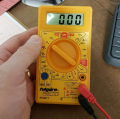
I bought this extremely affordable multimeter for about $7.00 dlls to keep with me at all times while on the road:
Capture.PNG


And I couldn't help but notice that it has an hFE function in its dial that I hadn't heard of before... I naturally did some googling before posting my question here (I don't like getting rapped by my peers) ... and found out that this thing supposedly reports a transistor's gain value.

Question: Isn't a transistor's gain a function that is particular to each model and not a fixed value? And if it is, what does the number reported by the MM represent, and is it of any practical use?
 

crutschow

Joined Mar 14, 2008
38,325
Isn't a transistor's gain a function that is particular to each model and not a fixed value? And if it is, what does the number reported by the MM represent, and is it of any practical use?
That multimeter looks very similar to the one that Harbor Freight here occasionally gives away as a freebee. ;)

Yes a transistor's gain can vary from model to model.
Why is that confusing to you as regarding the meter?

The measurement allows you to determine if a particular transistor is working, and if the gain is within its specified limits.
 

#12

Joined Nov 30, 2010
18,224
That's the good ol' Centech from Harbor Freight.:D
Anyway, let's look at something simple and common like a 2N3904 or 2N2222 or 2N4401
Their gain starts at zero when Vce is zero and hits a maximum which is in a different range for different part numbers.
The only way a cheapo is going to do anything useful is to pick a range which is convenient for the battery inside it. Maybe Vce = 5V and Ib = 10 ua.
That way, a gain of 100 will use up 1 ma in the collector.
There is no reasonable way to check a transistor that has its peak gain at 100 ma and expect to last long with a 9V battery.
It's cheap. It will give you a number. It has no chance of doing a good job in the range from a TO-92 to a TO-3 transistor.
 

#12

Joined Nov 30, 2010
18,224
I keep a couple of those in my tool boxes, just in case, but my Fluke 27 has never failed me.
They are labeled for 1000 volts, but I would never hook one up to anything higher than 240 VAC for fear it would burst into flames.:eek:
I haven't tested a transistor for gain since I got a batch of counterfeits in 1975. It just doesn't seem to be a problem.
 

shteii01

Joined Feb 19, 2010
4,644
Transistor hFE is not a function. It is listed in a datasheet in the table. However, it is not a fixed value. It is a range, there is a minimum and a maximum. So two parts of the same model can have two completely different values. But! As long as the value falls into the specified range, they will leave the factory and be sold to me and you.
 

shteii01

Joined Feb 19, 2010
4,644
I have one from Harbor Freight. It is actually quiet useful for simple breadboard stuff. Notice that it has On/Off switch. Your's got Off on the selector dial, I admire that.
 

MrChips

Joined Oct 2, 2009
34,629
Transistor hFE is not a function. It is listed in a datasheet in the table. However, it is not a fixed value. It is a range, there is a minimum and a maximum. So two parts of the same model can have two completely different values. But! As long as the value falls into the specified range, they will leave the factory and be sold to me and you.
Let's not get pedantic here.

According to the definition of function:

noun
  1. 1.
    an activity or purpose natural to or intended for a person or thing.
    "bridges perform the function of providing access across water"
    synonyms: purpose, task, use, role
    "the main function of the machine"
    responsibility, duty, role, concern, province, activity, assignment, obligation, charge;
    task, job, mission, undertaking, commission;
    capacity, post, situation, office, occupation, employment, business
    "my function was to select and train the recruits"

hFE function in this context clearly means "readout transistor hFE value on the meter display".

hFE function is totally acceptable in this context. We know what it means.
 

GopherT

Joined Nov 23, 2012
8,009
Transistor hFE is not a function. It is listed in a datasheet in the table. However, it is not a fixed value. It is a range, there is a minimum and a maximum. So two parts of the same model can have two completely different values. But! As long as the value falls into the specified range, they will leave the factory and be sold to me and you.
@shteii01 , the OP is talking bout the Hfe FUNCTION on the meter, it measures and displays the values of Hfe on the meter. See the dial, see the Hfe function?
 

Thread Starter

cmartinez

Joined Jan 17, 2007
8,727
@shteii01 , the OP is talking bout the Hfe FUNCTION on the meter, it measures and displays the values of Hfe on the meter. See the dial, see the Hfe function?
Just to clarify things... the way I understand the word function, is that one inputs a value, and a different value that depends on the first value is delivered as a result... of course said value can be a constant. But I'd normally expect an output that varies in accordance to the input...

Hence the source of my question. An ordinary transistor has what we call a beta function, which is a current output curve that depends on its input. So (as far as my understanding goes), a transistor's gain (output) cannot be expressed as a constant before it reaches saturation.
 
Last edited:

GopherT

Joined Nov 23, 2012
8,009
Just to clarify things... the way I understand the word function, is that one inputs a value, and a different value that depends on the first value is delivered as a result... of course said value can be a constant. But I'd normally expect an output that varies in accordance to the input...

Hence the source of my question. An ordinary transistor has what we call a beta function, which is a current output curve that depends on its input. So (as far as my understanding goes), as transistor's gain (output) cannot be expressed as a constant before it reaches saturation.
Right, most transistors (every transistor?) has an Hfe that is dependent on collector current. Although a group of transistors made the same way may have the same part number, the Hfe vs current will not be identical. That is why matched pairs of transistors are so much more expensive that a random pair. The parts must be individually tested and a mate found.
 

Thread Starter

cmartinez

Joined Jan 17, 2007
8,727
Right, most transistors (every transistor?) has an Hfe that is dependent on collector current. Although a group of transistors made the same way may have the same part number, the Hfe vs current will not be identical. That is why matched pairs of transistors are so much more expensive that a random pair. The parts must be individually tested and a mate found.
That is very, very interesting information, thank you. I didn't know that producing a pair of transistors with identical properties could be so hard. After all these years I would've thought that the industry would've already mastered what at first sight appears to be a simple task...

I can imagine a few uses for matched transistors in the real world... metrology comes to mind... for instance...
 

Jony130

Joined Feb 17, 2009
5,593
My cheap multimeter also have Hfe function. And in the manual we can read that the Hfe is measured at Ib = 10μA and Vce = 2.8V.
So, you can use this to check if BJT is not damage and also you can much the BJT as well.
 

GopherT

Joined Nov 23, 2012
8,009
That is very, very interesting information, thank you. I didn't know that producing a pair of transistors with identical properties could be so hard. After all these years I would've thought that the industry would've already mastered what at first sight appears to be a simple task...

I can imagine a few uses for matched transistors in the real world... metrology comes to mind... for instance...

About the time you joined, a famous member here was banned. Audioguru. He had a phrase that was essentially, "the data sheet states min, max and typical values but you can't call a distributor and ask for a 'typical' part."
 

#12

Joined Nov 30, 2010
18,224
I didn't know that producing a pair of transistors with identical properties could be so hard.
After studying IC op-amps, I suffered from the belief that any two transistors intended to be identical and produced on a single piece of silicon were matched. Somebody on AAC corrected me. He said, even if you buy a pair of transistors on a single chip, they aren't, "matched" unless testing proves they are matched.

Look: Nearly identical part numbers. Some are, "matched", and some are not.
Matched: 42 cents
Not Matched: 32 cents
 

Attachments

Top