instability due to transfer function peaking

Thread Starter

yef smith

Joined Aug 2, 2020
1,446
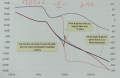
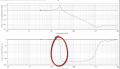
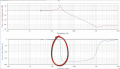
Hello,In the video at 7:46 and the photo below they say that a drop of 180 degrees and a massive peak is a sign of instability.
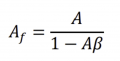
but in theory we have the formula taken from the attached article where they say that gain needs to be 1 (0dB) and phase 180 , because that way the denomiator will be 0 (unstable)
So how a peak of 20dB in theory will make the system unstable?
As i see it the transfer function will be stable with 20dB peak.
Thanks.
1772820810368.png1772820794939.png
 

Papabravo

Joined Feb 24, 2006
22,058
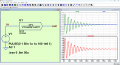
What you should see, if you did a transient response to step input, would be a sine wave with a decaying exponential envelope. This would be typical of an underdamped system.

See the transient response below

Screenshot 2026-03-06 170518.png

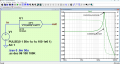
And the corresponding Bode Plot

Screenshot 2026-03-06 171939.png

I see absolutely no visible hint of instability. It would be possible of course to construct a transfer function which demonstrates mild to violent instability. This system is not it!
 
Last edited:

WBahn

Joined Mar 31, 2012
32,702
Hello,In the video at 7:46 and the photo below they say that a drop of 180 degrees and a massive peak is a sign of instability.
but in theory we have the formula taken from the attached article where they say that gain needs to be 1 (0dB) and phase 180 , because that way the denomiator will be 0 (unstable)
So how a peak of 20dB in theory will make the system unstable?
As i see it the transfer function will be stable with 20dB peak.
Thanks.
View attachment 364308View attachment 364307
Since you talk about THE video, and even tell us exactly what time to look at, yet don't supply a link to it, are we to conclude that there is only one video that talks about this and that everyone knows exactly which one it is???? Or just that we are expected to dig out our crystal balls so that we can read your mind?

Think about what you would expect to see for a signal that has content in the vicinity of that peak. Portions that are slightly below are not inverted while portions that are slightly above are inverted. Now consider that pretty much every signal has some amount of frequency jitter, so what would you expect to see as the signal moves around slightly and portions of it move back and forth through that peak. Is that something that you would like your system do?

This could be what this unspecified video as talking about at that time hack. But, I don't know, because I just threw out my crystal ball because it never seemed to work as well as the infomercial said it would.
 

LvW

Joined Jun 13, 2013
1,994
Hello,In the video at 7:46 and the photo below they say that a drop of 180 degrees and a massive peak is a sign of instability.
but in theory we have the formula taken from the attached article where they say that gain needs to be 1 (0dB) and phase 180 , because that way the denomiator will be 0 (unstable)
So how a peak of 20dB in theory will make the system unstable?
As i see it the transfer function will be stable with 20dB peak.
Thanks.
* The transfer function shows a typical lowpass response (Chebyshev - however, with a large peaking).
There is no instability.

* Stability criterion: The stability limit is reached when the LOOP GAIN (in your example: A*beta) is unity, equivalent to a magnitude of "1" (0dB) and a phase shift of 360deg (identical to 0 deg).
In this case (stability limit) the peak of the closed-loop transfer function would approach infinity.

Remark: Sometimes the loop gain is defined as (-A*beta). In this case, the loop gains phase shift at the stability limit is -180deg.
 

Papabravo

Joined Feb 24, 2006
22,058
* The transfer function shows a typical lowpass response (Chebyshev - however, with a large peaking).
There is no instability.

* Stability criterion: The stability limit is reached when the LOOP GAIN (in your example: A*beta) is unity, equivalent to a magnitude of "1" (0dB) and a phase shift of 360deg (identical to 0 deg).
In this case (stability limit) the peak of the closed-loop transfer function would approach infinity.

Remark: Sometimes the loop gain is defined as (-A*beta). In this case, the loop gains phase shift at the stability limit is -180deg.
It may not be a Chebyshev since there is no visible ripple in the passband. In order to get the Chebyshev response we need a transfer function that looks like:

\( |T_n(j\omega)|^2\;=\;\cfrac{1}{1\;+\;\epsilon^2C_n^2(\omega)} \)

where

\( C_n(\omega)\;=\;cos(n)cos^{-1}(\omega),\;\;\;|\omega|\le1 \)

These relations define the Chebyshev response.
 
Last edited:

LvW

Joined Jun 13, 2013
1,994
It may not be a Chebyshev since there is no visible ripple in the passband.
No - the shown magnitude response is a TYPICAL Chebyshev response (however, with a very large peaking).
A 2nd-order Chebyshev function shows one single "ripple" - identical to a single peaking in the close vicinity of the pole frequency wp.
 

Papabravo

Joined Feb 24, 2006
22,058
No - the shown magnitude response is a TYPICAL Chebyshev response (however, with a very large peaking).
A 2nd-order Chebyshev function shows one single "ripple" - identical to a single peaking in the close vicinity of the pole frequency wp.
Show me the transfer function.
 

LvW

Joined Jun 13, 2013
1,994
Show me the transfer function.
Each 2nd-order lowpass transfer function with a pole-Q larger than Qp=0.7071 (Butterworth response) has - per definition - a Chebyshev response.
Infos can be found in each relevant textbook with tabulated pole data:

Examples (peaking/Qp):
0.1dB/0.75736; 0.5dB/0.8637 ; 1dB/0.9565; 3dB/1.30656.
 

Papabravo

Joined Feb 24, 2006
22,058
Each 2nd-order lowpass transfer function with a pole-Q larger than Qp=0.7071 (Butterworth response) has - per definition - a Chebyshev response.
Infos can be found in each relevant textbook with tabulated pole data:

Examples (peaking/Qp):
0.1dB/0.75736; 0.5dB/0.8637 ; 1dB/0.9565; 3dB/1.30656.
That is manifestly NOT a transfer function. It is a hand full of data values.
Show me the actual transfer function that behave as you described in post #7, or is that too difficult for you?
 

LvW

Joined Jun 13, 2013
1,994
That is manifestly NOT a transfer function. It is a hand full of data values.
Show me the actual transfer function that behave as you described in post #7, or is that too difficult for you?
"...or is that too difficult for you?"

May I kindly ask you: Do you really think it's necessary and appropriate to ask such a polemical question?

Nevertheless, I will try to give an answer, even though I don't understand the meaning of the question.

You want a 2nd-order transfer function ?
Must I repeat the function you have allocated to the block U2 in your post#2 ?
This is a second-order transfer function in its general form.

Let me explain it to you:
If you compare this general form with the correponding 2nd-order transfer function for a given circuit (expressed through values for R and C ) you can solve for the characteristic pole data wp and Qp.

In this context, we distinguish between different 2nd-order lowpass approximations with very special properties, which differ only in terms of their pole-Q (Qp). This quantity Qp describes the pole position in the complex s-plane.

Typical exmaples:
* Thomson-Bessel characteristic (maximally flat delay time): Qp=0.57735
* Butterworth (maximally flat magnitude) characteristic: Qp=0.7071
* Chebyshev characteristic (with amplitude peaking, ripple): Qp>0.7071 (some examples given in my post#9)
* Chebyshev-inverse or Elliptical (Cauer) characteristics: Poles and real zeros.

I like to repeat that in all relevant textbooks 2nd-order transfer functions for pole-Q values Qp>0.7071 are listed under "Chebyshev response".
(Because you have objections - how would you call filters with Qp>0.7071 ?)

What else would you like to know?
(I have published a book about active filters - unfortunately not in English.)

Added later:
Some additional information about peaking/ripple for Chebyshev responses (n=degree of transfer function):
* n even: Minimum at w=0 and number of peaks p=n/2
* n odd: Maximum at w=0 and number of peaks p=(n-1)/2
 
Last edited:

Thread Starter

yef smith

Joined Aug 2, 2020
1,446
Hello In the links below we have a system where the instability is measured at 0dB (video 3) while in video 5 the stability is measured in 20dB.
I attached the links and the exact time points for them.
In both cases he plugs something in circuits and measures.
What is the difference in what he does in the lab so at one case he considers 0dB as a point of instability and the other is at 20dB instability.
every thing in the real world is closed loop ,because the circuit is already built.
video 5 7:46
video 3 2:58
video 3 plot
1773001052412.png

video 5 plot
1773001093894.png
 

LvW

Joined Jun 13, 2013
1,994
@ yef smith
I just took a quick look at the first video and saw that it talks about a simple passive L-C filter.
So it's not about an RC active filter with feedback.
That's why I don't think the video is relevant in the context of the question.

Comment: With reference to the 20 dB peak the author speaks about "instability".
Perhaps he has the corresponding time domain (step response) in his mind. The step response of such a circuit will exhibit an excessive (damped) ringing. And he shows how the 20dB peak can be reduced using a damping resistor.
However, such a definition of "instability" has nothing to do with the stability criterion which is applied to systems with feedback and is based on the loop gain of the circuit
 
Last edited:

MisterBill2

Joined Jan 23, 2018
27,159
Mostly, instability is a function of both time delay and amplitude peaking. So to have a useful discussion of instability BOTH must be part of the discussion to reflect the real world.
 

MisterBill2

Joined Jan 23, 2018
27,159
Hello Mr.Bill , could you give an example to instability with time delay and amplitude peaking so I could simulate it.
Time delay is a phase shift for a repetitive signal, and since amplitude peaking is usually associated with the phase shift , the result is that the feedback may cross the line between negative and positive.That will cause distortion that may become unstable.
As an example, look at a circuit of an audio amplifier that has an obvious negative feedback loop, then consider the effect of a (DC blocking) coupling capacitoor in that loop adding some phase delay. That is the classic example.
 
Top