Help with diy power supply with potentiometer

Thread Starter

Aussie battler

Joined Mar 29, 2023
23
I found this aswell different sort of board much smaller in amps ability but exactly same of what I wanted to achieve being new to electronics I wasn't 100% sure on values for the pots to have the full sweep just like blue trim pots didView attachment 291034
If you look in this diagram there original cv is 50k and there fv 2k so without calculator that sounds around 10% a user has already stated so seems like a good working point

I must not be explaining myself well enough everyone wants schematics of my power supply when the variable voltage comes from boars above the blue one simply relocated the trim pots with about 6 inch of wire and now I want to ad in fine voltage pot just trying to figure out the new value I knew it was less but didn't know how much guess this confirms it. I'll reply back with photos once done
 

MrChips

Joined Oct 2, 2009
34,884
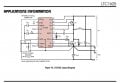
Example application of LTC1625
LTC1625 circuit.jpg

LTC1625 Output Voltage Programming.jpg


Assuming that the CV potentiometer is represented by R2 in the circuit, here is how you would connect the panel mounted FINE and COURSE potentiometers.

The lowest output voltage is 1.19V when R2 is zero.
PSU course and fine CV adjustment.jpg
You can make the resistance of the FINE pot to be 5% to 10% that of the COURSE pot.
The lower percentage gives you finer control over reduced adjustment range.
 

SgtWookie

Joined Jul 17, 2007
22,230
What you really need is a 10-turn potentiometer. These nifty devices are precision, and the dial gives you an approximate percentage of how far the wiper (2) is between (1) and (3). This eliminates the need to have a 2nd pot in the mix, and the 10 turn pot will have about the same precision as the existing trim pot.

Keep the wires short as possible. Place a 10nF capacitor (0.01 uF), preferably poly, between ground and the wiper, as pots are inherently noisy.
The Value of the pot isn't critical; somewhere from 20k to 200k should be fine.
 

Attachments

Thread Starter

Aussie battler

Joined Mar 29, 2023
23
Ahh yes I've seen this pots but have zero knowledge I'll jump over to googles to learn about them

so running cap is for these type of pots or any pots in general. Say run from pin 1 to pin 2 the 10uf poly cap
 

MrChips

Joined Oct 2, 2009
34,884
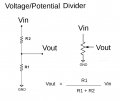
Potentiometer as a potential divider (voltage divider) or variable resistor

Potential Divider.jpg


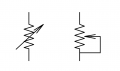
Variable Resistor

1680271575295.png

LTC1625 circuit.jpg

In this applilcation, R2 and R1 constitute a potential divider.

If the CV pot is represented by R2, then the CV pot is wired as a variable resistor. Connect terminal 1 to the existing terminal 1 pad. Connect terminals 2 and 3 to the existing pad locations.

If you wish you may use the CV pot as a potential divider by connecting all three terminals to the board. It this case you would have to remove the equivalent of R1 on the board. You would also have to connect terminal 3 of the pot to GND on the board.
 

Thread Starter

Aussie battler

Joined Mar 29, 2023
23
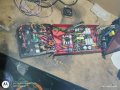
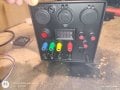
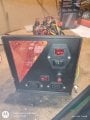
This is the build so far criticisms welcome I can only learn from here, and yes there a red lid off this box that's houses a 120mm fan

Any questions as away

Those pots are old for different board I was running not to do with this subject currently looking at 10 turn pots thanks again to everyone for your help truly appreciated I've gained much more knowledge with pots thanks to yous

A bit about it
It all housed in a nice clean professional looking box on The back has switched 240v in and switch 240v out runs to a 60w iron and soldering station to free up power board fan speed controller for main cooling

3 digit amp and volts monitor
On the front has 4 x usb3.0 out and one 12v cigarette lighter socket front fused, have continuous 3v 5v and 12v at 25 amps and variable output 1v to 32v at 10amp have additional cooling fans possibly get 15amps at short bursts.
Also has a load switch for the variable out
Also had GND out of I need to ground a wrist strap

Got everything I need and much more thought I'd share my version of a meaty power supply

If I was to do it again yes theres is few things id change

Remove fan speed controller can run at full speed, remove one lot of usb ports, ad 240v socket in place, use 240 for testing a times, use a better amps and volt display, swap out main power switch for a nicer one, instead of buy a premade boost and buck converter simply just make one 20 or 30a as I do a lot of automotive testing

All I can think of now maybe ad a nice 6 inch red led strip underneath for that wank factor haha
 

Thread Starter

Aussie battler

Joined Mar 29, 2023
23
What you really need is a 10-turn potentiometer. These nifty devices are precision, and the dial gives you an approximate percentage of how far the wiper (2) is between (1) and (3). This eliminates the need to have a 2nd pot in the mix, and the 10 turn pot will have about the same precision as the existing trim pot.

Keep the wires short as possible. Place a 10nF capacitor (0.01 uF), preferably poly, between ground and the wiper, as pots are inherently noisy.
The Value of the pot isn't critical; somewhere from 20k to 200k should be fine.
I've been looking in the old AliExpress because in the country we only have 1 electronics store and there rather useless for the most part I can find any 200k 10 turn pots 100k highest I found

Oh ok I thought if I didn't get 200k I would get the full range say if I got 100k I wouldn't only get 50% range so it doesn't work that way. So if the value was half just means it will cycle through the volts twice as fast ??


Reference to you capacitors is that for the 10 turn pot or the normal pots for 10uf capacitor or both and that just be between pin 1 and 2 aye as 1 and 3 are wipers correct 2 is ground
 

Thread Starter

Aussie battler

Joined Mar 29, 2023
23
Sorry for all the replies, I do have unfortunately I have abfewmental illnesses and electronics is my calming it's like I'm on speed some days,

The polypropylene capacitors I've found the deep reddish colour I cannot find anything under 63v but this would be a problem belongs it's higher value like other capacitors please correct me if I'm wrong
So a 63v or 100v 10nf is perfectly fine ? Just still need to confirm where to be connected too pin 1 and 2, and is that for all pots aswell thank you all

Made a few changes removed one usb bank adding in 240v socket, got a better and nicer power switch, as for the pots I can't find 10 turn at 200k , 100k may speed it up to much the dials would it? And swapped out the black banana plug bottom right for gnd strap for a yellow one
,The display I decided keep the same and for the variable output I've added some 20a Schottky diodes to protect against reverse accident

Also modified some extension powerleads at output end with clear cover 3mm led in4007 x 2 and 68k resistor for 240v now I have a power indicator on my extension leads booyaaa, hope y'all had an amazing weekend and can help when your back too it out of weekend mode lol
 

MrChips

Joined Oct 2, 2009
34,884
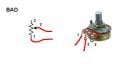
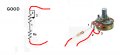
I neglected to advise you that there is a right way and a wrong way to configure a potentiometer as a variable resistor.

Varible resistor - bad.jpg

In the above configuration, terminal (3) of the potentiometer is not used. This is a bad thing. When the center wiper (2) loses contact with the resistive track, the resistor goes open circuit (infinite resistance). This can result in disastrous consequences depending on the circuit application.

Also, when the wiper (2) is turned fully counter-clockwise (CCW) to (1), the resistance is zero. This also can result in disastrous consequences.

Varible resistor - good.jpg

In this modified application, terminals (2) and (3) are connected. Hence even if the wiper loses contact with the resistive track, the maximum resistance will be the full resistance of the potentiometer.

An optional resistance Rs is wired in series with the variable resistor in order to set a minimum resistance of the circuit.
Select the value of Rs to suit the application.

You may wish to interchange terminals (1) and (3) depending on how you wish the pot setting to function, CCW vs CW operation.
 

AnalogKid

Joined Aug 1, 2013
12,163
Assuming that the CV potentiometer is represented by R2 in the circuit, here is how you would connect the panel mounted FINE and COURSE potentiometers.

You can make the resistance of the FINE pot to be 5% to 10% that of the COURSE pot. The lower percentage gives you finer control over reduced adjustment range.
A problem with this method in post #22 is that as the coarse adjustment goes lower and lower, the percentage effect of the fine adjustment increases. For example, let's say the two pots are selected such that when the coarse adjustment sets the output to 12 V, the fine adjustment can vary this by +/-10%. Then, if the coarse adjustment is set to 3 V, the fine adjustment range might be +/-30%. Exact ratios depend on the values of the two pots.

ak
 
Last edited:

MrChips

Joined Oct 2, 2009
34,884
A problem with this method is that as the coarse adjustment goes lower andlower, the percentage effect the fine adjustment has increases. For example, if the coarse adjustment sets the output to 12 V, the fine adjustment might vary this by +/-10%. If the coarse adjustment is set to 3 V, the fine adjustment might be +/-30%. Exact ratios depend on the values of the two pots.

ak
True. How would you solve this problem?
SgtW suggested using a 10-turn pot. The problem with that is it takes a lot of turns to go from maximum to minimum and vice versa in a hurry.
 

AnalogKid

Joined Aug 1, 2013
12,163
How would you solve this problem?
In one of the bench supplies I built, the voltage reference goes through a pot to the non-inverting input of the voltage regulator opamp. That circuit has a nominal gain of 8, to give a max output of over 30 V from an LM4040 4.096 V reference. The output from the pot ranges from 0.0 V to 4.096 V. This is the coarse adjustment.

Two pots in series will work in this topology IF

a) the bottom of the coarse adjust pot goes to GND instead of to another resistor,
and
b) the the coarse adjust pot is not wired as a rheostat, and the wiper goes to a reference input rather than a feedback input. Many commercial bench supplies, such as BK Precision supplies where I used to work, do it this way.

In my supply, I did not do that. For the fine adjustment I vary the gain of the opamp circuit. The usual series feedback resistor is replaced by a fixed resistor in series with a smaller-value pot. This varies the gain of the control loop, and thus the output voltage, a fixed percentage regardless of the input.

In general, there are two basic topologies for an adjustable power supply:

1. A variable voltage (derived from a fixed reference) driving a fixed-gain (constant feedback) power stage

2. A fixed reference voltage driving a variable-gain (adjustable feedback) power stage. This is how the LM317 works. A typical marker for this type of circuit is that it cannot adjust down to 0 V without extra complexity.

Two pots in series can work well with #1. Unfortunately, the LTC1625 is #2.

I once had a request for a fine-adjust circuit that varied the output voltage a fixed number of +/-volts regardless of the output voltage setting: 24V +/-0.5 V, 12 V+/- 0.5 V, 3.3 V+/- 0.5 V, etc. That is close to how the circuit in #22 would behave, except that you cannot adjust the output down to 0 V, and the response curve (output voltage vs pot rotation) would be logarithmic rather than linear. Linear was harder.

ak
 
Last edited:

Thread Starter

Aussie battler

Joined Mar 29, 2023
23
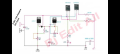
If extending the pots on this particular boost buck converter is becoming a head ache would I be best to make a simple circuit like this attached. also there's a circuit just like this that's rated 0-50v 0-20a just had few more trannies
Guess for reliability longevity this might the better option.

Let me know what you think small home made circuit or keep that premade buck boost converter seems a head ache with these pots
 

Attachments

AnalogKid

Joined Aug 1, 2013
12,163
There is no feedback from the output to the regulator, so regulation will be poor. And the heat will be large. Please post a link to the source of the schematic.

To be clear, putting two pots (one small, one large) in series will get you a coarse and fine adjust as you requested in post #1. The response curve might not be ideal, but it will work.

ak
 

Thread Starter

Aussie battler

Joined Mar 29, 2023
23
Cool will stick with 1st board then

The link for that last post with diy circuit was from YouTube user name is watermarked across the schematic, it seemed a bit raw but my knowledge is very limited, he did or another one the same I seen had a very large heat sink I think it would need a fast aswell the heat sink itself may not be enough especially when pushed
 

Thread Starter

Aussie battler

Joined Mar 29, 2023
23
I've ordered the pots just waiting for them to arrive will post the outcome,

Thank you very much to those who contributed has been some very useful informative posts I've taken on board with learning so thank you for that.
 
Top