HealthRider R60 (Model HCTL07120) Motor Control Board MC2000H Diagnosis

Thread Starter

mmbridges

Joined May 24, 2025
13
Motor control board kept shutting down intermittently. Motor thermal overload switch was not opening but motor control board shut down at higher treadmill speeds and with load (i.e. someone running on it). I put multimeter in series with red motor wire and read currents of < 5A DC when shut down occurred. This seemed too low to me to cause shutdown given DC motor nameplate is 14.3A.

I did measure AC line voltage and noticed a bit of voltage droop at higher unloaded treadmill speeds. I then realized (silly me) that I had a long etension cord to plug the treadmill into the wall. I switched it out to a 12AWG shorter extension cord and could get treadmill up to 10mph without shutting down. However when I put my 14 year old son on the treadmill and had him push up to 10 mph it started to shutdown again.

I saw a thread that suggested a IR2125 MOSFET gate driver is part of the MC2000 and has a current sense resistor that prevents the motor current from exceeding a certain level.

Questions:

1.) does anyone know which resistor on the MC2000 is used as the current sense resistor?
2.) what is the current level that the board limits the current to?
3.) my understanding is the IR2125 gate driver can limit hard shorts or pulsed high current loads in such a way that the motor board keeps driving the motor but at the reduced current levels. Does anyone know what current level causes the entire board to be shut down requiring the stop button on the treadmill console to be pressed before the motor control board is reset and can start driving the motor again?
4.) Finally which particular components on the motor control board might typically be damaged by the use of the incorrect gauge extension cord and if so how would I test them?

Mike
 

MaxHeadRoom

Joined Jul 18, 2013
30,605
The cvurrent sense resistor is R32 on the reverse engineered schematic, it is a WW resistor 0,01Ω 1W and the signal is sensed by pin 4 of this particular micro.
 

Thread Starter

mmbridges

Joined May 24, 2025
13
The current sense resistor is R32 on the reverse engineered schematic, it is a WW resistor 0,01Ω 1W and the signal is sensed by pin 4 of this particular micro.
Thank you so much for the response. While delving through all of the old posts regarding the various flavors of the MC motor controller boards out there, you have provided a wealth of information!

Can I ask which "reverse engineered schematic" shows the 0.01 ohm current sense resistor as R32 and is this schematic for the MC60? The schematic for the MC60 from Tom Rollins that I have shows the 0.01 ohm resistor being R28. Also is the MC2000H design similar enough to the MC60 design?
 

Thread Starter

mmbridges

Joined May 24, 2025
13
Looks like my MC2000H is a version of the motor controller prior to release of the MC2100. My board as described in MC2000H actually comes in two boards. The power board PB-30iS contains the incline motor circuit and also seems to receive PWM speed commands from the console and report tachometer info up to the console. this PB-30iS also sends analog speed commands down to the MC2000H motor control board. I believe the MC2100 consolidates the PB-30iS and the MC2000H into a single MC2100 board.

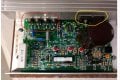
It is not clear to me how I can take reverse engineered MC60 and MC2100 schematics and figure out what is going on with my MC2000H board which is identical to the picture below taken from the MC2000H link above. I believe this board is a mix of SCR and MOSFET PWM but I'm not quite sure how the two interact. I believe the 4 components circled in red form a SCR bridge rectifier circuit where D13,D15 are diodes and Q2,Q3 are SCR's similar to what is found in the MC60 reversed engineered schematic. If this portion of the circuit mimics that in the MC60, then gates of the SCR's are used to control the firing angle and consequently chop up the rectified AC waveforms. The component circled in green is an IR2125 gate driver which I believe drives the large components circled in yellow. I'm guessing these are MOSFETS and are used to form 1/2 of a PWM DC motor H-bridge but that is pure speculation. The reverse engineered MC2100 shows a single MOSFET in the return leg of the motor so if that is one of the components circled in yellow that leaves the second large component yet to be identified. Maybe it is the flyback diode across the motor? MC2000H rev 1p06.jpg

Can anyone tell me how close I am to understanding how the components circled in red, green and yellow above interact?
 

MaxHeadRoom

Joined Jul 18, 2013
30,605
That looks very much like the ver prior to the MC2100 ver!
In the case of the latter, the two semi's were Mosfet and flyback diode suppressor.
I personnaly have no knowledge of them as far as repair etc.
 

Thread Starter

mmbridges

Joined May 24, 2025
13
That looks very much like the ver prior to the MC2100 ver!
In the case of the latter, the two semi's were Mosfet and flyback diode suppressor.
I personnaly have no knowledge of them as far as repair etc.
thanks, I think I remember you responding in an older post that you did not have much familiarity with the MC2000 board. Setting aside repair questions can I ask you to speculate on theory of operation? I'm hoping that your knowledge of the MC60 and MC2100 might help me fill in the blanks. You wrote here for the MC2100 that

" I believe the operation is that there is a SCR on the heatsink that is on the output of the bridge rectifier, the SCR is controlled by the microprocessor and ramps up the DC at power up, so even if the motor has a command initially it does not go into full power, the DC ramp up controls this,... "

Refereing to the image of the MC2000H controller board, do you think the components circled in red (2 diodes 2 SCR's) perform that ramp up operation you described above and that is completely separate from the PWM of the MOSFET circled in yellow?

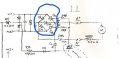
I'm thinking the 2 diodes and 2 SCR's attached to the heat sink are arranged in a bridge rectifier circuit similar to the portion of the MC60 reverse engineered schematic circled in blue below (maybe without D12):

MC60 SCR bridge rectifier portion.jpg

What do you think of this theory.

The PB-30iS receives a PWM speed command from the console which then turns that into an analog speed command and sends it to the MC2000H via the HWL lines. There is some circuitry which may or may not involve the microprocessor that converts this analog speed command signal to a PWM pulse train that is input to the IR2125 MOSFET gate driver. The driven MOSFET PWM's the HV DC bus which has a voltage proportional to the SCR firing angle where the SCR's are part of bridge rectifier. So soft start is accomplished by ramping up the bus voltage via ramping up the SCR firing angle.


Does anyone have a recommendation of how to reverse engineer a PCB? Is it basically identifying board components and following traces.
 

holbeneine

Joined Jan 17, 2025
8
Hello,

interesting to see that the R4 resistor on the board of the picture is 2.7Kohm, in contrast to the 5.6kOhm of my MC2000ES (3 resistors in parallel: 22k // 15k // 15k = 5k6).

Do you live in a country where you have 115AC?

I live in italy, we have 230v AC

Sincerly, holbeneine
 

Thread Starter

mmbridges

Joined May 24, 2025
13
Hello,

interesting to see that the R4 resistor on the board of the picture is 2.7Kohm, in contrast to the 5.6kOhm of my MC2000ES (3 resistors in parallel: 22k // 15k // 15k = 5k6).

Do you live in a country where you have 115AC?

I live in italy, we have 230v AC

Sincerly, holbeneine
Yes I’m in the USA and my multi meter measures 116VAC at input to the MC2000H.

I finally disconnected board from heat sink and took tons of pictures front and back. Also used strong backlight to see how traces from top and bottom of board overlay.

did you every reverse engineer your boards schematic? If so I think it will help me reconstruct mine.

by the way what is the purpose of R4? Do you think it is part of the current sense circuit for controlling the gate driver?

so glad you responded!!!!
 
Last edited:

holbeneine

Joined Jan 17, 2025
8
Hello,

Thank you, that also explains the other value of resistor R4 to my circuit board. (230AC instead 115)

no, i never made a schematic of this board.

In my opinion, resistor R4 is needed for a simple, inefficient power supply unit. There are 2 diodes (D2/D5) for rectification, resistor R4 to dissipate excess voltage and a diode somewhere for voltage regulation. If you trace the tracks, you will come to driver U4.
As the resistor has to consume the excess voltage, it becomes very hot. Did your resistor have 2k7?

holbeneine
 

Thread Starter

mmbridges

Joined May 24, 2025
13
Hello,

Thank you, that also explains the other value of resistor R4 to my circuit board. (230AC instead 115)

no, i never made a schematic of this board.

In my opinion, resistor R4 is needed for a simple, inefficient power supply unit. There are 2 diodes (D2/D5) for rectification, resistor R4 to dissipate excess voltage and a diode somewhere for voltage regulation. If you trace the tracks, you will come to driver U4.
As the resistor has to consume the excess voltage, it becomes very hot. Did your resistor have 2k7?

holbeneine
Thanks! I will measure this resistor over the weekend. I wasn't familiar with the 2k7 =2.7k resistance notation. That will be pretty cool if that is the only thing that needs to be replaced. I would have thought wire wound resistors fail open vs degrade gradually but either way an easy fix. I think I will still draw out this portion of the circuit just to get a better handle on things.

I did notice when I used my clamp on multi-meter to measure AC current the reading was fairly low 2A at 3mph unloaded (i.e. with no one on it). However when I (175lbs) got on it and started walking at that same 3mph setting, the AC current reading started fluctuating between OL and 4A. I was surprised that the digital multi meter was fluctuating so wildly. Really need to look at AC waveform with scope.

I'm curious what the "simple inefficient power supply unit" formed by 2 diodes and R4, actually powers. I guess if the ripple gets too large due to improper R4 and what ever it drives is sensitive to that ripple, I can see it possibly screwing up things.
 

Thread Starter

mmbridges

Joined May 24, 2025
13
R4 is measuring 3.75k but it is still soldered in and I haven’t drawn the circuit diagram to know if there is another resistor in parallel. I did unplug the AC wires just in case there was something upstream affecting the resistance but no difference.
 

holbeneine

Joined Jan 17, 2025
8
Hello. I've been on holiday.

What value is written on your resistor R4? The image above is not your board, right?

R4 has to dissipate heat, thats why it is bigger and made with ceramic (Called Cermamic resistors).
 
Top