Half-wave rectifier issue

Thread Starter

ltorres

Joined Oct 17, 2024
25
After some LTspice simulations, it would appear that you may need to use a detector diode with low capacitance (i.e. <1pF) specifically made for such RF frequencies.
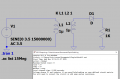
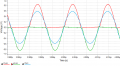
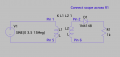
I am very new at using LTSpice and I found out how to create a transformer, with 2 inductors and a k statement. However, I get this.
1741806832768.png

I can add a resistor in series with the voltage source and make it kind of work. What else would I be doing wrong?
 

Thread Starter

ltorres

Joined Oct 17, 2024
25
What is the simulation doing that you think is wrong?

Your inductances for the transformer are rather small.

Note you can use 15Meg for 15MHz rather than adding all those zeros to the value.
Yeah, I've done it 15Meg, 15MHz and 15000000.

I wasn't sure what to put as inductance since the transformer data sheet just says its 1 to 1. I was playing with different inductance but the error came up.

Maybe I am reading it wrong but why does it think I have 2 voltages? Source V1 and the inductor, or is it calculating V at the inductor.
 

MisterBill2

Joined Jan 23, 2018
27,530
I see at least one immediate problem, which is capacitive coupling.
A second problem is the frequency, which I did not see mentioned.
Consider that a diode has some capacitance across the PN junction, and at voltages lower than what is required to cause conduction that capacitance is the major actor in coupling the two ends of the diode.
A zener diode will not conduct in either the forward direction or in the reverse direction, below some voltage. Nor most other diodes.
AND, besides all of that, there are response time issues. Nothing in electronics happens "instantly", unless you are using a mechanical stopwatch to measure the time.
What part of "below some voltage" was not clear?? Different voltages for each direction, but below that, not much conduction.
 

MrAl

Joined Jun 17, 2014
13,707
I am very new at using LTSpice and I found out how to create a transformer, with 2 inductors and a k statement. However, I get this.
View attachment 344397

I can add a resistor in series with the voltage source and make it kind of work. What else would I be doing wrong?
Hi,

Yes it does not like to see an inductor directly across a voltage source. It could be because that would imply an infinite voltage as t goes toward infinity with a DC source. They might generalize that to an AC source as well though. With zero resistance you would have to wait forever for the current to reach maximum also.

Whatever the case may be, there has to be at least some resistance in series with the inductor, and it reaches steady state faster that way too.

The inductance values depend on your actual transformer, and you'd have to know what they were or be able to measure that. It's probably good enough to just test some values and see what you end up with. Since it is a 1:1 transformer, they will both be the same which makes it easier.

You could also check into PIN diodes for high frequency work. I've never used one for that in the past though, but I've read they are used for that.
 

0ri0n

Joined Jan 7, 2025
173
I can add a resistor in series with the voltage source and make it kind of work. What else would I be doing wrong?
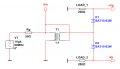
Your generator is probably of the 50 Ohm variant IRL, put 50 Ohm in series with the voltage source in LTspice. The diodes need to be (very) fast, have (very) low capacitance and no recovery time to speak of. RF Schottky diodes would be a good choice.

In my example below I used two diodes to have the choice between (+) and (-) peaks and 200 load resistors to make the input impedance of the peak detector close to 50 Ohm for both half waves. Keep the capacitive load across the 200 Ohm resistors below 2...3pF. Be aware that the reverse voltage rating for diodes from the BAT15 series is only 4V.
The 1:1 transformer is connected as 1:4 to achieve a voltage gain of 2. It also works without any transformer whatsoever by changing the loads from 200 to 50 Ohm. The diode voltage drops increase with increasing input voltage. Output voltages look much better at lower frequencies (e.g. 15 MHz).

Peak_Detector_Schematic.png

Peak_Detector_TA_2.png
 

MrAl

Joined Jun 17, 2014
13,707
Your generator is probably of the 50 Ohm variant IRL, put 50 Ohm in series with the voltage source in LTspice. The diodes need to be (very) fast, have (very) low capacitance and no recovery time to speak of. RF Schottky diodes would be a good choice.

In my example below I used two diodes to have the choice between (+) and (-) peaks and 200 load resistors to make the input impedance of the peak detector close to 50 Ohm for both half waves. Keep the capacitive load across the 200 Ohm resistors below 2...3pF. Be aware that the reverse voltage rating for diodes from the BAT15 series is only 4V.
The 1:1 transformer is connected as 1:4 to achieve a voltage gain of 2. It also works without any transformer whatsoever by changing the loads from 200 to 50 Ohm. The diode voltage drops increase with increasing input voltage. Output voltages look much better at lower frequencies (e.g. 15 MHz).

View attachment 344449

View attachment 344450
Hi,

That's an interesting way to connect it up, but you do lose the secondary isolation though. That limits the way you can connect the ground reference on the secondary side. May or may not be an issue of course depending on the application.
 

MisterBill2

Joined Jan 23, 2018
27,530
The circuit in post #27 can be modified to provide isolation, but not DC offset, simply by disconnecting the secondary of T1 from Vin, and instead tying it to the common side of the two loads. Of course, for that to work, the transformer must be adequate for the frequency in use. That is a separate challenge.
 

N5KS

Joined Apr 17, 2016
11
Just reading the issue you are having, and the first thing that hit me was the connections you've made. You aren't using the transformer. The input should be fed via pins 1 and 5, while the output should be taken between pins 2 and 6. If I understood you correctly, you are using the case ground rather than pins 5 (for input) and 6 (for output). Pins 7 and 8 are case ground, which in an RF transformer are for shielding.
 

KarriLee

Joined Mar 16, 2025
11
Check if the diode's facing the right way, make sure it's not busted, and check the AC input too. Also see if the load fits the setup.
 

Thread Starter

ltorres

Joined Oct 17, 2024
25
Just reading the issue you are having, and the first thing that hit me was the connections you've made. You aren't using the transformer. The input should be fed via pins 1 and 5, while the output should be taken between pins 2 and 6. If I understood you correctly, you are using the case ground rather than pins 5 (for input) and 6 (for output). Pins 7 and 8 are case ground, which in an RF transformer are for shielding.
I was using the correct gound(case pins), but I have to feed the input through both pins 1 and 5 and not just pin 1?
 

MisterBill2

Joined Jan 23, 2018
27,530
I looked at post #1 again and it seems that possibly just adding a series DC offset voltage to the original signal might satify the requirement. That might be an alternative scheme that could be much simpler.
 

N5KS

Joined Apr 17, 2016
11
I was using the correct gound(case pins), but I have to feed the input through both pins 1 and 5 and not just pin 1?
The RF input you described is going to pins 1 and 7, while the output was described as pins 2 and 8. It should be pins 1 and 5 for input and the RF output should be pins 2 and 6. Do not use the case ground or try it with pins 5, 6, 7 and 8 tied together. You can think of pins 5 and 6 as RF ground, while pins 7 and 8 are earth ground. RF ground is not the same as earth ground. In a way, you can compare it to a neutral wire in house wiring compared to the ground wire.

kds
 

Thread Starter

ltorres

Joined Oct 17, 2024
25
The RF input you described is going to pins 1 and 7, while the output was described as pins 2 and 8. It should be pins 1 and 5 for input and the RF output should be pins 2 and 6. Do not use the case ground or try it with pins 5, 6, 7 and 8 tied together. You can think of pins 5 and 6 as RF ground, while pins 7 and 8 are earth ground. RF ground is not the same as earth ground. In a way, you can compare it to a neutral wire in house wiring compared to the ground wire.

kds
I never grounded pins 5-8 but did tie 7 and 8. However I left pins 5 and 6 floating, should I still ground them to something?
 

N5KS

Joined Apr 17, 2016
11
I never grounded pins 5-8 but did tie 7 and 8. However I left pins 5 and 6 floating, should I still ground them to something?
Your signal generator has 2 leads (hot and ground) that should be connected to the 2 leads of the transformer input, which is pins 2 and 5. As I understood your description in the first post, you have the signal generator connected to pin 1 and 7 + 8. You are taking the output from pin 2 and 7 + 8. The output of the transformer is pins 2 and 6. Pins 7 and 8 that you are using have nothing to do with the transformer from an RF point of view.

kds
 

N5KS

Joined Apr 17, 2016
11
RF_CKT.png

The phase dot is incorrect on the primary side, so don't go by that. Pay attention to the pin numbers. Just did a down and dirty schematic to show how the connections should be.
 
Last edited:
Top