Half-wave rectifier issue

Thread Starter

ltorres

Joined Oct 17, 2024
25
Hello,

I have been experimenting with half wave rectifiers but I am having an issue and would like to see if anyone can help me troubleshoot it, or if I am completely wrong and need a different circuit.

I want to only let positive voltage go through my circuit and get rid of all the negative. I am using a signal generator to output a 15MHz sine wave at about 3dBm I then send that through an amplifier with a 34dB gain. I use attenuators to only output a max of 20dBm for testing.

I started reading on half and full wave rectifiers and I thought I would experiment a bit. So what I did was use a transformer, TMO-1-1T+, a Zener diode and a 1k resistor.

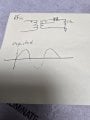
I input the sine wave into the transformer's pin 1, the primary dot. Pin 2, secondary dot, gets connected to the Zener diode, forward biased, and then the other end of the diode to the 1k resistor which is then grounded, pins 7 and 8 on the transformer are also grounded.

On my oscilloscope the signal does not get modified at all, I see the same output voltage with a unaffected sine wave. I changed the Zener diode to a rectifier diode. Is the signal too fast for switching? am I not using the correct transformer? or should I try a different type of circuit for this application?

Any suggestions are welcomed. Thanks.
 

Attachments

MrAl

Joined Jun 17, 2014
13,667
Hello,

I have been experimenting with half wave rectifiers but I am having an issue and would like to see if anyone can help me troubleshoot it, or if I am completely wrong and need a different circuit.

I want to only let positive voltage go through my circuit and get rid of all the negative. I am using a signal generator to output a 15MHz sine wave at about 3dBm I then send that through an amplifier with a 34dB gain. I use attenuators to only output a max of 20dBm for testing.

I started reading on half and full wave rectifiers and I thought I would experiment a bit. So what I did was use a transformer, TMO-1-1T+, a Zener diode and a 1k resistor.

I input the sine wave into the transformer's pin 1, the primary dot. Pin 2, secondary dot, gets connected to the Zener diode, forward biased, and then the other end of the diode to the 1k resistor which is then grounded, pins 7 and 8 on the transformer are also grounded.

On my oscilloscope the signal does not get modified at all, I see the same output voltage with a unaffected sine wave. I changed the Zener diode to a rectifier diode. Is the signal too fast for switching? am I not using the correct transformer? or should I try a different type of circuit for this application?

Any suggestions are welcomed. Thanks.
Hi,

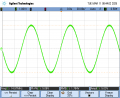
Just to be sure, I'd like to see the waveforms on the input AND output of the transformer with and without any load or any diodes.
Then if that all looks ok, you have to use the right diode.
 

Thread Starter

ltorres

Joined Oct 17, 2024
25
Hi,

Just to be sure, I'd like to see the waveforms on the input AND output of the transformer with and without any load or any diodes.
Then if that all looks ok, you have to use the right diode.
Input, going into pin 1scope_5.png
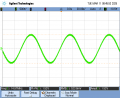
Output, coming out of pin 2 before the diode/resistor. (nothing was attached)scope_6.png
This is just for experimenting and trying to make this work. The end goal is different, I want to see how this half wave rectifier would work.
 

Thread Starter

ltorres

Joined Oct 17, 2024
25
We would suggest you better solution of you can tell the expected ampere " current" at that doide?
I am not really sure at this point maybe a few milliamps. In further experiments I would need to drive a laser diode with a threshold current of about 30+ mA
 

MrAl

Joined Jun 17, 2014
13,667
Input, going into pin 1View attachment 344288
Output, coming out of pin 2 before the diode/resistor. (nothing was attached)View attachment 344289
This is just for experimenting and trying to make this work. The end goal is different, I want to see how this half wave rectifier would work.

Hi,

Are you saying that the output is only about 1.5 volts peak to peak? That's only about 0.75 volts peak, which is going to be kind of hard to rectify even with a Schottky. You might get some output but it's not going to be the full 0.75v peak because the diode(s) will drop some of that voltage, and it could be a lot.

What is your intended load going to be in the end?

I would look into the Zetex line of Schottky diodes. They seem to have the lowest voltage drop. I've seen some as low as 0.2 volts.
They were acquired by another company at some point.
 

MisterBill2

Joined Jan 23, 2018
27,164
I see at least one immediate problem, which is capacitive coupling.
A second problem is the frequency, which I did not see mentioned.
Consider that a diode has some capacitance across the PN junction, and at voltages lower than what is required to cause conduction that capacitance is the major actor in coupling the two ends of the diode.
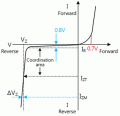
A zener diode will not conduct in either the forward direction or in the reverse direction, below some voltage. Nor most other diodes.
AND, besides all of that, there are response time issues. Nothing in electronics happens "instantly", unless you are using a mechanical stopwatch to measure the time.
 

crutschow

Joined Mar 14, 2008
38,316
After some LTspice simulations, it would appear that you may need to use a detector diode with low capacitance (i.e. <1pF) specifically made for such RF frequencies.
 

Thread Starter

ltorres

Joined Oct 17, 2024
25
Hi,

Are you saying that the output is only about 1.5 volts peak to peak? That's only about 0.75 volts peak, which is going to be kind of hard to rectify even with a Schottky. You might get some output but it's not going to be the full 0.75v peak because the diode(s) will drop some of that voltage, and it could be a lot.

What is your intended load going to be in the end?

I would look into the Zetex line of Schottky diodes. They seem to have the lowest voltage drop. I've seen some as low as 0.2 volts.
They were acquired by another company at some point.
Ok thanks for the input.

I actually need a much faster response I would like to eventually have a rectifier that works with 80MHz, if that is even possible or maybe I need to go a different route.

This was the output just from a function generator into the transformer, I just wanted to see how the circuit ran. The input will go through an amplifier and will end up getting much more voltage in the 10-15V range.
 
Top