Full bridge inverter with charger

Thread Starter

Joeadeoye

Joined Apr 2, 2017
49
I made an inverter using the full bridge mosfet configuration which worked perfectly. I used transformer 7v-220v for the inverter with a 12v battery, which is a common practice with a pure sine wave inverter.

Now, I want to add a charging circuit, in the sense that, the same transformer that is used for inverting will be used for the charging.

As we all know, a typical battery charger will consist of just the transformer, bridge rectifier and possibly some capacitors to smoothen the current.
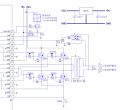
FTCLMPNKGXP5EOX (1).png

With the full bridge mosfet configuration, if I send 220v AC mains to the 220v side of the transformer, the body diode of the full bridge mosfets automatically forms a bridge rectifier, the input filter capacitors automatically becomes smoothing capacitors for the incoming rectified current which automatically charges the battery.

Now here is the question, since the transformer is 7v-220v and the battery is 12v, if 220v AC is applied to the transformer, the rectified voltage at the other side will be 7v DC which will not be sufficient to charge a 12v battery.

So, how can I make the same transformer to charge the inverter battery? FTCLMPNKGXP5EOX (1).png
 

Thread Starter

Joeadeoye

Joined Apr 2, 2017
49
The (not so simple) way is to not use the diodes in the mosfets unless you can make them into a voltage doubler circuit. More later.
Thanks for the reply, do you mean I should multiply the voltage before rectifying it? If I do that, will I get upto the required current (20A) for charging the battery?
 

Dodgydave

Joined Jun 22, 2012
11,395
Thanks for the reply, do you mean I should multiply the voltage before rectifying it? If I do that, will I get upto the required current (20A) for charging the battery?
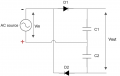
No, if you double the voltage, then you will half the current, a voltage doubler uses two capacitors and two diodes used as a bridge rectifier.

Screenshot 2021-12-01 at 14.55.25.png
 

Ian0

Joined Aug 7, 2020
13,097
The way it is done is to use the MOSFETs as a boost converter.
T1 is designed with a certain amount of leakage inductance. As an inverter, this inductance along with C22 forms a 2nd order filter which turns the PWM into a sinewave. Effectively, it is a buck regulator.
To make it into a charger the buck must become a boost, with the leakage inductance of T1 as the energy storage component.
I don't know if it would be possible with the feedback mechanisms in the IC that you are using.
 

MisterBill2

Joined Jan 23, 2018
27,186
The way it is done is to use the MOSFETs as a boost converter.
T1 is designed with a certain amount of leakage inductance. As an inverter, this inductance along with C22 forms a 2nd order filter which turns the PWM into a sinewave. Effectively, it is a buck regulator.
To make it into a charger the buck must become a boost, with the leakage inductance of T1 as the energy storage component.
I don't know if it would be possible with the feedback mechanisms in the IC that you are using.
As Ian states, simply using the buck regulator boost in the opposite direction may not be possible, and certainly would not be simple.
I suggested creating a voltage doubler for charging because it is not reasonable that any simple scheme to rectify a 7 volt AC source will provide a high enough voltage to charge a 12 volt battery. Recall that charging a battery requires forcing current back into it. That is how charging works. AND, doubling the voltage will indeed reduce the current available, because it can not increase the power.
 

Thread Starter

Joeadeoye

Joined Apr 2, 2017
49
As Ian states, simply using the buck regulator boost in the opposite direction may not be possible, and certainly would not be simple.
I suggested creating a voltage doubler for charging because it is not reasonable that any simple scheme to rectify a 7 volt AC source will provide a high enough voltage to charge a 12 volt battery. Recall that charging a battery requires forcing current back into it. That is how charging works. AND, doubling the voltage will indeed reduce the current available, because it can not increase the power.
The main transformer can comfortably handle upto 50A current in the 7v winding. Lets assume I am able to get 7v AC with 50A current, if I apply this to the voltage multiplier circuit and I get 14v (for example), can I get upto 20A current output?

Because, I know the capacitors in that circuit arranged in series with the voltage from the transformer is what doubles the voltage, and as far as I know, I don't think a capacitor can give me upto that 20A current I'm looking for (I stand to be corrected).
 

MisterBill2

Joined Jan 23, 2018
27,186
Full wave voltage double circuits current delivery are limited by the rating of the diodes, the capacitance and power ability of the capacitors, as well as the ability of the load to accept power. Charging a 12 volt battery at a lower than 20 amp rate is usually a better choice. UNLESS YOU ARE IN A REAL HURRY!!!
The 20 amps charging current may require a greater voltage to force that much current to flow.
Because the larger capacity batteries are not cheap, I have not experimented to see how much abuse it takes to shorten the battery life.
 

Ian0

Joined Aug 7, 2020
13,097
Agreed. You shouldn't be charging a battery at any more than C/5, so more than 20A is not a good idea unless the battery is more than 100Ah.
 

Thread Starter

Joeadeoye

Joined Apr 2, 2017
49
The way it is done is to use the MOSFETs as a boost converter.
T1 is designed with a certain amount of leakage inductance. As an inverter, this inductance along with C22 forms a 2nd order filter which turns the PWM into a sinewave. Effectively, it is a buck regulator.
To make it into a charger the buck must become a boost, with the leakage inductance of T1 as the energy storage component.
I don't know if it would be possible with the feedback mechanisms in the IC that you are using.
Can you please show a schematic to demonstrate how it is done?
 

Thread Starter

Joeadeoye

Joined Apr 2, 2017
49
Agreed. You shouldn't be charging a battery at any more than C/5, so more than 20A is not a good idea unless the battery is more than 100Ah.
The battery I'm using is a 220AH tubular battery, which is why I chose 20A as the charging current.
 

Thread Starter

Joeadeoye

Joined Apr 2, 2017
49
Full wave voltage double circuits current delivery are limited by the rating of the diodes, the capacitance and power ability of the capacitors, as well as the ability of the load to accept power. Charging a 12 volt battery at a lower than 20 amp rate is usually a better choice. UNLESS YOU ARE IN A REAL HURRY!!!
The 20 amps charging current may require a greater voltage to force that much current to flow.
Because the larger capacity batteries are not cheap, I have not experimented to see how much abuse it takes to shorten the battery life.
The battery I am using is 220AH, and I have some commercial inverters that charges this battery at 30amps and 40amps (can be configured). If charging this battery at current lower than 20amps, might take forever to complete charging because using the commercial inverter to charge the same battery at 30amps take roughly 4 - 5hrs to complete charging
 

MisterBill2

Joined Jan 23, 2018
27,186
Certainly charging a battery at a higher current will charge it in less time. I never addressed the time that charging takes.. My comment was about battery lifetime as far as being able to deliver a useful amount of power after each charging. Faster charging puts more stress on a battery. I once fried a quite expensive battery that way, by putting it in my van, which charged at a rate high enough that the $200 battery failed in less than a month. That was a rather expensive lesson, since it was my money involved.
 

Thread Starter

Joeadeoye

Joined Apr 2, 2017
49
Certainly charging a battery at a higher current will charge it in less time. I never addressed the time that charging takes.. My comment was about battery lifetime as far as being able to deliver a useful amount of power after each charging. Faster charging puts more stress on a battery. I once fried a quite expensive battery that way, by putting it in my van, which charged at a rate high enough that the $200 battery failed in less than a month. That was a rather expensive lesson, since it was my money involved.
So sorry about that my brother.
 

Thread Starter

Joeadeoye

Joined Apr 2, 2017
49
Do you know how a normal buck regulator works (with one transistor and one diode)?
Do you mean buck converter? Yes, I know how it works. It reduces voltage and increase current. Output voltage can be controlled by duty cycle of the timer IC switching the transistor
 

MisterBill2

Joined Jan 23, 2018
27,186
I still see issues with the seven volt winding. I am missing how seven volts into an "H bridge" is going to charge a 12 volt battery, which requires a least 14 volts.
 

Ian0

Joined Aug 7, 2020
13,097
Do you mean buck converter? Yes, I know how it works. It reduces voltage and increase current. Output voltage can be controlled by duty cycle of the timer IC switching the transistor
Right.
Replace the diode by another MOSFET, which is on when the main MOSFET is off and vice versa so that the second MOSFET conducts when the diode would normally conducts
You will see that the function of the circuit remains the same, except that we don't have the voltage drop across the diode.
That's a synchronous buck regulator. The output voltage is the input voltage multiplied by the duty cycle, just the same.

However, there is a subtle difference.
The diode only allowed current to flow one way. If the output voltage was held above d.Vin then no current flows.
With a synchronous circuit, if the output voltage is above d.Vin, then current flows the other way, from load to supply
and it becomes a boost regulator.
 
Top