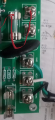
Have you checked that the bridge rectifier and C45 are inserted the correct way round ? Which version do you have ? (Standard or high power.) What output voltage is the transformer that you used ? What is the value and voltage rating of C45 ? The capacitor in the high power version is being run right on the limit of it's voltage rating. (Voltage rating 100 volts. Peak voltage 99 volts) and the standard version is running the capacitor above it's voltage rating. (Voltage rating 63 volts. Peak voltage 67 volts) These voltages could be slightly higher if the load was low or your mains voltage on the high side of nominal. This is bad design practice running components right on the limit or above.
The picture in post #11 shows an AC line connected to the board itself. Are you using an external transformer or are you putting this transformer on the board? Also, look at the picture where the white wire connects to the neutral terminal. Just left of that are some jumpers (labeled JMP2, JMP4 and JMP{can't read}). It's possible they select between 120 VAC and 240 VAC. You said you're running 120 VAC, so if it were mistakenly set up for 240 - that would not hurt the transformer. F41 fuses the power input. F42 fuses the DC input. If you're trying to put the transformer directly to the input (labeled IN- and IN+) you could be dead shorting the transformer, which after a minute or so would cause it to smoke. Those inputs are looking for a DC input. An AC input would be - since AC is positive going one way then negative going - you could be hurting the transformer. At this point we have no idea what that DC input is supposed to be. Some of us may be assuming it's a 12 volt battery backup input, NOT a transformer 12 volt input. And you can't mix AC and DC the way you appear to be attempting to do.
Best advice - if this is a picture of the board - is to put your 120 VAC in at the three terminals at the bottom of the picture exactly the way they've shown it.
The picture in post #11 shows an AC line connected to the board itself. Are you using an external transformer or are you putting this transformer on the board? Also, look at the picture where the white wire connects to the neutral terminal. Just left of that are some jumpers (labeled JMP2, JMP4 and JMP{can't read}). It's possible they select between 120 VAC and 240 VAC. You said you're running 120 VAC, so if it were mistakenly set up for 240 - that would not hurt the transformer. F41 fuses the power input. F42 fuses the DC input. If you're trying to put the transformer directly to the input (labeled IN- and IN+) you could be dead shorting the transformer, which after a minute or so would cause it to smoke. Those inputs are looking for a DC input. An AC input would be - since AC is positive going one way then negative going - you could be hurting the transformer. At this point we have no idea what that DC input is supposed to be. Some of us may be assuming it's a 12 volt battery backup input, NOT a transformer 12 volt input. And you can't mix AC and DC the way you appear to be attempting to do.
Best advice - if this is a picture of the board - is to put your 120 VAC in at the three terminals at the bottom of the picture exactly the way they've shown it.
Tony, see post #17 which shows the schematic. The 70 VAC CT transformer is external to the board and while I agree and pointed it out the board takes an AC input even though it is labeled In + and In - . The AC is shown fused (3 amp) and goes to a full wave bridge followed by a 2 watt bleeder resistor and one or two filter caps depending on what they send. The board does not use any external DC power.
I must be missing something here? How is a fuse on the secondary going to protect the transformer at all???? It will supposedly protect the board but has no protection for the transformer that I can see. To protect the transformer wouldn't the fuse be on the primary of the transformer?
What are the red wires shown plugged into the fuse clip and connected to the input for? Any thing the board needs should be in a PCB trace, not something stuck between the fuse and the fuse holder.
Saw that. However, a schematic is a piece of paper. The picture of the board shows a (probably) 120 VAC line input. As for the plus and minus "IN" puts - - - if AC then why labeled with plus and minus? The schematic can be the wrong revision - or even a different model. Just looking at what is on the board itself leads me to these questions / comments.
After reviewing the schematics in larger portion, able to see detail, the 48 or 70 VAC transformer can be connected to the two inputs. But why label them pos and neg? So assuming this is the right schematic, a burned up transformer on a 3 amp fuse - the rectifier (BR41) may be shorted.
Saw that. However, a schematic is a piece of paper. The picture of the board shows a (probably) 120 VAC line input. As for the plus and minus "IN" puts - - - if AC then why labeled with plus and minus? The schematic can be the wrong revision - or even a different model. Just looking at what is on the board itself leads me to these questions / comments.
I don't know and in my initial comments pointed out that I didn't like the board label where it is clearly an AC input and yes there is also a clearly labeled 120 VAC input and the use of the jumpers is discussed. Most schematics are a piece of paper and most also include Rev levels but in this case all we have to look at is what there is for a schematic and the board images in the book. That is as good as it gets.
The circuit diagram clearly shows that the terminals IN- and IN+ are for an AC supply. A transformer secondary is shown connecting to a bridge rectifier. All standard stuff and easily understood. Except why they chose to label them - and +!
A bird in the hand is worth all the drawings of every bird to ever fly. A picture of the board counts more for me than a schematic that can be incorrect. Nevertheless, the drawing (not picture) shows an AC source connected to a DC labeled input. That may be as intended - but it makes no sense. You COULD have a 48 volt battery as backup. Elementary stuff goes out the window when things don't make sense. Either the BR is shorted or (less likely) the cap is shorted. Never heard of a shorted resistor.
One other thought - what if BR41 is installed backwards? This IS a kit build, and there is no picture of the solder side of the board.
Besides - - - what is this 63V being used for? The board has its main transformer and 12 volt regulator to run the board electronics. I haven't found where 63 volts is applied. I see a "DC_POSITIVE" and a "DRAIN_SUPPLY+". Q8 controls power to L1, which is connected to 4MHz via Q12 to drive the Tesla coil. Could THAT be where the higher DC voltage is going?
@DesertCrawler
Stop what you're doing. You simply don't know enough. That's not a bad thing, we all started there. Don't throw the kit away, keep it. Keep everything. So you can come back to it when you do know enough. I suggest this book to start:
Title: Understanding Basic Electronics, 1st Ed.
Publisher: The American Radio Relay League
ISBN: 0-87259-398-3
Beyond that, this is definitely NOT a beginner project. For one thing, it is way, way, too dangerous. You don't even know how to use a DVM, you could get killed if you get this thing to work. I think you're being sent a message- stop before you hurt yourself.
Start with some simpler projects, a breadboard, some components, learn what you can do and get comfortable with understanding the DC environment before you even try to work with AC. You're fighting too many battles right now, and it can get your hurt. Just be patient, learn and come back to the Tesla Coil project when you're really ready.
The thread starter was already asked about that. Did you read everything covered before you got here? The use of the plus and minus signs was questioned early on also. Now all anyone has to work with is the board drawing and schematic posted, that's all there is. That is also likely as good as it gets.
Also, two of us have mentioned jumpers. The TS 's only response was to the effect of what's a jumper. He needs to review that part of the manual and check his construction. Connecting all 4 jumpers could result in smoke.
Also, two of us have mentioned jumpers. The TS 's only response was to the effect of what's a jumper. He needs to review that part of the manual and check his construction. Connecting all 4 jumpers could result in smoke.

 Facebook
 Google
 GitHub
 Linkedin