Facebook
 Google
 GitHub
 Linkedin
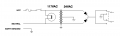
Hello, very new amateur here. Most of my experience is with guitar effects pedals, which I've generally had good success with or been able to troubleshoot myself. Recently, I built an AC/DC power supply for salt water etching aluminum pedal enclosures, which I got the "schematic" for from the knife forging community. I wired everything up and tested it out on a piece of scrap aluminum and it seemed to work perfectly for about 5 minutes, until I noticed the machine smoking. It did etch, but now the fuse blows immediately so I'm pretty sure the transformer is fried. I'm used to working with PCBs, mostly passive components and following a more detailed/formal schematic; so I'm not exactly sure where I went wrong or even how to go about troubleshooting this since the transformer is shot and much more expensive to replace than the little transistors and diodes I've killed before.
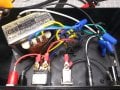
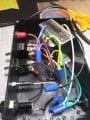
It's a pretty simple circuit and I'm fairly confident I had it wired correctly, since it did etch the metal, but I could be wrong. I can't see any obvious shorts in the circuit (no exposed wires/components touching). I did use a slightly different transformer than the original did, since the original was out of production, but as far as I can tell from the datasheets, the only difference is that mine was rated at 3A instead of 2A (both were 24v center tapped 0-117 primary 12-0-12 secondary). I'm thinking my problem may have been with the physical grounding of the transformer. I wired the center lug of the secondary side to the ground from the power cable and to a wire which I soldered to the base of the transformer, which is steel. It was much more difficult to get the solder to stick because of some sort of coating, so I ended up filing the steel a bit and eventually got it to stick. My thinking is that I didn't have a good connection and therefore wasn't properly grounded. I'm guessing I should have gotten the multimeter out and checked before just firing it up.
So, my questions are:
1) Would this have caused the transformer to overheat and fry? Or could something else have caused this?
2) If my soldering was to blame, should I have used a different solder (I used either 60/40 or 63/37 tin lead w/rosin core) or another connection entirely? Or just improve my soldering technique? (Never had any issues with PCBs, but the thicker steel chassis is a new material for me)
I am very much early amateur level and I'm probably jumping ahead in terms of the difficulty level of the projects I'm trying to tackle. I do have some books I'm working through and have been able to trouble shoot issues with guitar pedals by reading and looking over schematics, but I know I should probably do a little more homework before getting into these bigger projects. I've tried Google, but it seems like all of the resources I find are about much larger transformers related to building wiring and the knife making community where I found this project has limited electrical experience. Any input, advice, or even just recommendations for resources and teaching myself more about electronics would be greatly appreciated!
It's a pretty simple circuit and I'm fairly confident I had it wired correctly, since it did etch the metal, but I could be wrong. I can't see any obvious shorts in the circuit (no exposed wires/components touching). I did use a slightly different transformer than the original did, since the original was out of production, but as far as I can tell from the datasheets, the only difference is that mine was rated at 3A instead of 2A (both were 24v center tapped 0-117 primary 12-0-12 secondary). I'm thinking my problem may have been with the physical grounding of the transformer. I wired the center lug of the secondary side to the ground from the power cable and to a wire which I soldered to the base of the transformer, which is steel. It was much more difficult to get the solder to stick because of some sort of coating, so I ended up filing the steel a bit and eventually got it to stick. My thinking is that I didn't have a good connection and therefore wasn't properly grounded. I'm guessing I should have gotten the multimeter out and checked before just firing it up.
So, my questions are:
1) Would this have caused the transformer to overheat and fry? Or could something else have caused this?
2) If my soldering was to blame, should I have used a different solder (I used either 60/40 or 63/37 tin lead w/rosin core) or another connection entirely? Or just improve my soldering technique? (Never had any issues with PCBs, but the thicker steel chassis is a new material for me)
I am very much early amateur level and I'm probably jumping ahead in terms of the difficulty level of the projects I'm trying to tackle. I do have some books I'm working through and have been able to trouble shoot issues with guitar pedals by reading and looking over schematics, but I know I should probably do a little more homework before getting into these bigger projects. I've tried Google, but it seems like all of the resources I find are about much larger transformers related to building wiring and the knife making community where I found this project has limited electrical experience. Any input, advice, or even just recommendations for resources and teaching myself more about electronics would be greatly appreciated!
Attachments
-
62.8 KB Views: 24
-
 4.5 MB Views: 20
 -
 1.9 MB Views: 20