Energy from reciprocating beam

Thread Starter

JulesP

Joined Dec 7, 2018
458
I think it's a step in the right direction too if we have excess energy for solar or wind that can't be more efficiency stored or used by other means like smart-grids, pumped hygro or large scale batteries. At large energy scales the low efficiency solutions become environmental problems of concentrated heat waste because heat engine efficiency is fundamentally limited.
So there is likely to be waste heat that could be captured and used effectively.
 

Alec_t

Joined Sep 17, 2013
15,121
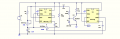
Here's my suggested 555-based timer which simulation says should cover both the required frequency range and duty-cycle range.

IndependentFreq&Duty_555based.PNG
 

nsaspook

Joined Aug 27, 2009
16,330
So there is likely to be waste heat that could be captured and used effectively.
Yes there will be but it's turtles all the way down to nothing. The real solution is efficiency in energy conversion (in things like advanced batteries) so you don't have excess heat at any step in the process to recover with limited efficiency.
 
Last edited:

MrAl

Joined Jun 17, 2014
13,709
Generating electricaql energy from a slow moving object will be a challenge in efficiency because rate of change is a first order variable in the formula. That was my reason for suggesting a fluid pumping arrangement, which does not depend on speed so much.
That's actually what is used in some wave energy converters used to extract energy from ocean waves.
The up and down movement is utilized in these mechanisms similar to what one end of the beam will do.
 

MisterBill2

Joined Jan 23, 2018
27,584
I have been trying to visualize a method of directly driving that beam mechanism with wind. I have not had much success yet. At that point it would be capturing free energy. Not perpetual motion, but none-fuel based energy.
 

Thread Starter

JulesP

Joined Dec 7, 2018
458
I have been trying to visualize a method of directly driving that beam mechanism with wind. I have not had much success yet. At that point it would be capturing free energy. Not perpetual motion, but none-fuel based energy.
A good idea but I think the wind where I live can be so strong that it would rip my mecanno model apart :|
 

MisterBill2

Joined Jan 23, 2018
27,584
A good idea but I think the wind where I live can be so strong that it would rip my mecanno model apart :|
Nothing on this site provides me with any clue as to where you are located. Possibly a small vane that would vary between two positions, moving the weight back and forth. I have had things like that oscillate in the wind, I don't recall exactly how they were arranged, and the oscillation was never welcomed.
 

Thread Starter

JulesP

Joined Dec 7, 2018
458
Nothing on this site provides me with any clue as to where you are located. Possibly a small vane that would vary between two positions, moving the weight back and forth. I have had things like that oscillate in the wind, I don't recall exactly how they were arranged, and the oscillation was never welcomed.
West Cornwall where the wind has come all the way across the Atlantic. I have solar panels and often thought of adding wind power but I’d be forever adjusting the blades to offset the often high speed.
 

MisterBill2

Joined Jan 23, 2018
27,584
OK on that location. I have never been there and I am not familiar with the wind situation. But with a generally high wind there can be enough power available to spin an automotive style alternator, which can live with speeds of at least 5000 RPM. So you would not need to have the blades adjusted to control the speed. A feedback circuit can adjust the field current to maintain a constant output voltage.. A transformer can step up the AC output and then a cyclo-converter can change the high frequency AC into the standard 50Hzused in the UK area. All of the technology in this approach is fully matured and so nothing new and wonderful would need to be invented. The efficiency would be less than the maximum possible but that means that you would need to catch more wind. And since wind is evidently quite plentiful there that should not matter much.
 

Thread Starter

JulesP

Joined Dec 7, 2018
458
OK on that location. I have never been there and I am not familiar with the wind situation. But with a generally high wind there can be enough power available to spin an automotive style alternator, which can live with speeds of at least 5000 RPM. So you would not need to have the blades adjusted to control the speed. A feedback circuit can adjust the field current to maintain a constant output voltage.. A transformer can step up the AC output and then a cyclo-converter can change the high frequency AC into the standard 50Hzused in the UK area. All of the technology in this approach is fully matured and so nothing new and wonderful would need to be invented. The efficiency would be less than the maximum possible but that means that you would need to catch more wind. And since wind is evidently quite plentiful there that should not matter much.
We have our quiet times especially in the summer but variable energy production does ideally require some storage system. Alternatively a suitable feed in system to the grid that would require up front investment. Perhaps when my 20 year feed in tariff for British Gas finishes in 8 years I may need to look into that. :)
 

shortbus

Joined Sep 30, 2009
10,050
It is not cute, not friendly, just disruptive bad actors attacking someone trying to improve a 2 stage oscillator model.
The forum suffers from their wrongful activity of disruption resulting in people get tired of them and leave the forum.
There are trolls and their activity can be seen on this thread.
If that was meant for me I accept. But the real people trolling the TS are those egging him on. While the mechanism can and does store some potential energy, it can not do any kinetic energy/work. And many people on the web agree with me. If you take time to actually read the many postings out there. Once you try to remove any energy, it stops fairly fast. It's a toy like the Newtons cradle nothing more or nothing less.
 

MisterBill2

Joined Jan 23, 2018
27,584
The TS was not chasing after some goofy concept, but did at one point comment that this was "an investigation", apparently prompted by claimed boredom. As such, it did provide a chance for some thinking in areas that I had not considered before. The fact that it does not appear to be very practical in the suggested application is secondary to the insights gained while investigating.
Then, consider also that the original request was to help with developing a speed control circuit that delivered better control than the one he was using.
So this thread was more interesting than those of some poor individual who has burned all of the traces off a circuit board and is now seeking advice on how to fix it. We have had that thread a few times here.
 

MisterBill2

Joined Jan 23, 2018
27,584
The concept of synchronicity is sometimes avoided because the addition of electronic
knowledge raises the slope of the learning curve. By having a choice of monostable or astable mode
and allowing for a more intuitive feel when these modes are a benefit then the chances are in favor of
adopting a remedy.

I recall wondering how, after getting a late start, the kid caught up but then had the big struggle to keep up. Why was it that he was able to go faster to catch up but then not able to go faster to leave them all behind? That never made any sense at all.
 

Thread Starter

JulesP

Joined Dec 7, 2018
458
Make them self-feathering.
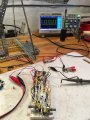
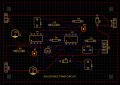
I have built the fully adjustable timer circuit on breadboard, and designed a PCB for it (see attached), and it works fine, except that the frequency is not very stable and for my application of pulsing a pendulum it needs to remain stable or it goes out of sync after 10 or so swings.

For example, it stays at 1.162 Hz for 5 sec and then jumps to 1.4 for 2 sec and then back to 1.162Hz. That is enough to upset the syncing over time. I expect the 555 is better at higher frequencies but there might be something I can do.

Is there any way to improve stability, such as switching the timer capacitor (C1) to a ceramic or polymer one? I also imagine that the pots, which 'travel' 50k or 500k in only 4 complete turns also make it hard to maintain stability.

Thanks
 

Attachments

MisterBill2

Joined Jan 23, 2018
27,584
The timing of a 555 depends on both component values and supply voltage, and the triggering also depends on a stable voltage. A large filter capacitor across the IC supply, and usin a regulated supply for the timer will help. Any voltage noise can have an effect on the triggering, and so it is useful to have a separate power feed for the timer.
On the circuit board, since there are multi-pin power connectors already, I suggest separate pins and traces for the motor power circuit. Even the best DC motors create some power circuit noise that can affect other parts of the system. The connections to C1 seem to be sharing a current path with other elements, but not having the circuit visible now that may not be an issue.
I do suggest making the negative common trace as wide as is reasonable since lower ground impedance reduces unintended coupling.
 
Top