Inductor energy calculation

Thread Starter

Vihaan@123

Joined Oct 7, 2025
220
1768836894817.png
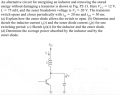
I was able to get started with the problem with the previous exercises i have done, i am struck up at one point
During ON time when the transistor is ON
The inductor equation is V = L di/dt;
V = 12V; L = 75mH; t = 20ms
iL = 12*20*10^-3/75*10^-3 Amps = 3.2A;
when the transistor is OFF
The current has to be continuous, so the inductor voltage has to change to maintain that current. I am unable to find this voltage, if i attempt
use the KVL equation
Vcc - VL - Vz = 0;
VL = Vcc - Vz
(Vcc - Vz) = 75*10^-3 * 3.2/50*10^-3;
I get Vz = 7.2V but the zener diode is not reverse biased, I am struck up here.
 

WBahn

Joined Mar 31, 2012
32,702
View attachment 362368
I was able to get started with the problem with the previous exercises i have done, i am struck up at one point
During ON time when the transistor is ON
The inductor equation is V = L di/dt;
V = 12V; L = 75mH; t = 20ms
iL = 12*20*10^-3/75*10^-3 Amps = 3.2A;
Other than not tracking units -- which is going to bite you -- this is fine. But do you understand where and how that final equation comes from? Or are you just throwing numbers at an equation?

when the transistor is OFF
The current has to be continuous, so the inductor voltage has to change to maintain that current. I am unable to find this voltage, if i attempt
use the KVL equation
Vcc - VL - Vz = 0;
VL = Vcc - Vz
(Vcc - Vz) = 75*10^-3 * 3.2/50*10^-3;
I get Vz = 7.2V but the zener diode is not reverse biased, I am struck up here.
And this is why I suspect you are just throwing numbers at equations without understanding where they came from.

When the switch is ON, you have a constant voltage across the inductor of Vcc and you want to find i(t) as a function of time. That means solving the differential equation

\(
V_{CC} \; = \; L \frac{di}{di}
\)

which yields

\(
i \left( t \right) \; = \; \frac{V_{CC}}{L}t \; + \; I_0
\)

Where Io is the current in the inductor at the beginning of the ON period.

This is assuming that the Vce of the transistor is 0 V

Assuming (an assumption that must be verified) that the initial current is zero, then the current at T_ON is

\(
i \left( T_{ON} \right) \; = \; \frac{V_{CC} \cdot T_{ON}}{L} \\
i \left( T_{ON} \right) \; = \; \frac{12\;V \cdot 20\;ms}{75\;mH}
\)

The units of inductance can be obtained directly from the constitutive equation which shows that it has units of voltage·time/current, or

\(
1\;H \; = \; \frac{Vs}{A}
\)

Which gives us

\(
i \left( T_{ON} \right) \; = \; \frac{12\;V \cdot 20\;ms}{75\;mH} \\
i \left( T_{ON} \right) \; = \; \frac{12\;V \cdot 20\;ms}{75\;\frac{mVs}{A}} \\
i \left( T_{ON} \right) \; = \; 3.2\;A
\)

But it's important -- critical -- to understand that this equation for current as a function of time is only valid for the conditions under which it was obtained, namely that the voltage is held constant throughout the entire time from t=0 to t=T_ON.

It is NOT some general equation that is always true.

But, during the interval that the transistor is off, you are just grabbing that equation and insisting that it must always be true.

But think about this -- that means that the voltage across the inductor is a constant that depends on how long the transistor is off T_OFF. Does that make any sense at all? This would require that the inductor has some way of knowing, in advance, how long the transistor is going to be off so that it can set the voltage across itself accordingly from the moment that the transistor is switched off?

You have to apply reasoning to the problem and develop the equations that result instead of just finding the nearest equation that seems to have the right variables and throwing values at it.

You are correct that, when the transistor turns off, that the current must be continuous across that event. But what are the consequences of that? Where does that current go? If the current goes there, what does that mean for the voltage across that device? Does that voltage remain constant at that level for the entire time that the transistor is off? If not, what determines when it changes? What does it change to? What happens if the transistor turns back on before that happens?

These are the engineering questions that you need to evaluate before you are in a position to know which equations apply.
 

Thread Starter

Vihaan@123

Joined Oct 7, 2025
220
After thinking the below would be the logic
1. As soon as the transistor will be OFF to keep the current continuous the inductor will generate very high voltage and once it goes beyond 20V the zener breakdown voltage the lower side of the inductor will be clamped to 20V.
2. During the off duration of 50ms a constant voltage of 20V - 12V will be applied across the inductor.
3. Since the voltage is constant i can apply the Inductor equation
i(t) = (Vcc - Vz)*t/L + I0; ->1
i(t) = 3.2A - ((8V*t ms) / (75*10^-3 H)) ; ->2 linear decrease of current
When current through zener diode is 0 it will come out of break down region.
i(t) = 0 then calculating the time
0 = 3.2A - 8 V *t ms/ 75 mH
t = 30ms.
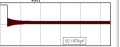
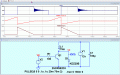
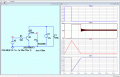
Between 30ms to 50ms the zener is reverse biased, transistor is OFF, only question is it kind of grounds floating? Till this time it is matching with simulation results.
1768885403365.png
Is this a floating voltage?
 

Thread Starter

Vihaan@123

Joined Oct 7, 2025
220
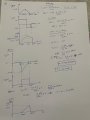
The power calculation is attached i hope it is correct.
InductorEnergy.jpeg
During the period from 0 to 20ms the inductor is storing energy and during 20ms to 50ms the inductor is releasing energy and that energy is dissipated in the zener diode, is my explanation correct, but i feel the energy released by the inductor is less compared with the energy the zener is dissipating, i need to check again.
 

MrAl

Joined Jun 17, 2014
13,667
The power calculation is attached i hope it is correct.
View attachment 362424
During the period from 0 to 20ms the inductor is storing energy and during 20ms to 50ms the inductor is releasing energy and that energy is dissipated in the zener diode, is my explanation correct, but i feel the energy released by the inductor is less compared with the energy the zener is dissipating, i need to check again.
Hi,

Where did that -8v come from?

To calculate the power in the zener you first have to calculate how long the inductor discharges into the zener. Since Vcc-Vz is constant, the inductor discharges in a linear way just like when it was charging. The first question is, how long does it take for the inductor current to reach zero.

The volt seconds rule helps a little here. For the inductor, the volt seconds in equals the volt seconds out:
Vin*Tin=Vout*Tout
The volt seconds in is 12v times 0.020 which equals 0.24 volt seconds. From that you can calculate the time it takes to discharge.
Now since it charged for 20ms at 12v, when it discharges with 20v, it will take less time. Calculate that time first.
You can then calculate the same using the inductor definition and compare results.

Once you have the right discharge time, you can calculate the power in the zener, and then the energy dissipated.

You have to be a little careful with simulations using zener diodes because spice zeners usually mimic real zeners better than just a set voltage like 20v. The conduction voltage can range from something less than that (like 15v) to something greater than that (like 22v). It is better to use a voltage source for the zener just for the purpose of the simulation until the inductor current hits zero.

If you want to go one step further, see if you can pick a part number for a zener that won't burn up quickly on the first discharge.
 
Last edited:

Thread Starter

Vihaan@123

Joined Oct 7, 2025
220
The -8V is the voltage across the Inductor VCC - Zener Breakdown voltage = 12 - 20 = -8V.
Let me do the power calculations again and I will post.
 

WBahn

Joined Mar 31, 2012
32,702
The power calculation is attached i hope it is correct.
View attachment 362424
During the period from 0 to 20ms the inductor is storing energy and during 20ms to 50ms the inductor is releasing energy and that energy is dissipated in the zener diode, is my explanation correct, but i feel the energy released by the inductor is less compared with the energy the zener is dissipating, i need to check again.
During the discharge period, there are three components in series -- the power supply, the inductor, and the zener diode. The current is always the same direction, just going from 3.2 A down to zero. Thus, the power supply is still providing power to the circuit while the inductor is discharging. The zener has to not only dissipate the energy that was stored in the inductor, but also the energy that was supplied by the supply during the discharge.

The energy stored in the inductor is LI²/2 = 384 mJ

Since the voltages are constant and the current is a linear ramp, we can use the average current over the discharge time to the energy supplied by the source and dissipated by the zener. In either case, the average current is 1.6 A.

The energy delivered to the inductor during the 20 ms charging interval is therefore

E_charge = 12 V · 1.6 A · 20 ms = 384 mJ

If the discharge time is T_discharge, then the zener must dissipate not only the 384 mJ, but also the supplied power at the average current of 1.6 A, at 12 V, for T_discharge.

E_discharge = 384 mJ + (12 V · 1.6 A · T_discharge)

But this is also equal to the average current of 1.6 A times the zener voltage

E_discharge = 20 V · 1.6 A · T_discharge

Equating the two, we can get the discharge time (which you already know is 30 ms from your prior work).

20 V · 1.6 A · T_discharge = 384 mJ + (12 V · 1.6 A · T_discharge)

8 V · 1.6 A · T_discharge = 384 mJ

T_discharge = 384 mJ / (8 V · 1.6 A) = 30 ms

Your power calculations indicate that you are still throwing numbers at equations without considering what those equations mean.

You also seem to be confusing power and energy. They are NOT the same thing.

P(t) is an instantaneous quantity. At 50 ms, the current is zero and so the power in everything has dropped to zero -- just like it was zero in everything at t=0 at the beginning of the charging cycle.

The power being delivered to the inductor during the charge cycle ramps from 0 W at t = 0 and to 38.4 W at t = 20 ms. During the discharge is starts at -25.6 W at t = 20 ms and goes to 0 W at t = 50 ms.
 

WBahn

Joined Mar 31, 2012
32,702
Hi,

Where did that -8v come from?

To calculate the power in the zener you first have to calculate how long the inductor discharges into the zener. Since Vcc-Vz is constant, the inductor discharges in a linear way just like when it was charging. The first question is, how long does it take for the inductor current to reach zero.

The volt seconds rule helps a little here. For the inductor, the volt seconds in equals the volt seconds out:
Vin*Tin=Vout*Tout
The volt seconds in is 12v times 0.020 which equals 0.24 volt seconds. From that you can calculate the time it takes to discharge.
Now since it charged for 20ms at 12v, when it discharges with 20v, it will take less time. Calculate that time first.
You can then calculate the same using the inductor definition and compare results.

Once you have the right discharge time, you can calculate the power in the zener, and then the energy dissipated.

You have to be a little careful with simulations using zener diodes because spice zeners usually mimic real zeners better than just a set voltage like 20v. The conduction voltage can range from something less than that (like 15v) to something greater than that (like 22v). It is better to use a voltage source for the zener just for the purpose of the simulation until the inductor current hits zero.

If you want to go one step further, see if you can pick a part number for a zener that won't burn up quickly on the first discharge.
Uhm... how is it you are determining that the voltage across the inductor is 20 V during the discharge?

That's the voltage across the zener, but the zener is not in parallel with the inductor. There's a power supply in there, too.
 

MrAl

Joined Jun 17, 2014
13,667
Uhm... how is it you are determining that the voltage across the inductor is 20 V during the discharge?

That's the voltage across the zener, but the zener is not in parallel with the inductor. There's a power supply in there, too.
Hi,

Yes, I looked at it wrong. Since the voltage is 8v that also means the discharge time will actually be longer than the charge time.
The factor is 12/8=1.5 so it is longer.
 

MrAl

Joined Jun 17, 2014
13,667
The -8V is the voltage across the Inductor VCC - Zener Breakdown voltage = 12 - 20 = -8V.
Let me do the power calculations again and I will post.
Hi,

Yes, I looked at it wrong. Since the voltage is 8v that also means the discharge time will actually be longer than the charge time.
The factor is 12/8=1.5 so it is longer as you found. The volt seconds rule written clearer:
Vcharge*Tcharge=Vdischarge*Tdischarge
12*20=8*Tdischarge
(12/8)*20=Tdischarge
30=Tdischarge
so it is 30 units as you found.
This rule works when both the charge and discharge waveforms are ramps.

Usually with these circuits the zener is directly in parallel with the inductance :)
 
Top