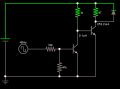
The post #40 circuit will work if the power MOSFET is a logic-level type. If it's not, connect the top 10k resistor to +12V instead of to +5V.
(BTW, when drawing circuits, get into the habit of labelling each component, e.g. R1, R2 etc. It makes it much easier to discuss the circuit.)
Not exactly the same. Your second MOSFET isn’t a logic level MOSFET and hence your pull up resistor is to the solenoid power supply. All MOSFETs in this circuit are logic level and need a lower voltage on the pull up.
The post #41 circuit will work if the power MOSFET is a logic-level type. If it's not, connect the top 10k resistor to +12V instead of to +5V.
(BTW, when drawing circuits, get into the habit of labelling each component, e.g. R1, R2 etc. It makes it much easier to discuss the circuit.)
My point was that it is easier to invert the signal polarity in software (since it is custom software already) than adding external parts, no matter how few.
Place 100Ω resistor between the APM output and the 2N7000 gate, with a 10kΩ resistor from the 2N7000 gate to ground.
Better to move the load to the drain so the FET acts as a saturated switch rather than a source follower. The follower configuration will decrease the voltage across the load by several volts.
AND, now the uC output has to swing up to +12 V to turn off the FET. Not good.
The post #41 circuit will work if the power MOSFET is a logic-level type. If it's not, connect the top 10k resistor to +12V instead of to +5V.
(BTW, when drawing circuits, get into the habit of labelling each component, e.g. R1, R2 etc. It makes it much easier to discuss the circuit.)
If you want to stay with the low=on / high=off logic polarity, then two NPN transistors in series will work. The second transistor is the load driver, emitter to GND, collector to the load, load to +12 V.
My point was that it is easier to invert the signal polarity in software (since it is custom software already) than adding external parts, no matter how few.
We don’t know enough about the device providing the signal. Hence, a 100Ω resistor protects the APM.
It is a fairly common practice to use pull-up or pull-down resistors on MOSFET gates. Do you believe they are unnecessary?
Also, the software may not be accessible on the APM. I suggested a software solution earlier in this thread. But it appeared to not be a viable solution and hence I concentrated on solving the issue in hardware.
To use BJT transistors, you’d still need two in series. And they’d require base resistors. You’d need the maximum current draw of the solenoid as well as the voltage into the base. Divide the current by 10 or 20. Then, given the base voltage and the calculated current, use Ohm’s law to calculate the base resistor. Repeat for the first transistor, using the calculated current (/10) and divide it by 10 or 20 again. Repeat applying Ohm’s law to get the second base resistor value.
Then, there is the whole issue of picking a standard resistance value for each of the calculated resistances.
The MOSFETs simply can use 10kΩ pull-up or pull-down resistors.
And depending on what’s driving the MOSFETs, you may not need that 100Ω resistor. It’s just there to protect your circuitry. And anything from 100Ω to 1kΩ will probably work.
While these resistor values work for many MOSFET circuits, with BJTs the resistance values are fairly critical and must be calculated for each circuit.
Post #1 looks pretty clear to me. The driving signal is a +5 V source, which is way below most power MOSFETs max. Vgs rating of 20 V. Also, as this is not a switching power supply or motor controller that must meet european or MIL EMI rules, I don't think the occasional few microseconds of gate voltage ringing is going to hurt anything so a damping resistor is not necessary.
It is a fairly common practice to use pull-up or pull-down resistors on MOSFET gates. Do you believe they are unnecessary?
In this application, yes. I think the odds are virtually zero that the uC output is an open collector PNP that would require an external pull-down resistor to GND. A pulldown resistor provides no additional functionality, and are a (very) small but unnecessary additional drain on the battery.
To use BJT transistors, you’d still need two in series. And they’d require base resistors. You’d need the maximum current draw of the solenoid as well as the voltage into the base. Divide the current by 10 or 20. Then, given the base voltage and the calculated current, use Ohm’s law to calculate the base resistor. Repeat for the first transistor, using the calculated current (/10) and divide it by 10 or 20 again. Repeat applying Ohm’s law to get the second base resistor value.
Then, there is the whole issue of picking a standard resistance value for each of the calculated resistances.
The MOSFETs simply can use 10kΩ pull-up or pull-down resistors.
And depending on what’s driving the MOSFETs, you may not need that 100Ω resistor. It’s just there to protect your circuitry. And anything from 100Ω to 1kΩ will probably work.
While these resistor values work for many MOSFET circuits, with BJTs the resistance values are fairly critical and must be calculated for each circuit.

 Facebook
 Google
 GitHub
 Linkedin