Electromagnet

ThePanMan

Joined Mar 13, 2020
925
Two things we all need to keep in mind - 1) the TS wants to use the same system as was originally there. But it doesn't seem clear there was ever a working situation. 2) the TS has limited space.

Don't know what ever happened to make the original circuit work (or not work). When we don't know enough information some of us start thinking outside the box. OR outside the puppet at this point.
 

MrChips

Joined Oct 2, 2009
34,866
Thanks for the info.
Sorry to be a novice but please could you show me which wires need to connect to which to wire in series?

Also, which value resistor would you recommend please?

Thanks in advance
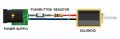
Solenoid power.jpg
This diagram shows how the push-button and resistor are wired in series between the power supply and the solenoid.
Current flows in a loop from the power supply, through the push-button, resistor, solenoid, and back to the power supply.
You can interchange the position of the push-button with the resistor. It will make no difference.

You need to experiment with the value of the resistor that gives the desired current and action of the solenoid.

The current is calculated using,
I = V / R
For example, if V = 12 V, and R = 10 Ω
The current I = V / R = 12 V / 10 Ω = 1.2 A

If we ignore the resistance of the solenoid, the power dissipated by the resistor is,
P = I x V = 1.2 A x 12 V = 14.4 W

As another example, if V = 12 V, and R = 100 Ω
I = V / R = 12 V / 100 Ω = 0.12 A
P = I x V = 0.12 A x 12 V = 1.44 W

You would add the resistance of the solenoid to that of the resistor in the calculations for current.
In that case the power dissipated by the resistor R is,
P = I x I x R
 

Thread Starter

Annie Vaws

Joined May 1, 2026
32
View attachment 367661
This diagram shows how the push-button and resistor are wired in series between the power supply and the solenoid.
Current flows in a loop from the power supply, through the push-button, resistor, solenoid, and back to the power supply.
You can interchange the position of the push-button with the resistor. It will make no difference.

You need to experiment with the value of the resistor that gives the desired current and action of the solenoid.

The current is calculated using,
I = V / R
For example, if V = 12 V, and R = 10 Ω
The current I = V / R = 12 V / 10 Ω = 1.2 A

If we ignore the resistance of the solenoid, the power dissipated by the resistor is,
P = I x V = 1.2 A x 12 V = 14.4 W

As another example, if V = 12 V, and R = 100 Ω
I = V / R = 12 V / 100 Ω = 0.12 A
P = I x V = 0.12 A x 12 V = 1.44 W

You would add the resistance of the solenoid to that of the resistor in the calculations for current.
In that case the power dissipated by the resistor R is,
P = I x I x R
Thank you so much for this detailed and clear explanation. It gives me something to work with. I have a multimeter now so can find out what the resistance of the coil is ans hopefully calculate from there.

Appreciate everyone’s help and suggestions.
 

B-JoJo-S

Joined Jan 3, 2026
342
Here you have it
HANDS ON ELECTRONICS! I'd forgotten about that name. But yes, that's the very article I was thinking of. But those lips are kind of creepy.

Anyway - in accordance with the thread - there are different ways to accomplish the same thing. But for sure testing is the first thing to do. You need to understand what you're working with before you can do any calculations. Once you have the knowledge you can do the engineering. Good luck with your project.
 

MisterBill2

Joined Jan 23, 2018
27,645
The graphic (wiring disgram) in post #66 neglects to show the power supply connection, which is on the left side of that push button module.
I went back to post #1, where the TS tells what they did that does not work as required. Then in post #11 we finally get a statement as to what they are trying to do. Sort of. But still not any statement of the actual requirements of the project, which would be motion distance, motion force, and probably motion speed. From that information a choice could be made about the general arrangement of some device, such as a solenoid or a motor/gear arrangement. No speculation on a device for an unknown application.
 
Last edited:

Thread Starter

Annie Vaws

Joined May 1, 2026
32
So, I have a multimeter now and it’s telling me the coil has a resistance of 680 k ohms. How do I calculate the resistor to purchase for the power circuit please?
Please be gentle!
 

drjohsmith

Joined Dec 13, 2021
1,615
So, I have a multimeter now and it’s telling me the coil has a resistance of 680 k ohms. How do I calculate the resistor to purchase for the power circuit please?
Please be gentle!
Is this the old coil ?
That's very high for a wire of reasonable length .
..have you scratched the insulation off the ends to reveal shiny copper
 

MrChips

Joined Oct 2, 2009
34,866
So, I have a multimeter now and it’s telling me the coil has a resistance of 680 k ohms. How do I calculate the resistor to purchase for the power circuit please?
Please be gentle!
680 k ohms does not sound right.
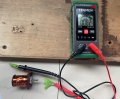
Post a picture showing the coil, meter, and how the meter is connected to the coil
 

Thread Starter

Annie Vaws

Joined May 1, 2026
32
assuming say a very high wire resistance of 1 ohm per meter, thats 680000 meteres of wire on that coil !
Photo attached. I don’t like this multimeter much - bought it off Amazon yesterday - the numbers jump all over the place. It’s probably me but now I am getting a different reading to earlier. The only way I could get a photo was by taping the probes to the wire as I only have one pair of hands.

not sure what to make of it!
 

Thread Starter

Annie Vaws

Joined May 1, 2026
32
Photo attached. I don’t like this multimeter much - bought it off Amazon yesterday - the numbers jump all over the place. It’s probably me but now I am getting a different reading to earlier. The only way I could get a photo was by taping the probes to the wire as I only have one pair of hands.

not sure what to make of it!
 

Attachments

Top