Electromagnet

MrChips

Joined Oct 2, 2009
34,829
82 ohm is more like what I would expect.

I = 12 V / 82 Ω = 0.146 A
P = 12 V x 0.146 A = 1.75 W

That sounds reasonable.

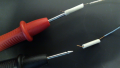
Edit: 680 kΩ is most likely the resistance through your body when you were holding the meter probes with your fingers. The probes were not making contact with the wire of the coil
 

Thread Starter

Annie Vaws

Joined May 1, 2026
32
82 ohm is more like what I would expect.

I = 12 V / 82 Ω = 0.146 A
P = 12 V x 0.146 A = 1.75 W

That sounds reasonable.

Edit: 680 kΩ is most likely the resistance through your body when you were holding the meter probes with your fingers. The probes were not making contact with the wire of the coil
Thank you, that sounds hopeful.

What I don’t get is that the core is identical size to the original, the wire gauge is identical, the diameter and length of the coil is identical, yet the new one measures 82 ohm, the original measures 270-280 (not by me, measured by the owner.

Perhaps he has made a mistake?
 

MrChips

Joined Oct 2, 2009
34,829
Thank you, that sounds hopeful.

What I don’t get is that the core is identical size to the original, the wire gauge is identical, the diameter and length of the coil is identical, yet the new one measures 82 ohm, the original measures 270-280 (not by me, measured by the owner.

Perhaps he has made a mistake?
We don't know until we have all the details. Something is different. It could be the resistivity of the material used to make the wire.
 

MisterBill2

Joined Jan 23, 2018
27,587
It IS POSSIBLE to achieve a poor connection when using meter probes. It is also EASY to contact a section of wire that has a layer of corrosion, which will result in a much greater resistance measurement. AND if the measurement was done by somebody else, it is indeed possible, maybe even likely, that they measured their resistance and not the coil resistance. For that value, 680K ohms is reasonable.
 

B-JoJo-S

Joined Jan 3, 2026
317
the new one measures 82 ohm, the original measures 270-280
Assuming these numbers are both accurate, the original having a higher resistance would draw less power. 82Ω (reasonable) is probably a slightly larger wire, which would have less resistance per length of wire and reasonable to expect a bigger coil. If the coil is the same size physically then there are less turns of wire. Also, I would expect the 82Ω coil is designed to work on a lower voltage, not on 48V. At 48V / 275Ω = 175mA. At an assumed voltage of 12V / 82Ω = 146mA. But if you use 48V / 82Ω you get 585mA, FOUR TIMES MORE current.

Given that at 48V and 275Ω is 175mA and 12V and 82Ω is 146mA, both are very close numbers. You should find both the new and the old work very close to the same way the original worked.
 

MisterBill2

Joined Jan 23, 2018
27,587
At this point it makes sense to ask about how that 48 volts is going to be switched. And certainly it is an inductive load. So there is the probability of an uncomfortable string of shocks.
 

drjohsmith

Joined Dec 13, 2021
1,612
It's the wire gauge that's important.
You say it's the same , look at the resistance data for the wire .
If wire was one or two thou smaller , depending how you measured thickness ,you might not have notice.
It would let you have more wire and higher resistance .
 

MrChips

Joined Oct 2, 2009
34,829
It's the wire gauge that's important.
You say it's the same , look at the resistance data for the wire .
If wire was one or two thou smaller , depending how you measured thickness ,you might not have notice.
It would let you have more wire and higher resistance .
Agreed. The resistance changes dramatically (as the inverse of the square of the diameter) with the wire gauge.

30 AWG is 105 Ω per 1000 ft
32 AWG is 167 Ω per 1000 ft
34 AWG is 266 Ω per 1000 ft
 

drjohsmith

Joined Dec 13, 2021
1,612
Agreed. The resistance changes dramatically (as the inverse of the square of the diameter) with the wire gauge.

30 AWG is 105 Ω per 1000 ft
32 AWG is 167 Ω per 1000 ft
34 AWG is 266 Ω per 1000 ft
and 30 AWG has diameter of 0.2546mm
32 has diameter of 0.2019mm
 

MisterBill2

Joined Jan 23, 2018
27,587
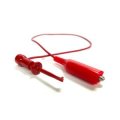
Certainly test leads with clips are a very handy resource. BUT it is important to avoid contact with hazardous voltages when attaching them to acircuit to be tested. Insulated clips are what I recommend.
 
Top