Electra Molins 7 kW generator problem

Thread Starter

zxvova

Joined Jan 6, 2023
6
Good afternoon engineering team.

I am writing to you from Ukraine, engulfed in darkness due to Russian missile strikes.

We are trying to survive by the methods we love, so I am asking for your help.


Good people from Spain gave me an Electra Molins 7 kW generator.

But there is no voltage regulation unit in the generator.

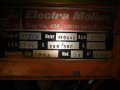
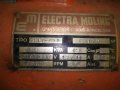
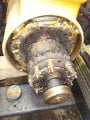
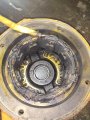
I am attaching a photo of the generator and the removed cover.

Please advise me how to run it. Which AVR is suitable for this generator.

I'm writing to you with the help of Google Translate, so I'm sorry if I write illiterately.
 

Attachments

strantor

Joined Oct 3, 2010
6,875
Google translate has done a good job for you. I understand you well.

There are some brushed generators (alternators) which do not require any AVR. These are characterized by a bridge rectifier where you might expect to see an AVR. since your drawing shows a bridge rectifier and does not show any AVR (or any place to connect one) I suspect you have received a non-regulated alternator. I am not totally confident about this, but that is how it seems to me.

If I am correct, then the good news is that your alternator should be good to go right now, just put it back together and run it. The "bad" news is that voltage won't be regulated. Instead it will depend on engine RPM. So make sure you couple it to an engine that won't overshoot the target RPM or else your devices will experience higher than normal voltage.
 

Thread Starter

zxvova

Joined Jan 6, 2023
6
Google translate has done a good job for you. I understand you well.

There are some brushed generators (alternators) which do not require any AVR. These are characterized by a bridge rectifier where you might expect to see an AVR. since your drawing shows a bridge rectifier and does not show any AVR (or any place to connect one) I suspect you have received a non-regulated alternator. I am not totally confident about this, but that is how it seems to me.

If I am correct, then the good news is that your alternator should be good to go right now, just put it back together and run it. The "bad" news is that voltage won't be regulated. Instead it will depend on engine RPM. So make sure you couple it to an engine that won't overshoot the target RPM or else your devices will experience higher than normal voltage.
Thank you for responding. I started this generator before I started to disassemble it. He didn't show any tension at all. From what I saw after disassembly, I understood that it is brushless. The windings in the cover of the generator are the key to thinking about the method of regulating the magnetic field of the generator. Searches on the Internet give results, and I already have an idea how to start the generator. After I accurately draw the windings in the lid, I think I will start the generator.
 

strantor

Joined Oct 3, 2010
6,875
Thank you for responding. I started this generator before I started to disassemble it. He didn't show any tension at all. From what I saw after disassembly, I understood that it is brushless. The windings in the cover of the generator are the key to thinking about the method of regulating the magnetic field of the generator. Searches on the Internet give results, and I already have an idea how to start the generator. After I accurately draw the windings in the lid, I think I will start the generator.

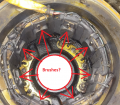
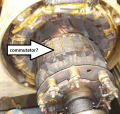
I may be confused about what I saw in the pictures. I thought I saw brushes and a commutator:


1673022552457.png 1673022575751.png


But after your comment about it being brushless, I am no longer confident about it. I don't know why the commutator would have windings wrapped around it. I must admit, I don't know what I am looking at now. Sorry I can't help further.
 

Thread Starter

zxvova

Joined Jan 6, 2023
6
I may be confused about what I saw in the pictures. I thought I saw brushes and a commutator:


View attachment 284673 View attachment 284674


But after your comment about it being brushless, I am no longer confident about it. I don't know why the commutator would have windings wrapped around it. I must admit, I don't know what I am looking at now. Sorry I can't help further.
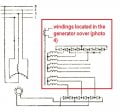
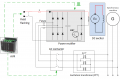
Here, the energy transfer is like in the picture-
 

Attachments

LesJones

Joined Jan 8, 2017
4,511
As there are two information plates does the generator consist of two units ? I am guessing that the part in the red box marked "in the end cover" are one unit and the three windings on the left are the stator windings of the main alternator.
Is the circular item on the bottom left slip rings ? I suspect that the small rotor in picture 3 of post #1 supplies AC which is rectified (By diodes on the metal plate.) to provide DC to the rotor of the main alternator part. I also think the stator windings in the end cap are supplied with DC. I think controlling this current is a means of controlling the output of the main alternator.
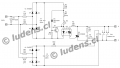
I think the regulator may be like the circuit in post #3 and the stator in the end cap would be connected to terminals "Z" on that circuit. The terminals on the left marked 230 V would be connected between neutral an one phase of the main alternator output to sense the actual output voltage.

Les.
 

Thread Starter

zxvova

Joined Jan 6, 2023
6
As there are two information plates does the generator consist of two units ? I am guessing that the part in the red box marked "in the end cover" are one unit and the three windings on the left are the stator windings of the main alternator.
Is the circular item on the bottom left slip rings ? I suspect that the small rotor in picture 3 of post #1 supplies AC which is rectified (By diodes on the metal plate.) to provide DC to the rotor of the main alternator part. I also think the stator windings in the end cap are supplied with DC. I think controlling this current is a means of controlling the output of the main alternator.
I think the regulator may be like the circuit in post #3 and the stator in the end cap would be connected to terminals "Z" on that circuit. The terminals on the left marked 230 V would be connected between neutral an one phase of the main alternator output to sense the actual output voltage.

Les.
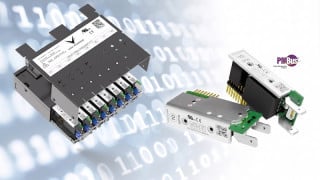
Regulation in generators takes place in two ways. 1. Voltage supply to the excitation winding. 2. Shorting of the generator armature (such AVR in photo 3). What principle of adjustment will I know after dismantling the winding in the generator cover.
 
Top