(Co)sine wave generator with phase shift

Thread Starter

Samantha Groves

Joined Nov 25, 2023
159
If you wanted to create a perfect (co)sine wave you could use a Colpitts or a Hartley oscillator.Suppose for some reason you needed to add a phase shift to the circuit,in the laplace domain if the phase shift was φο ,then in the laplace domain that would be the laplace transform of the (co)sine signal * e^(-φο/s).But how can I do this as a circuit?
 

LvW

Joined Jun 13, 2013
1,998
Question: A phase shift can exist between two signals only.
For example - between input and output of an amplifier.
However, the oscillator produces one single signal only.
Which two signals do you want to compare with each other?
 

Thread Starter

Samantha Groves

Joined Nov 25, 2023
159
Question: A phase shift can exist between two signals only.
For example - between input and output of an amplifier.
However, the oscillator produces one single signal only.
Which two signals do you want to compare with each other?
Ehm yes sorry I am planning to use 3 colpitts oscillators used by a single DC source to create a 3 phase sine wave generator thats why I am asking this.Also the phase shift would be 120 degrees between the phases.
 

ericgibbs

Joined Jan 29, 2010
21,395
hi S,
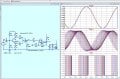
The source on my circuit is not pulsed it is a 1V, 16kHz Sine wave. R5
E

The Phase shift is being stepped to show the shift operation.
 

MrChips

Joined Oct 2, 2009
34,629
Since we don't know the output frequency but the three waveforms have to be exactly 120° apart, I would do it digitally.

Create a divide-by-3 counter using CD4017 Johnson counter.

Feed each of the three outputs to divide-by-2 counters using CD4013 flip-flops. Now you have 50% duty cycle.
Synchronize your oscillator to this or use a resonant circuit tuned to the desired frequency.
 

AnalogKid

Joined Aug 1, 2013
12,049
In a simulator, three independent oscillators with theoretically perfect components will hold their phase differences, but synchronizing them 120 degrees apart remains a problem. There is no point in time when all three waveforms are at the same potential - zero-crossings, peaks, whatever. One approach is a single sine oscillator followed by two 120-degree phase shift circuits in series. This is a variation of a phase-shift oscillator, a very common sinewave generator. A problem with this approach is that it is not easily tunable; all of the phase-delay circuits are tuned to a single frequency.

Something you can do in simulation, but might not be practical in the real world, is to have one sine generator, one 120-degree phase lag circuit (with capacitors), and one 120-degree phase lead circuit (with inductors).

Another way is to create three 50/50 square waves digitally from a single counter with decoding, and filter off the harmonics.

ak
 
Last edited:

ericgibbs

Joined Jan 29, 2010
21,395
hi S,
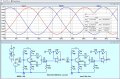
This circuit shows a 50Hz [ 20mSec period] signal as an input, creating a phase time shift of 6.67mS. for the following two phases.
Is this what you require??

E

EG 2086.jpg
 

crutschow

Joined Mar 14, 2008
38,325
Something you can do in simulation, but might not be practical in the real world, is to have one sine generator, one 120-degree phase lag circuit (with capacitors), and one 120-degree phase lead circuit (with inductors).
Why not two identical 120-degree lag circuits in series?
 

drjohsmith

Joined Dec 13, 2021
1,553
@Samantha Groves
you say

"If you wanted to create a perfect (co)sine wave you could use a Colpitts or a Hartley oscillator "

note neither of these are perfect ,

The best oscilator is one that meets your needs !

what frequency do you want
is it fixed
is there one or many phase shifts you require
is the phase shift constant

for instant , a lot of radios use a frequency and its phase shifted one ( I Q )
these are often done now with DDS digital type circuits , but radios of old used analog oscilators and phase shifters to aproximate the two.

Just what do you actualy want,
 
Top