(Co)sine wave generator with phase shift

drjohsmith

Joined Dec 13, 2021
1,609
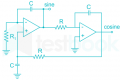
* At the same time and in order to achive this goal it must contain a certain non-linearity which must be as small as possible, but as large as necessary (to allow only small pole fluctuations across the imaginary axis).
Your assuming an analog oscilator there !
 

AnalogKid

Joined Aug 1, 2013
12,142
hi AK,
Is that for me? if yes, they are GP OPA amps.
The LM393 is a comparator, not an opamp, and it has an open-collector output stage. Since your schematic has no pull-up resistors, how does the simulation run? Does your 393 model have a totem-pole output?

Also, there is some variability in the exact internal schematic for this part depending on who made it. For some, the internal compensation capacitor that is in most opamps is completely eliminated. This can make the part unstable in a low gain, linear amplifier circuit.

https://www.ti.com/lit/ds/symlink/lm393a.pdf?ts=1777342688757

ak
 
Last edited:
I may have missed whether the desired frequency is mentioned, but if I just wanted a result instead of an elegant analog solution I’d use a fast processor with a sine wave lookup table and three DACs

Or an analogue oscillator, A to D and two DACs. Resolution up to 12 bit is cheap to do. For low frequency a fairly basic Arduino would work. The blisteringly fast Teensy4.0 might work up to kHz. For fixed frequency lower resolution with analogue filtering?
 

drjohsmith

Joined Dec 13, 2021
1,609
re reading your posts @Samantha Groves
seems your after three phase signal , and only in a simulator
is this as signal source ?
@ericgibbs
your way more expert at ltspice etc than most , certainly me, so I wont embarris myself,
I can create a sine source , but how would samantha create a three phase sine source ?
 

crutschow

Joined Mar 14, 2008
38,526
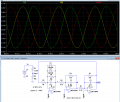
Below is the LTspice sim of a three op amp, phase-shift oscillator that gives three 120° signals:
Its not necessarily an optimized circuit, but demonstrates a simple oscillator that generate the signals.

Signal V(1) has some noticeable distortion due to the diode soft limiters.
That could be minimized if an active AGC circuit was used to control the loop gain instead of the diodes.

1777472160553.png
 

MrAl

Joined Jun 17, 2014
13,708
Its supposed to be for a simulation on a simulator.
Hi,

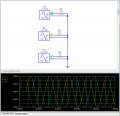
If it is for a simulation you can just use three sine sources and set the phase shifts to 120 and 240 for example, with the first having a 0 degree shift.

In real life there are several ways to do this. For one, using phase locked loops, but simpler would be to just use one sine oscillator and two phase shift networks and amplifiers that can get the amplitude right for each of the three phases. You would have to check the variation in phase with temperature and stuff like that but it should be good enough for most things that don't have to be perfect.

Three phase sine converters use digital techniques to generate three sine waves that are exactly 120 degrees a part. That brings up another possibility for signal-only applications:
Generate three square waves exactly 120 degrees apart (not hard to do) and then use simple bandpass filters on each phase to get sinusoidal outputs. That would work when assuming constant frequency.
 

crutschow

Joined Mar 14, 2008
38,526
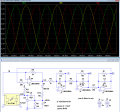
Here's the LTspice sim of the phase-shift oscillator with an AGC circuit, using a FET opto-coupler output as a variable resistor to control the loop gain, which minimizes the distortion:
This gives three low-impedance outputs for the signals.

Edit: Circuit modified to use more stable TLV431 reference for better amplitude stability with temperature.
Note that this circuit is not necessarily optimized, but demonstrates the concept.


1777668729777.png
 
Last edited:
Top