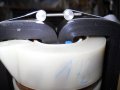
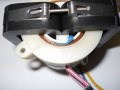
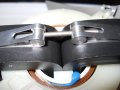
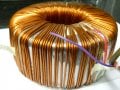
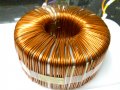
HP I totally hate to ask but if u can find time plz upload pics of the xfmrs that show better detail of core cuz I know what they look like but I need to show other ppl when I ask abt operating frequency and like that.
Also if it's not asking totally too much do u think u can manage a pic of that toroidal line xfmr that's identical to the one I salvaged from Powervar conditioner?
Hint -- For faster 'service' in future -- lose the 'tude!
Note that the line isolation transformer exhibited in the images below is with its outer bunting removed so as to provide access to the outer winding (to wit: the original primary)...
my preference has always been Robinair brand and that's the one which "accidentally" achieved 40 microns. I remember my first vacuum pump was Robinair, but I forget what brand the second pump was.
Testimony being that Robinair has been in business for probably 50+ years and has developed quality in spite of lax standards for the industry.
So... I purchased ten pumps (bearing 'wide-ranging' S/Ns) through 'geographically diverse' retailers as a test sample...
ATTN: @#12 Following is my test procedure - please comment upon the validity (or not) of results obtained thereby
Test procedure (each pump)
-Charged pump with the recommended oil.
-Ran pump (closed) for a period of four hours.
-Drained pump and refiled with fresh oil.
-Attached indicator directly to the intake fitting (via 'collapse-proof' silicone tubing).
-Noted pressure indication following 30 seconds of operation (all pumps attained minimum pressure in less than 15 seconds).
With the findings that:Minimum pressures ranged from 20 μmHg to 25 μmHG - hence exceeding specifications in each case
I find this particularly auspicious inasmuch as $200 isn't likely to 'scare off' even the most parsimonious hobbyist! Then too is the added benefit of 'bricks and mortar' distributors (i.e. no shipping fees and no hassle warranty service/replacement should such become necessary)
Best regards
HP
PS -- @Aleph(0) - You're welcome for the Xfmr images
I've located a source for new, high quality, two-stage Vac pumps (Guaranteed to 35 μmHg) -- At a price of Ca. $200 (USD) via 'bricks and mortar' retailers! FOR EXAMPLE
HP that's good to hear cuz pressure < 500um isn't needed for refrigeration service so it's good to know pumps live up to their specs even though they'd prolly get away w/o it with their _target market_!
I find this particularly auspicious inasmuch as $200 isn't likely to 'scare off' even the most parsimonious hobbyist! Then too is the added benefit of 'bricks and mortar' distributors (i.e. no shipping fees and no hassle warranty service/replacement should such become necessary)
HP I totally agree that nothing beats _bricks and mortar_ for customer service!
So abt Siemens xray PSU, HP I still can't imagine why it uses those 6kΩ resistors at all cuz it can't be current limiting cuz that's still 8.3A on each side! Also why is cathode side 6kΩ and anode side 6.01kΩ?
HP What's that blue stuff/thing that runs along and crosses over core insulator? Cuz if it's secondary lead I say it partially defeats core to wdg insulation
Succinctly: To spare the capacitors via limitation of fault currents (i.e. discharge rate) should flash-over occur --- Please recall that one end of R[mA_Indicator] is at ground potential, and, further, that said resistance is < 1kΩ (I really should have drafted that)...
Yebut -- At a maximum energy of 25J and a TC of 60μs - everything's 'groovy' --- OBTW - as regards the diodes - inasmuch as they are not in the 'discharge path' they need only withstand the secondary short-circuit current pending PSU OC shutdown...
First off here's the 'line up' of the four constituent resistors (each side) (as illustrated HERE and HERE {respectively})
R1= 1.5kΩ+1.5kΩ+1.5KΩ+1.5kΩ (6kΩ)
R2 = 2kΩ+2KΩ+1.5kΩ+510Ω (6.01kΩ)
But to your question -- Well, clearly, there is no operational rationale for the slight disparity in values of the 'flash-over protection resistances' -- Hence I can but imagine said arrangement is by way of a scheme whereby the boards are electrically distinguishable (as by automated fabrication equipment or for troubleshooting purposes) --- But then a guess is just that -- the good news is that it doesn't really matter, intriguing though it is
HP What's that blue stuff/thing that runs along and crosses over core insulator? Cuz if it's secondary lead I say it partially defeats core to wdg insulation
That'd be the 'inner' primary lead -- note that passing same through the 'gap' does not constitute a 'compromise' inasmuch as the primary circuit must needs be (electrically) near ground and, hence, the core...
Why you piker, you're just as wealthy as the rest of us. You in all reality should have done the same testing and 'culled' any that didn't meet the standards. At least that's how I pick my tools.
Good deal! It's the best way of course - time consuming tho' it often is... -- That said, I've a definite responsibility to our readers - hence my reluctance to recommend products offered at seemingly 'too good to be true' prices sans 'investigation'
@#12 -- Many, many thanks! -- You doubtless saved me a great deal of work and time via 'putting me onto' a quality 'brand' from the proverbial 'get go'!!!
HP did a perfectly good job of testing the pump, the whole pump, and nothing but the pump (so help me, Dog). After that, any discrepancies must be attributed to the external assembly of components and/or out-gassing of the subject matter. In air conditioning, out-gassing is the goal, as entrapped water and solvents are scavenged by the vacuum pump.
Somehow I am reminded of the phrase, "blanked off". When the pump reaches its ultimate capability, we say it has blanked off. This is probably related to some high tech terminology, but I forget where it came from.
Like I said, no guarantees, but that means the manufacturer provides no guarantee of the quality afforded. For that lack of a guarantee, you get a lower price. At least you have eliminated any doubt that I routinely take my A/C systems down to 50 microns in accord with my iconoclastic nature and spite of the, "Industry Standard". When installing excess quality costs me nothing more than to wander off and perform another chore for half an hour, it is a very economical investment.
#12 That's totally the reason we use them for potting electrical equipment too! So to pot like line operated 150kv xfmr that's been stored dry we pull vacuum on xfmr for abt 40 hrs until vacuum stays vry low for hours after pump is off and chamber isolation valve is closed. Then oil is processed in separate chamber by pulling vacuum until everything with vapor pressure above 800 umHg at 20°C is boiled off. Then chamber with oil is brought back to atmospheric pressure with anhydrous N2 and oil is drawn into chamber with xfmr by same principle as antique coffee pot!
Shortbus I'm happy you said that cuz when ppl just accept out of spec products it enables lying manufacturers to keep ripping ppl off! So I say thanks for fighting the good fight!
Water in the transmission oil! IMNSHO whoever thought immersing transmission oil cooler lines in the pressurized engine cooling system was a good idea should be consigned to a vivisectionist!
If you want to kill a transmission, pour a quart of water in the transmission fluid. The clutch plates will be mulch in an hour.
So yes, whomever decided to subject the cooler pipes to pressurized water should be tied to a post and flogged.
If you want to kill a transmission, pour a quart of water in the transmission fluid. The clutch plates will be mulch in an hour.
So yes, whomever decided to subject the cooler pipes to pressurized water should be tied to a post and flogged.
Speaking of... I had to have my Audi towed to the repair shop after a hose under the transmission burst and spilled its contents on the street... I didn't know those cars' transmissions had any external hoses underneath! ... Anyway, the thing is factory sealed, and there's no way for an ordinary mortal to check its oil level. Besides, special equipment is needed to add fluid to it....
Good news is that I didn't try to force the car to run after that happened and it wasn't damaged... bad news is that replacing the couple of hoses and refilling the transmission cost me $400.00 dlls

 Facebook
 Google
 GitHub
 Linkedin

but now that you mention it, maybe bribery to generate interest in tutorials isn't a bad idea at all