EHT power supply design and construction

Thread Starter

Aleph(0)

Joined Mar 14, 2015
597
Hi all! I've returned and will respond to your posts ASAP -- Thence it's on to the tutorial! -- Please be patient! I'm down to one typing hand for a few days (following a 'fight' with a 'vintage' motorized 'wringer press' during an antique show:oops:) -- No need to light a candle for me @Jazz2C - I'll be good as new (well, good as new+4 decades) in a week's time:) -- In the meantime I can and will forge ahead:D

Very best regards
HP:)
HP Make sure to let us know when you've rested up from your vacation:rolleyes::p
 

KL7AJ

Joined Nov 4, 2008
2,229
But polycarbonate is totally easier to work with:)! I agree with JC that cracking is what acrylic does best:rolleyes:
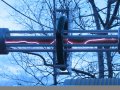
Hi Aleph...thought you'd like this. This is a 1 GW emp pulse generator we built at HIPAS about 15 years ago. The arc gap is 6 feet long pressurized with 140 PSI of SF6 gas. We achieved our benchmark of 1 gigawatt, with a few nanoseconds decay time.....we could toast FETs at about a kilometer from this. Fun stuff
 

Attachments

Hi Aleph...thought you'd like this. This is a 1 GW emp pulse generator we built at HIPAS about 15 years ago. The arc gap is 6 feet long pressurized with 140 PSI of SF6 gas. We achieved our benchmark of 1 gigawatt, with a few nanoseconds decay time.....we could toast FETs at about a kilometer from this. Fun stuff
---Emphasis added---
Wow! -- What was the estimated/nominal gap breakdown EMF? And what were you using for Cap{s}?

With genuine curosity
HP:)
 

KL7AJ

Joined Nov 4, 2008
2,229
---Emphasis added---
Wow! -- What was the estimated/nominal gap breakdown EMF? And what were you using for Cap{s}?

With genuine curosity
HP:)
We were using large oil-filled caps, about 10 uF total. You can't see it in the photo, but inside the primary coil (yellow Romex) was the secondary coil, about 2.000 turns of 20 ga magnet wire in a solenoid around a 1' diameter Sonotube. Primary voltage was about 15,000 volts with a large vacuum contactor breaking the primary. We adjusted the primary and secondary dimensions to give us precisely critical coupling. Secondary voltage at breakdown was just about a million volts, and a peak current of 1.000 amperes, measured with the large Pearson transformer. What you can't see in the picture is the 90 meter dipole antenna on either side of the spark gap....primary resonance was about 3.3 Mhz, with a Q of about 20, as I recall. The dipole itself was made from 9" aluminum irrigation pipe...so it had a few thousand picofarads of capacitance. It was fun stuff....alas, it's all in the scrap heap now. :(
 

KL7AJ

Joined Nov 4, 2008
2,229
We were using large oil-filled caps, about 10 uF total. You can't see it in the photo, but inside the primary coil (yellow Romex) was the secondary coil, about 2.000 turns of 20 ga magnet wire in a solenoid around a 1' diameter Sonotube. Primary voltage was about 15,000 volts with a large vacuum contactor breaking the primary. We adjusted the primary and secondary dimensions to give us precisely critical coupling. Secondary voltage at breakdown was just about a million volts, and a peak current of 1.000 amperes, measured with the large Pearson transformer. What you can't see in the picture is the 90 meter dipole antenna on either side of the spark gap....primary resonance was about 3.3 Mhz, with a Q of about 20, as I recall. The dipole itself was made from 9" aluminum irrigation pipe...so it had a few thousand picofarads of capacitance. It was fun stuff....alas, it's all in the scrap heap now. :(
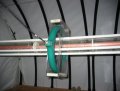
When winter rolled in, we built a tent over the arc gap to continue the experiments. Notice how the Lexan tube shows some serious abuse....not just from electrical breakdown...but because of the huge shock wave propagating through the high pressure SF6. We blew the end caps right off the tube the first few times, until we built the fiberglas rods to hold everything together. :) Despite the violent arc inside, all you could hear was a little "tick" when it fired off!
 

Attachments

but if you crank it up b4 its ready it will just get like all turned off and frigid then it'll need a _Wimshurst Westheimer treatment_ to put it right;):D
Dr. Ruth to the rescue aye!:D --- Well hey! -- The analogy vested in your (attempted:rolleyes:) humor argues my point (as regards the 'virtues' of 'attentiveness to tacit feedback' quite nicely:D!

PS @Jazz2C -- I probably don't have to disclaim this - In light of your recent ion-motion experiments, however, I feel that I should: 'frigid', in the context of Aleph's post, does not refer to temperature drop...

TTFN
HP:)
 
Last edited:
When winter rolled in, we built a tent over the arc gap to continue the experiments. Notice how the Lexan tube shows some serious abuse....not just from electrical breakdown...but because of the huge shock wave propagating through the high pressure SF6. We blew the end caps right off the tube the first few times, until we built the fiberglas rods to hold everything together. :) Despite the violent arc inside, all you could hear was a little "tick" when it fired off!
May I assume said project concerned one (or both) of: (A) Munitions development, or (B) A 'test source' applied to development/determination of effective 'hardening' of assets against natural or hostile EMP sources (as, for instance, lightning or thermonuclear device detonation)?

In either case why was the project abandoned?

Best regards
HP:)
 

KL7AJ

Joined Nov 4, 2008
2,229
May I assume said project concerned one (or both) of: (A) Munitions development, or (B) A 'test source' applied to development/determination of effective 'hardening' of assets against natural or hostile EMP sources (as, for instance, lightning or thermonuclear device detonation)?

In either case why was the project abandoned?

Best regards
HP:)
It was a test source. And since it was an "extracurricular project" of HIPAS Observatory anyway, when HIPAS went belly up, so did all the extracurricular projects. It was a fun ride while it lasted.
 
@Aleph(0) --- Please remember to include the 'notes' (transmitted to your home addy @9/11/2016 ≈ 1:00 AM CDT) in the glossary! -- Please note that I prefer 'linking'' expansions to 'messing up' the text with same - thoughts?

All the best
HP:)
 

Thread Starter

Aleph(0)

Joined Mar 14, 2015
597
HP! I say it's time for you to stop effing around with ltspice and just finish tutorial:mad:! I've been vry busy with glossary so now's my turn to say GET TO WORK! Btw plz upload the balanced hv meter pics you've taken so far so I can work on outline and not be flying blind:)!

PS
Please note that I prefer 'linking'' expansions to 'messing up' the text with same - thoughts?
HP I say perfect! Cuz link highlighting is a lot less irritating to ppl who already know than a bunch of extra text:)!
 
HP I have some questions:)! Where can ppl get nice hv resistors in pic? What are their physical dimensions? What are grommets for?
Aleph! Puleeeze! One tutorial at a time!!!

I'll respond this time but no more 'jumping the starting gun' in future, ok?

Where can ppl get nice hv resistors in pic?
Via salvage from 'old' HV probes commonly available at 'hamfests' (i.e. electronics-themed 'flea markets'), etc... Ebay may likewise be a good contact --- Should said components prove elusive, the builder may 'string together' the requisite number of lower value HV resistors such that a wide margin is granted the maximum drop per device spec... Information Unlimited is a good source for high EMF components in 'hobbyist-friendly' quantities...

What are grommets for?
The non-conductive neoprene grommets facilitate mounting of each resistor in it's respective housing (fashioned of a length of 1" ID PVC tube) -- Please note that the assembly process will be minutely described in the reference!

What are their physical dimensions?
As a 'reflexive point of order' -- electrical parameters are likewise physical entities;) --- But to your (intended) question:

Spacial dimensions:
Len (excluding contact hardware) = 178 mm
Dia = 14 mm

Electrical parameters (each resistor):

Resistance: 400MΩ (15% Tol)
Stability: ±0.0001% (400Ω) per year.
Maximum EMF drop (free air, non-condensing humidity) - 60kV
Maximum power handling (free air) - 10W
Maximum power handling (free air) for less than 5% thermal resistance 'drift' following 2 minutes operation - 6W

...and not be flying blind:)!
Which reminds me -- Could Mr. Henley have had you in mind when he wrote this song, @Aleph(0) ?:D


Best regards
HP:)
 
Last edited:
Those are from a high voltage probe...most likely a Heathkit or a Fluke. I'd contact Fluke and see if you can get a replacement....since Heathkit hasn't been around in a while. P_
A reliable source for EHT resistors of that form-factor would be truly grand!:)

Best regards
HP
 
Last edited:
@Aleph(0) et al.

Ok -- for 'starters' I've created a blog entry containing a cursory list of 'select' abbreviations and linked same from the text -- Granted! It would be 'cleaner' if the links pointed to specific expansions (as opposed to the entire list) -- unfortunately I have no way of achieving that sans creation of a distinct blog entry for each abbreviation:eek:

Please review the list with the aim of suggested 'additions' and/or 'removals'

Many thanks
HP:)
 

JoeJester

Joined Apr 26, 2005
4,390
You can get cheap HV probes and remove their multiplier resistor. Build a voltage divider and send two wires to some posts to connect your digital meter or scope.

Back in the day, 50 uA or 1 mA meter movements were used to display HV on some transmitters. The multipliers limited the current to the full scale current of the meter.
 
Top