EDM - Electrical discharge machine

Thread Starter

shortbus

Joined Sep 30, 2009
10,050
I am not into EDM, but have you used "glassy" carbon as the electrode. It is quite hard and "like glass." That is, it can be polished to a very smooth and non-absorptive surface. I used it as an electrode in an electrochemical cell for an HPLC detector many years ago. My company wouldn't patent it, and Beckman stole it. Fortunately, we were still able to use it without paying royalties.
Can't recall ever seeing that, but the graphite we used was very hard, dense and abrasive. It was made from residue from oil refining. They also had some with copper powder incorporated in it.
 

jpanhalt

Joined Jan 18, 2008
11,087
For my purposes, it was perfect, and a new material at the time. I can see that for an electro-ablation process, its hardness might not be an advantage. It can be ground to a very fine edge, which is what I thought might help.

Here's the usual Wiki link: https://en.wikipedia.org/wiki/Glassy_carbon From Google, it seems not to be so exotic as it was in the 70's and early 80's.

John
 

roong

Joined Feb 11, 2017
59
Looks like your machine is very close to the performance of a real industrial machine. Great job!
A complement from a sincere person, keeps me going. Thanks Mr. ShortBus. Last time I drilled similar hole with copper electrode. I remember it finished in less than three hours but the copper trode was in bad shape. I guess you were right when you said that my electrode plung down too fast. That may make frequent short circuit. This time, I reduce speed and introduce some stategy. My machine now is so reliable eventhough it slow, everytime you turn it on it just keep sparking. Nothing is hot, every thing is just slightly worm.
These are ways I look into iimprove speed of machine
-It could be faster if I use EDM fluid instead of diesel oil. My guess with EDM fluid I could finish the job in 3 hours.
-Now I use NEMA17 size stepper motor for this machine. It perhaps smallest EDM motor. I can not have the motor run so fast because it will be too hot.
-I am considering changing from SG3525 to SG3524 PWM because 3524 allow me to adjust duty-cycle beyond 0.49 up to 0.9. May be it faster.
 
Last edited:

Thread Starter

shortbus

Joined Sep 30, 2009
10,050
Roong, that's what this is all about, getting better results. Size of the stepper isn't that important, it's the step frequency and size of the step. A coarse thread and micro stepping are the way to go in this. It is the same way in making a CNC milling machine. It sounds wrong, but it's what works.
 

EdmGuru

Joined Aug 21, 2018
47
Hi Roong and all,


I agree that any progress made on these machines is good so well done and I also agree that you need to increase your duty cycle to speed up erosion time.

I too have been busy and have finally got round to completing a 20 amp plug in expansion module, mainly to make it easier to trial different components etc, so my machine is now 30 amp in theory but I know the transformer is the weak link and will have to be increased ASAP.

Just as a point of interest the EDM industry standard charts (Agie) for a copper (positive) electrode into steel states that 9 amps at 10 KHz with a duty cycle of 90% (on time) will remove 40 cubic mm per minute (@12 amps it’s 45) with 1.4% (12 amps is 1.5%) electrode wear, BUT I have always found these values optimistic so would at least halve the cubic mm values as they’re probably based on ‘perfect’ flushing conditions etc. either way you should be looking at 1 to 2 hours max (depends on head lift interval for flushing) for the 12mm dia hole you eroded through a 7mm file unless my maths is wrong? If you just require a hole in a steel plate then use a copper tube and flush through the centre hole, it’s much faster.

The fastest setting giving the least electrode wear at 10 amps is 5 KHz. (0.1% wear)

Sometime soon I’ll spark a 12mm hole (solid electrode) through a piece of steel plate and post results, also I’ll erode a coin into hardened steel at low amps for a finish/ wear comparison.

I’ll post some photos of my project also an interesting paper on the influence of duty factor on pulse generator in EDM process which may be useful.

Keep up the good work.

Cheers.
 

Attachments

EdmGuru

Joined Aug 21, 2018
47
Hi all,
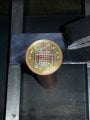
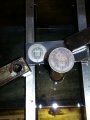
I managed to spark erode a 1p coin (20.3mm dia) into hardened steel today with mixed results.
My machine definitely doesn’t like low amps at high KHz without a lot of messing about with the duty factor which started at 90% (at 5 KHz) and finished at around 70% (at 150 KHz) in order to achieve a stable burn, I think it is lacking some sort of refinement (probably a proper gap volt adjustment circuit) so I might need your help there guys as I only know about basic electronics.
At higher amps (7 amps plus) there’s no problem with performance at any KHz setting although higher KHz does require a lower duty cycle for a stable burn but this is to be expected in EDM.
I used paraffin as the dielectric with a side flush and occasional lift off timer use (made the burn unstable at high KHz settings?) at approx once per second with a 0.5mm lift off.Erosion started at 3.5 Amps throughout project, at 5 KHz for approx 1 minute then,10 KHz for approx 5 minutes, 20 KHz for approx 10 minutes, 50 KHz for approx 20 minutes, 100 KHz for approx 20 minutes and finally 150 KHz for approx 10 minutes (off and on due to problems mentioned earlier).
Total erosion time was just over 1 hour then I took it off to inspect results.
Surprisingly the electrode wear wasn’t too bad with a very small spark gap which is consistent with commercial machines, but could be improved by using lower power at maybe only 1 amp?
Hopefully tomorrow I’ll spark a 12mm hole through a steel plate (10 Amps at 5 KHz) to test best performance at lowest electrode wear, and then maybe I’ll try out the new expansion module by sparking another 12mm hole at 20 amps (transformer permitting) at 5 KHz to test speed.
I’ll post some before and after photos of the coin project/ experiment for you all and hopefully some short videos in .RAR format for you to view.

Cheers.
 

Attachments

Thread Starter

shortbus

Joined Sep 30, 2009
10,050
That, 20.3mm is a really big burn for the amps you were putting into it. There used to be some information online about area and amperage but didn't see it after a quick search.

Would you be willing to share any of your circuit? That I'm interested in is how you are getting different amperage's by using a switch.

I really should work on mine again but things keep popping up that are more pressing.
 

roong

Joined Feb 11, 2017
59
Hi, Edmguru that the best homemade EDM machine that I have ever seen. You should post it on Youtube. Here are some questions...How do you stick coin to electrode ....soldering?
Why do you use relays, since you are using transisters in pararell..then could it be easier if you just turn on or off at base of those transisters.
I am using diesel oil without filter ,only #60 mesh to protect my pump...do you think that black sludge that eject with oil could effect very much on speed... mine look like green color with water or air bubble......Your fluid is so clear.

I think I dont really understand how they define Amps in pulse EDM. Is it peak, Is it at flat current after peak or is it average over On time.
 
Last edited:

EdmGuru

Joined Aug 21, 2018
47
Hi Shortbus and Roong,
In reply to your questions, the general rule for max Amps per square inch for a copper electrode is 25 Amps but this depends on how much wear you’re prepared to put up with.
The coin was soldered to a 15 mm copper tube and relays are used to switch in power transistor base lead, and as each transistor is on a separate channel with their own high wattage output resistor, then basically because of Ohm’s law it just a resistors in parallel calculation, so the more resistors switched in the lower the resistance and therefore higher the output amps.
I have worked for over 40 years on various manufacturers EDM machines and I have seen them when they go wrong and talked to service technicians when they strip them down to fix them and I have noticed that this is basically the way all manufacturers were building their machines throughout the 70’s, 80’s and 90’s. It’s all based on Ohm’s Law (even the feedback for the head motor control). Maybe it’s old technology today but perfectly good for a home shop machine.
I wouldn’t worry too much about dirty dielectric fluid so long as it’s not heavily stained with soot or thick with sludge. I use paraffin as a dielectric and settles to a fairly clear liquid if left for even a short while which is ideal. If you pass dirty paraffin through denim or similar fine weave cloth it’s surprising how it can be filtered just by gravity alone.
I would define output amps in pulse EDM as when it’s at it’s stable working voltage which is usually just under half (maybe two fifths?) open voltage, but who knows?

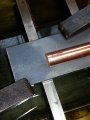
Anyway today I sparked the 12 mm hole through a 6 mm steel plate at 10 Amps and at 10 KHz (I decided not to do at 5 KHz as I know that the wear rate is good at this setting).
I started with the lift off timer at approx one second interval but had to increase it to twice a second because of using a side flush which is always a bad idea. It took 1 hour 50 minutes to the break through point, but then it started to act like it had an arc so I had to increase pulse to 20 KHz briefly to clear it then back to 10 KHz to finish through completely. The total erosion time was two hours and ten minutes which isn’t quick but ok I guess for home build machine. The electrode wear was good surprisingly.
I tried out the expansion module also but only at 20 Amps at 10 KHz for 10 minutes as the transformer started to get hot but in this short time it had eroded to a depth of 1.1 mm which is good. The electrode wear seems good also.

I’m glad you like the EDM machine. I’m thinking of calling it ‘Easy-Peasy EDM’ as all parts can be bought on Ebay and assembled over a few days.

I’ll post some before and after photos and some videos in .RAR format for you all to view.

Cheers.
 

Attachments

Thread Starter

shortbus

Joined Sep 30, 2009
10,050
Thanks for the answer, I thought that's what you were doing It is kind of how my first idea for an R-C machine was going to be. But instead of transistors I was just going to used toggle switches to change the resistor levels.

Your lucky with the tech working on the machines where you were working. Where I worked they wouldn't share any information. Have you used an Eltee Pulsitron? That was my favorite to use.
 

EdmGuru

Joined Aug 21, 2018
47
Hi Shortbus,
No I haven’t come across the Eltee Pulsitron before, I don’t think they sold many over here in the UK.
I never had a favourite EDM machine, they all seemed to have their good and bad points, some were better for electrode wear especially with copper electrodes and some were let down by their dielectric systems with slow to fill work tanks and awkward and messy to change filters.
I used to have a 200 Amp Glevum EDM back in the 80’s. It was a pulse machine which was good at removing metal especially in large drop forging dies. I seem to remember that it had a larger than normal spark gap when using roughing electrodes and it’s generator cabinets (two 100 Amp units wired together) contained a lot of large electrolytic capacitors so maybe this was the reason why the spark gap was so large?
This EDM had its own very large diatomaceous earth filter system which was the best I’ve ever seen, with filtering from a black to a slightly yellow colour dielectric oil almost instantly!
I’ve also used an old centrifugal oil filter made probably in the 60’s. It ran at 17,000 rpm and used to sound like a jet engine when starting up! It worked ok but had a slow filter rate so it had to be switched on all day!
I soon got rid of it, and the ear plugs!

Cheers.
 

Thread Starter

shortbus

Joined Sep 30, 2009
10,050
I never heard of the Glevum machines. In our EDM department we had if I remember correct, 10 machines, most of them pretty old. They were connected to a central dielectric system, 400 gallons of oil, and an fluid to air inter cooler. Most of our work was small, plastic injection mold parts, GM/Delphi/Packard Electric stuff, the connector bodies for cars. Before EDM, they were doing the similar work with pantograph machines and tons of bench work. EDM resulted in much smaller and much more elaborate designs of connector bodies.

Would you be willing to share your design here?
 

EdmGuru

Joined Aug 21, 2018
47
Hi Shortbus;
I’ve found the old handbook for the Glevum P200 machine and the max spark gap when roughing at 200 Amps was 0.85 mm per side!
I’m in the process of drawing up my design of this EDM but I’d like to retain ownership for a while yet as I’m not happy with the performance at high KHz settings (head gets sluggish) and I know it could be better.
It would be nice to put it all in a book etc but I know that the cost involved, and being a specialised subject, that not many people would be interested in it so it’s a none starter and somebody would go and put it online for free anyway!
When I was first challenged to build an EDM machine I realised that even though I have an understanding of how they work, my knowledge of electronics was only basic, so I had to go down the route of wiring together existing ‘off the shelf’ modules which surprisingly worked but it is lacking ‘refinement’ at the high KHz settings.
This is maybe something that you guys that know about electronics could help me with please.

Cheers.
 
Last edited:

Thread Starter

shortbus

Joined Sep 30, 2009
10,050
EdmGuru, you and I could be twins! At least on how we think and go about this project. I too had an idea of about how it should work, and wasn't satisfied with the DIY ones that were available in books and magazine articles. So had to start to learn about electronics and logic gates.

Hope you don't mind a few questions. Will ask but if you chose not to answer that's alright.

1. Why are you using an opamp for a comparator instead of a comparator? I know a lot of people do but a real comparator is made for the job and does it better.

2. Are you setting your gap voltage with two potentiates? Like all of the DIY circuits do? That is one problem I struggled with and finally found a way to do it using one pot, just like a modern machine does. If you don't find the correct balance on the two pots there will be a problem on the burn.

3. what are you using for the ram of your machine? What type of motor? The PDF looks like it is for a brushed motor, guessing a gear motor. The hole shooter EDMs we had used steppers and that is what I went with. A gear motor makes too big a move and causes gap problems. I know the big machines used hydraulics and "piddle valves" to control them but for something small that opens a whole new can of worms.
 

EdmGuru

Joined Aug 21, 2018
47
Hi Shortbus,
In answer to your questions
  1. I use the controller circuit as it is. It works as it is so I never thought about or have the knowledge to change it.
  2. I don’t have any settings or adjustment for gap volt setting I use the controller circuit as it is and it seems to sort itself out, all you have to do is bring the head down using the potentiometer and by only a slight turn of the pot in the up or down direction you can adjust or ‘move’ the burn voltage anywhere you want to even down to 20 volts if you want. It all seems strange I know but it works and it’s stable as you can see in the videos.
  3. The head motor is a cheap 12 volt geared brush motor available on Ebay. I think it’s a replacement motor for a child’s toy. The output shaft is 8 mm dia and has a drive flat on the end. In use it only gets slightly warm as when it’s eroding the working voltage is minimum. To me a brush motor is easier to control than a stepper motor especially with me having little electronics knowledge and it doesn’t make big moves like you think it would, it can’t because if it tried to the controller would move it back as it works by Ohm’s law changing the voltage in the preset comparator window or I think it does? Very early EDM machines used brush motors to drive the head. I find that sometimes the simple way works best and in this case it does, but I know it could be improved. Have another look at the videos I posted and compare with other machines on YouTube for stability and electrode wear.
You probably could replace the motor and use a servo valve in it’s place for a hydraulic ram if you wish? A lot of manufacturers in the 70’s and 80’s used a hydraulic ram and they worked ok.

Cheers.
 
Last edited:

Thread Starter

shortbus

Joined Sep 30, 2009
10,050
Never even thought of doing it like that. But still don't understand how your getting the motor controller to decide on the gap? The original controller did it by manually turning the pot, in some ways like how an remote control servo (model airplane and such) works.

That said there is a theoretical gap voltage that is used by every industrial machine at least the ones I've been around. I think I referenced it in the earlier parts of this thread. From the top of my head, it's something like, High Side of the gap is 35V, this means the ram advances, Low Side of the gap voltage is 30V, this means ram retracts. The window of where the gap is stable is around 5 volts. Most every machine I've used, that wasn't CNC controlled, you set just the high side of the gaps voltage and a comparator circuit managed the rest.

The reasons for the stepper motor over the brushed gear motor -
1. better control over the movement. When your talking 0.001 or less of gap distance control is needed or you end up retracting too much.
2. steppers are made to instantly reverse when needed. A brushed motor when reversed like an EDM needs the brushes 'spark' and each of those sparks erodes both the commutator segments and the brush itself.

There are probably others but those are the big ones. And with the availability of inexpensive easily available stepper motors and drive modules, to me it's a no brainer.
 

EdmGuru

Joined Aug 21, 2018
47
Hi Shortbus,

I too don’t fully understand how the controller works but it’s easy enough for the operator to ‘drive’ the head by turning the directional potentiometer to achieve the desired ‘optimum/ stable’ burn voltage which is good but I know that there could be some sort of improvements to the circuit design to make it even better at all frequencies, but I just don’t know what or where they are.
I agree with you somewhat about the choice of motor for EDM but not totally so I’ll explain.
I know that the EDM industry today uses stepper motors and that they are no doubt superior to brush motors but logically a stepper motor moves in steps, ok they can be very small steps but steps non the less which means that the head movement distance is in steps and therefore can’t be at the optimum spark gap distance 100% of the time it’s either spot on or ever so slightly up or down.
A brush motor doesn’t move in steps, it’s movement is infinitely adjustable which means it can be at the optimum spark gap distance maybe not always 100% of the time but for a lot longer in theory than a stepper motor.
I also don’t agree that much about the sparking at the commutator, it’s minimal when actual eroding as the voltage to the motor is so low.
I know that it will eventually wear out but the unit is very cheap to buy and can be quickly replaced if faulty and my goal from the start was to make a home build EDM machine for the home workshop which would only have occasional use, also I don’t understand the drive circuitry for a stepper motor to work in both directions.
That said I have made small press tools on this machine and I posted a photo of a punch being eroded a while back on an earlier post so it is capable of long term use it just lacks some refinement to the head control which I’m sure will eventually be overcome or improved with your kind help.
Sorry to disappoint but I’m sure you understand that I can only work with what I know about electronics, which is not a lot, it’s all a learning curve for me I guess.

Cheers.
 
Top