EDM - Electrical discharge machine

perfo

Joined Aug 15, 2012
10
Hello Roong I haven't looked at EdmGurus site but if that gives you an online calculator then great that's just what you need..
However if you want a real rough rule of thumb type stuff (ie not accurate) . Here's something to consider.
The time constant of the discharge of a capacitor in and R C set up is t = R*C so with R being 40k and C being 1 uf that equals 4 which is 4 ms . It is known that after 5 time constants the capacitor will be fully discharged and for every time constant it will loose about 63% of its charge. This is why the calcs are a bit tricky as the discharge isn't constant and you end up solving differential equations. However back to the rough and ready view... starting at 105V we know discharging through 40K for one time constant will give you something like 38vs which is 37ish % of 105V (105V * (1 - 0.63)). So this is lower than you want by near half. You could just say that as 4ms produces 38v then 2ms would be nearer the 70V which it would be but I'd take the non linear discharge in to account and opt for about 18ms. Interestingly enough by the time you've actually built these things and taken in to account the actual resistance of the complete circuit and the actual capacitance these "guesses" are often not that far off or at least as far off as the calculated value.

As for the water jet, I'd only want to cut ply wood with the water jet not carbide or anything particularity hard. The Edm was doing the drilling in hard stuff just to make bits for the Water Jet.
The PSU used in that youtube link you sent was near $3K on it's own
BaxEdm psu.
with nothing else.. It appears to work great but it isn't something many home builders will be able to afford unless they have a big contract up their sleeve.

I could buy a drill head for about $60 by the look of it but it isn't clear how a chuck mounts to it
Drill head

ShortBus :- I have looked at getting spare bits from other machines as per the youtube link I sent but there doesn't appear to be a set up optimized for water only , they all seem to allow for an abrasive which means the nozzle will be wrong for just water. If I got even half decent results from a cobbled together one then I would certainly look at buying jeweled orifices etc and maybe even a complete head. Ah if only I have £000 to throw at these things :)

EdmGuru:- I'd read most of those pdfs with my own googling but you did throw a good one in that was very helpful. A pulse control circuit is included in one paper 581-1-2352-1-10-20170926.pdf It is almost the same as mine which I suppose isn't unexpected once you've decided to build a micro controller Mosfet pulser. Except for a few component differences the operation is the same. I have one important difference and that is the inverter U4:A I've made a NAND with the other leg going to the voltage detection circuit via a divider ( could be squeezed in across the LED ?) this means the short circuit disconnect is done in hardware and thus is as fast as possible. I don't like the fact it connects the dirty side of the circuit to the clean so maybe would change it to go through an opt-isolator in to the NAND. This way the controller doesn't have to worry about interrupts etc and a program hang doesn't involve brown smoke. The disappointment about this paper is it isn't complete. It mentions motor control and stuff and shows a picture of the PCB but does give any clues as to the control spec or indeed if the whole thing actually worked as expected..

Had more thoughts about sizzle. Is this a constant ? What I mean is, is the sound the same if you are doing a 15 mm hole or a 25 mm hole ? maybe if the AC component could be decoupled from the current during the burn phase a Fourier analysis could be used to determine the fundamental frequency of the current fluctuation and thus measure what the sizzle may be sounding like ? Does this seem possible ? One the paper mentioned above it shows an oscilloscope trace of the burn and the current seems to be fluctuating around the 8Khz mark (very roughly) and this is well withing the human hearing range and is actually thought of as the sizzling frequency of cymbals
"The sizzle from cymbals and other percussion is present around 7k Hz to 10k Hz "

I know I keep using the term burn phase and the like and I know of course it isn't the correct term but short of another it is fairly clear which bit of the cycle I'm referring too I hope...
 

roong

Joined Feb 11, 2017
59
Thanks you EDM guru, the site is more than I expect.
Thank you Perfo, for your lecture...good stuff to know.
Perfo; To make a hole propper, I dont think you need that PSU, It is too over kill, The guy probably take it from his induction furnace.
Just a five pounds solid steel transformer, would be more than enough, that kind of super drill doesnt need much current, crosssection is small (by the way, ask ShortBus for sure). And you dont need to coorperate the pulse generator into you controller.....It might be a little better by doing so but you can do it latter. Your Rasbery should just only moves electrode up down(or stop) according to gap voltage, that is.
I am not sure about the chuck, but In the beginnig , you would start with order a single size electrode. You may turn a brass cover to replace that chuck and use a small bolt the snap the electrode with the plate.
By the way, what kind of PSU cost $3000. Is that Pentagon price? Today I saw a used 24V 1500W or 2000W dont remember exactly (Japs made) $150
 
Last edited:

perfo

Joined Aug 15, 2012
10
Roong thanks for the comments. I sort of know I could do this a lot easier (ie modified door bell) but once I start reading up on something I have to to understand it and thus I may never use a super hole popper but I'd like to know how to build one.
The link I posted above called BaxEDm ..Click on that and it will take you to the bax site and the $3K psu...
 

perfo

Joined Aug 15, 2012
10
Hello Roong I haven't looked at EdmGurus site but if that gives you an online calculator then great that's just what you need..
However if you want a real rough rule of thumb type stuff (ie not accurate) . Here's something to consider.
The time constant of the discharge of a capacitor in and R C set up is t = R*C so with R being 40k and C being 1 uf that equals 4 which is 4 ms . It is known that after 5 time constants the capacitor will be fully discharged and for every time constant it will loose about 63% of its charge. This is why the calcs are a bit tricky as the discharge isn't constant and you end up solving differential equations. However back to the rough and ready view... starting at 105V we know discharging through 40K for one time constant will give you something like 38vs which is 37ish % of 105V (105V * (1 - 0.63)). So this is lower than you want by near half. You could just say that as 4ms produces 38v then 2ms would be nearer the 70V which it would be but I'd take the non linear discharge in to account and opt for about 18ms. Interestingly enough by the time you've actually built these things and taken in to account the actual resistance of the complete circuit and the actual capacitance these "guesses" are often not that far off or at least as far off as the calculated value.

As for the water jet, I'd only want to cut ply wood with the water jet not carbide or anything particularity hard. The Edm was doing the drilling in hard stuff just to make bits for the Water Jet.
The PSU used in that youtube link you sent was near $3K on it's own
BaxEdm psu.
with nothing else.. It appears to work great but it isn't something many home builders will be able to afford unless they have a big contract up their sleeve.

I could buy a drill head for about $60 by the look of it but it isn't clear how a chuck mounts to it
Drill head

ShortBus :- I have looked at getting spare bits from other machines as per the youtube link I sent but there doesn't appear to be a set up optimized for water only , they all seem to allow for an abrasive which means the nozzle will be wrong for just water. If I got even half decent results from a cobbled together one then I would certainly look at buying jeweled orifices etc and maybe even a complete head. Ah if only I have £000 to throw at these things :)

EdmGuru:- I'd read most of those pdfs with my own googling but you did throw a good one in that was very helpful. A pulse control circuit is included in one paper 581-1-2352-1-10-20170926.pdf It is almost the same as mine which I suppose isn't unexpected once you've decided to build a micro controller Mosfet pulser. Except for a few component differences the operation is the same. I have one important difference and that is the inverter U4:A I've made a NAND with the other leg going to the voltage detection circuit via a divider ( could be squeezed in across the LED ?) this means the short circuit disconnect is done in hardware and thus is as fast as possible. I don't like the fact it connects the dirty side of the circuit to the clean so maybe would change it to go through an opt-isolator in to the NAND. This way the controller doesn't have to worry about interrupts etc and a program hang doesn't involve brown smoke. The disappointment about this paper is it isn't complete. It mentions motor control and stuff and shows a picture of the PCB but does give any clues as to the control spec or indeed if the whole thing actually worked as expected..

Had more thoughts about sizzle. Is this a constant ? What I mean is, is the sound the same if you are doing a 15 mm hole or a 25 mm hole ? maybe if the AC component could be decoupled from the current during the burn phase a Fourier analysis could be used to determine the fundamental frequency of the current fluctuation and thus measure what the sizzle may be sounding like ? Does this seem possible ? One the paper mentioned above it shows an oscilloscope trace of the burn and the current seems to be fluctuating around the 8Khz mark (very roughly) and this is well withing the human hearing range and is actually thought of as the sizzling frequency of cymbals
"The sizzle from cymbals and other percussion is present around 7k Hz to 10k Hz "

I know I keep using the term burn phase and the like and I know of course it isn't the correct term but short of another it is fairly clear which bit of the cycle I'm referring too I hope...
Opps , I must pay more attention to what I'm blurbing on about the 4ms and thus 2 ms should be 40 and 20 ...sorry . The result was right though.
 

Thread Starter

shortbus

Joined Sep 30, 2009
10,050
Shortbus: I ve tried these suplements, It works great for me. Coq10, Magnesium Citate and 1/2Vigra,
I do the CoQ10 and magnesium. The Viagra never heard that one,with Statins. I also do Turmeric, the addition of that has been the biggest help.

s
Nowaday, you can't trust doctor so much.
I agree with that. So much of what they do today is related to the drug industry. My Doc is Indian/American and asked her about Ayurveda medications and treatment. She said her mother and father were doctors in India and practiced both Western and Ayurveda treatments but she doesn't.
 

Thread Starter

shortbus

Joined Sep 30, 2009
10,050
I could buy a drill head for about $60 by the look of it but it isn't clear how a chuck mounts to it
Drill head
That drill head is real similar to the one our Charmilles hole popper(you guys call it that we called it a shooter) had. It used one stepper motor to rotate it and another on the ram to move it up and down.


By the way, what kind of PSU cost $3000.
That is for a EDM power supply made by a company named BAX, https://baxedm.com/ They make a power supply for retrofitting or for DIY machines.
 

Thread Starter

shortbus

Joined Sep 30, 2009
10,050

Attachments

Last edited:

Thread Starter

shortbus

Joined Sep 30, 2009
10,050
@perfo, sorry to send you to that site you need to joint ot print or save. Couldn't find the PDF in my files, but after finding it at that site it gave me hints of where to look. and I found it, so hope you didn't join the site, the PDF was free before. These sites taking possession of papers and either charging or asking for your information is a pet peeve of mine, so here is the "free" PDF -
 

Attachments

perfo

Joined Aug 15, 2012
10
I did sign up but no probs I never use real personal data on anything I join on the net so I don't mind so much how intrusive they all are. It is also a pet pev of mine. My view is , Data is the new gold and if you are lucky enough to have a lump of gold in your house , would you give it to anyone that asks ? We give away details (data) for free and for no benefit to us. If the passport office wants my details then great I need a passport and they need my details and it's all needed to help keep me and the family safe so I'll give the PP people anything they want. However some firm trying to sell me a BBQ want the same info and I just can't see the mutual benefit. opps sorry I started to rant ... you may have guess I'm totally with you on this one.
 

EdmGuru

Joined Aug 21, 2018
47
Hi all,
So the sizzle seems to be the operative word, would we say that the sound of the burn is the target then? So a very directional mic and a bit of processing may be able to “hear” when the gap , frequency , volts and current are right ?
Had more thoughts about sizzle. Is this a constant ? What I mean is, is the sound the same if you are doing a 15 mm hole or a 25 mm hole ? maybe if the AC component could be decoupled from the current during the burn phase a Fourier analysis could be used to determine the fundamental frequency of the current fluctuation and thus measure what the sizzle may be sounding like ? Does this seem possible ? One the paper mentioned above it shows an oscilloscope trace of the burn and the current seems to be fluctuating around the 8Khz mark (very roughly) and this is well withing the human hearing range and is actually thought of as the sizzling frequency of cymbals
I've come across this PDF today which is a possible solution to the interesting concept, as mentioned by Perfo, in anti arc detection and the servo control of an EDM.
Any thoughts on possibly constructing a 'mechanical ear' for the optimum 'sizzle' or plasma level or am I going mad in my old age?

Cheers.
 

Attachments

roong

Joined Feb 11, 2017
59
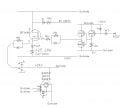
Hello, everybody. I recently have a chance to trace a part of the circuit of a commertial EDM machine ( Taiwan 1994) . The schematic is of a small board . The same type of board can be stacked together to increase Amp. As in the picture it called 2 Amps. If you need 6 Amps then you need to stack three boards together. I believe this type of circuit has been copy by many companies for modern sinker.
The schematic give me good idea how the Amps Is defined. How they limit current for each pulse.
Now I understand why whenever EDMguru talking about Amps. I couldn't understand. That 's because I was using different technique to limit the current.
Picture is edit as more information I receive
 

Attachments

Last edited:

MisterBill2

Joined Jan 23, 2018
27,606
Very interesting thread all about EDM and projects. That is one tool that I never touched. Mill, lathe, and surface grinder, and the wire feed gas shielded welder. Reading here I see that EDM has way more variables that must all be just so to do the best job. A whole lot of variables to have to set up, and different for each material.
I can make a suggestion for the servo to advance and retract the ire, or whatever gets advanced and retracted, which is to use a stepper and a backlash-free gear train so that the motion steps can be small enough. And if you need really fast really short moves back and forth, a piezo actuator, for moves up to a very few thou.
And since I really don't know more about EDM that will be the extent of my comments here.
 
Top