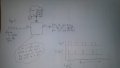
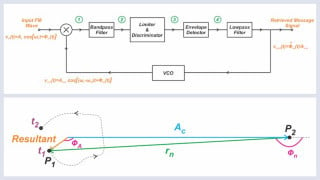
I'm looking for a way to take a external TTL signal, and adjust the duty cycle with out changing the freqeucny. Included is an image with a little better idea.
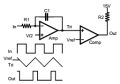
Off the top of my head, I'd integrate the input and use a comparator with an adjustable switching level to generate a variable pulse width at the same frequency as the input.
I'm not sure I'm understanding. Can you draw something down as an example?
Right now I've been defeated enough to use a 555 with an adjustable frequency and duty cycle in bi-stable mode to trigger two more 555 timers each in monostable mode. I'm currently wiring that up to see if that can give me the desired effect. Will post either more defeat or waveforms soon.
@AlbertHall, yeah, exactly. Thats what I'm trying to do now. I though there might have been some specific IC for this purpose, but as of yet I haven't been able to find it. So that is what I'm doing.
@dl324 : the output voltage of the integrator will vary quite a bit over the frequency range of 5 - 100 kHz. @AlbertHall : A monostable will not be able to cover the input frequency range of 5 - 100 kHz. @ericdmurphy : Your task is not easy due to this huge frequency range.
use the external signal to charge a capacitor. and then discharge the capacitor and compare its value vs. a set value (DC control value) -> user controllable DC.
As @bertus mentioned, the amplitude of the triangle wave will be frequency dependent and the RC time constant (R1C1) needs to be adjusted so it resembles a triangle wave.
When the amplitude of the triangle wave is above Vref, the output pulse will be HIGH. By connecting R2 to 15V, you can get the 15V swing you desired.
If the input is now three switched frequencies, then that same switch can switch the '555 timing capacitor or the integrator capacitor if that method was chosen.
Nope. For a constant frequency, if the input pulse width (the trigger signal) is wider than the output pulse width is supposed to be, the output pulse width will be incorrect unless you differentiate the input signal, and then you risk the differentiator time constant being too long. A 555 monostable circuit does not have positive feedback, so it is not a true monostable.
Even with a true monostable, having the input frequency vary over a 5:1 range (continuously or in steps, doesn't matter) is a problem for the classic circuit. If you really want one circuit to cover the whole range, this can be done with some extra gating to terminate a long output pulse. However, the adjustment pot will not have the same adjustment range at all freqs. For example, if the pot uses 100% of its mechanical range for 5% to 95% adjustment at 10 kHz, only 20% of its mechanical range will give the same adjustment range at 50 kHz. This might not be enough adjustability precision.
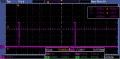
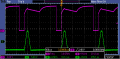
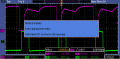
Channel 4 is the output of the second Amp (Comperator) rise to/fall time much to slow. Currently using a 741. I believe somewhere I have some OpAmps that have a rise/fall time of 100V/us or greater. Will keep you posted.
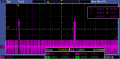
Ignore taht error message, didn't realize it would save with that. Either way, that is using an AD817 Op Amp, getting closer. I"ll adjust the bi-stable input and see if I can't get some cleaner signal and a shorter pulse width.
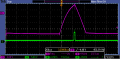
I can see what your saying with your circuit. I"m having issues getting the triangle wave to be very...well "tringley".
Is that were matching the R and C values comes into play?
Also, it seems that when I get the comp ref level up towards the higher end, so the pulse will be very short it just skips the higher range, and rails the output.
Would a longer rise/fall time accommodate for that?
Update: Even with a straight triangle wave into the comperator, I can't get a clean enough pulse with enough amplitude at a fast enough frequency. When I adjust the ref pot the output just ends up railing. Its no better that just using the bi-stable 555 I have now .
Even with a straight triangle wave into the comperator, I can't get a clean enough pulse with enough amplitude at a fast enough frequency. When I adjust the ref pot the output just ends up railing.
741's are okay as long as you understand their limitations. The common mode input voltage is only guaranteed to be about 3V from the supplies. What supply voltages are you using?
While an opamp *can* be used as a comparator, that doesn't mean it should. A comparator will have a faster response time.
What R and C are you using for the integrator and what is the frequency of the input signal?

 Facebook
 Google
 GitHub
 Linkedin