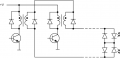
Yes. I was thinking of that too. We have had a number of occasions where RS485 networks have been zapped by lightning in the past. It may be a worth while option to opto-isolate the controller from the transistors, and use separate power supply. It can help a bit for a near miss but a close strike will fry it.
Yes. I was thinking of that too. We have had a number of occasions where RS485 networks have been zapped by lightning in the past. It may be a worth while option to opto-isolate the controller from the transistors, and use separate power supply. It can help a bit for a near miss but a close strike will fry it.
Some LEDs cannot tolerate any reverse bias without suffering long term degredation. Check the datasheets for the LEDs you intend to use before you settle on a design.
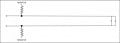
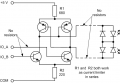
How about the relationship between inputs and Ground, do the IO_A, IO_B has any wire connected to Ground or the inputs only have IO_A, IO_B, if you only using two wires connected to the transistor Q1 and Q2 then the Q1 and Q2 do not like two transistors to the LEDs, the transistors just like two diodes from Base to Collector and to the LEDs, it means that the two transistors don't work like the switches any more.
How about the relationship between inputs and Ground, do the IO_A, IO_B has any wire connected to Ground or the inputs only have IO_A, IO_B, if you only using two wires connected to the transistor Q1 and Q2 then the Q1 and Q2 do not like two transistors to the LEDs, the transistors just like two diodes from Base to Collector and to the LEDs, it means that the two transistors don't work like the switches any more.
If the Vf of LED is 3V, how about when the inputs voltage are different as IO_A=0V, IO_B=3.3V(or 5V), or IO_A=3.3V(or 5V), IO_B=0V, do you think will the LEDs be damaged by inputs voltage?
If the Vf of LED is 3V, how about when the inputs voltage are different as IO_A=0V, IO_B=3.3V(or 5V), or IO_A=3.3V(or 5V), IO_B=0V, do you think will the LEDs be damaged by inputs voltage?
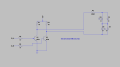
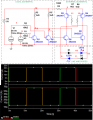
Good questions. It vas idea only. Now I finished simulation. Seems R5 = 1.2 k as current limiter is too big - current is 0.7 mA only.
When resistor R5 = 100 Ohm, LED's current is 20 mA.
If the Vf of LED is 3V, how about when the inputs voltage are different as IO_A=0V, IO_B=3.3V(or 5V), or IO_A=3.3V(or 5V), IO_B=0V, do you think will the LEDs be damaged by inputs voltage?

 Facebook
 Google
 GitHub
 Linkedin