Drive a washing machine direct drive motor

MisterBill2

Joined Jan 23, 2018
27,706
To drive any motor to its rated output you need to provide the dive required to achieve that output. And mostoften that means knowing the required drive voltage and current.
 

MaxHeadRoom

Joined Jul 18, 2013
30,699
Like any BLDC motor you need to first find out the pole count,. this can be done by back spinning the motor with the leads shorted and turn one rev and count the number of 'bumps' produced.
Although, if the 3 commutation detection devices have not been disturbed, it is not really necessary.
Presumably you would obtain the WM motor from scrap or surplus M/C, if you can also lay hands on the control board, then identify the rating of the drive Mosfets etc.
In the absence of any controller, it would require the building of a suitably sized BLDC drive, the number of drive examples out there are quite extensive.
One is one of the original Motorola examples featuring the MC33033/35 IC, initially Motorola offered a development board for the IC, which I also picked up at the time, for experimenting.
 

Attachments

roong

Joined Feb 11, 2017
59
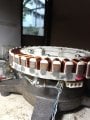
Update: I check 12 magnets of LG with a magnetic viewer and also test output of a hall sensor found that 24 pulses/ one sensor/one rev; each one of the magnet resemble four small magnets lay side by side alternate poles(field point toward center). LG direct drive is then a "Fisher-Paykel" type of motor.
A guy on Youtube successfully use it with VFD. But he states that you must set the VFD in sensorless vector mode( not ordinary induction motor). Another one successfully does it on Samsung similar type of motor. I brought a generic cheap Chinese VFD from the internet, unluckily it doesn't work, even though it said it has sensorless vector mode as selectable. The VFD only work for induction motor. So be careful don't waste money like me, go for brand names.
Its input voltage is very high as home AC voltage convert to DC, high voltage is an advantage because you save a buck convertor and the motor can be so powerful. The 12 permanent magnets(24 pole pairs) each has their polar laid radially and arranged alternately. The original sensor board has four wires, the most diagonal is 15V supply, next is ground, the other two are signal wires corespond to two sensors.
There are two sensors come originally. Each one doesn't sit in middle of a slot but so that the distance between the two sensors is a little more than the pitch of the slot. I have tested output of the two sensors by rotating the drum. It happens that the outputs can be in every combination 11,10,00,01. There are 24 pole pairs or 24North+24South. This should commute 48 times per one revolution. The letters on Hall sensors is W12C 1692, the IC has open collector output with internal 10k pullup resistor from my measurement and calculation, normally you won't get pull up resistor from Hall sensors of the shelth.The outputs can source about 0.5 mA and sink around 1 mA. I think Samsung use this two Hall sensors to indicate (24 pole pairs) the rotor position is, this information may use to start commuting the motor form stop into the desire direction. The two sensors change from 01 00 10 11 01 00 10 11 ...as being moved in one direction, reverse in another. This may look weird but, after I carefully analise, you can also use this two sensors to drive six steps commutation. Once the controller senses 00 or 11, you just put a sequence of two steps. But with predetermine period for the first step. A washing machine involves at low speed only. By reduce to two sensors lesser chance to breake down. What do you thing?
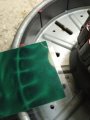
Finally I ignore the two original sensors and put three 41Fs by two slots apart, I attach a picture. Then I use cheap chinese red bldc driver board with 40Vdc, this one require 3 halls.
BLDC unlikes a 3 phase induction motor or a stepper motor you can not alternate a pair of wire and expect it will rotate in reverse.
For the first time it starts, you have to choose the right step out of six steps that corespond to signals from the Hall sensors. If the sensors are hooked up randomly, then there are 2/6 chances that motor will not move, 2/6 chances that the motor will move but low power, 1/6 chance that it works right but in reverse direction.
Finally, I use a cheapest smallest Chinese hub driver (6$). This one can make 80 rpm(@40Vdc) and as it said hall or halless, I took out Hall sensor connector, it still works without any problem. Hall sensors may be a thing of the past. I finally rewire the 12 slots per phase from original 12 slots in series to 2 slots in series X 6 in parallel. I can increase speed up from 80 rpm to 300 rpm with the cheap hub driver with 40 Vdc.
Thanks for reading.
 

Attachments

Last edited:
Top