drive ultrasonic diffusors without coils/manufactur-board

Thread Starter

momefilo

Joined Jan 16, 2026
15
Hallo people, engeneers and makers
I am and old power-electrican for Buildings with hobby-electronics interests with microcontrolers like Rpi-Pico. An actual project test the ultrasonic diffusors like this:
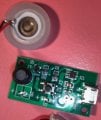
IMG_20260120_141849_DRO.jpg
for use in aeroponic systems. The ultrasonic disc is driven with 44V / 108kHz from the board with an coil. Now i will use the disc without the board and an 44V DC driven by an circuit with BS170 mosfet (this and 2n2222A i have on Hand).
This test-circuit:
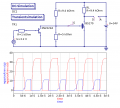
export.png
with Qucs-s software and in real i have buld an circuit to test. Without the disk this will work "fine"
My oszi shows on real circuit, the yellow line is between point G and ground, the blue point is D vs ground:
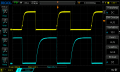
DS1Z_QuickPrint3.png

Whit the disc between point A and D the result is an other
The oszi shows the following:
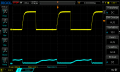
DS1Z_QuickPrint4.png

The Voltagedifference between A and D is to small to drive the disc

My question is, how can i drive the disk without an coil?
 

panic mode

Joined Oct 10, 2011
4,947
about the circuit... the yellow channel stays the same suggesting that 34V source is not the problem.

My question is, how can i drive the disk without an coil?
speakers with coil are low impedance and require high current.
piezo elements are high impedance requiring little current.

when you connect coil in a place of piezo, it creates short circuit.
 

Thread Starter

momefilo

Joined Jan 16, 2026
15
about the circuit... the yellow channel stays the same suggesting that 34V source is not the problem.


speakers with coil are low impedance and require high current.
piezo elements are high impedance requiring little current.

when you connect coil in a place of piezo, it creates short circuit.
Thanks for fast reply @panic mode
but i dont want to use a coil in the circuit!
 

panic mode

Joined Oct 10, 2011
4,947
ok so you are using same piezo transducer but.. now you are trying to drive it from your own circuit which does not have inductor. your circuit and graphs look ok. i would check for cold solder joints or adding inductor (at least for test) or replacing the mosfet. all circuits i have seen use inductor because piezo transducer is capacitive element and together they form resonant circuit.
 
Last edited:

MisterBill2

Joined Jan 23, 2018
27,362
This is an interesting question!! There is far more to that OUT OF FOCUS driver board than a coil. BUT, if the "ultrasonic diffusion" device contains only the piezo element, and no internal electronics, then without a 44V / 108kHz ultrasonic voltage drive signal you will only get a single DC "click". Having a coil is not the important part of driving a piezo device, but having an AC output signal is mandatory.
 

Thread Starter

momefilo

Joined Jan 16, 2026
15
yerh, the manufactur-bords come with the discs and the coil on there transforms a 5V/108kHz up to 44V/108kHz for the disk.
On little testing i found, that the half of RL to 4,7kOhm in my test-circuit make the Volagedifference on RL up to 17V with 108kHz. With smaller frequency the voltage is also greater. I now that a coil makes reverse voltage who must be respekted in circuits, and my experience is to small to make a stable long running system with it., And the coils on the boards are cheap and go hot and die on the long run.
 

Thread Starter

momefilo

Joined Jan 16, 2026
15
what is the reason to use ultrasound in aeroponic systems? do plants grow faster?
Yes, a test system is running whit an "Weihnachtsstern" for a few weeks. The nutrient goes with the aerosol in the roots. The elektrical problem is not the only, a stable, long running way for the nutrient to the disks is difficult. Also the temperatur of nutrient goes 3-4°C up. But it works noisless then high pressure-systems with min. 8bar for the same diffusion.
 

MisterBill2

Joined Jan 23, 2018
27,362
NOW I think that the problem is not "a coil" but rather a transformer. The confusing reference was the problem.
hile a transformer does contain coils of wire, I have not heard others calling a transformer "a coil."
 

Thread Starter

momefilo

Joined Jan 16, 2026
15
NOW I think that the problem is not "a coil" but rather a transformer. The confusing reference was the problem.
hile a transformer does contain coils of wire, I have not heard others calling a transformer "a coil."
Yes that i now too. But the Disk are not in resonanz with the coil, the coil only transform the voltage with frquency triggert by an µC. I will direct pulse the disk with an 44V DC by 108kHz, but my test-circuit dont look at the capacitance of the disk and ther feedback of the Voltagedifference over the bs170 and/or RL.
Have any one an idea without coils?
 

MisterBill2

Joined Jan 23, 2018
27,362
REALLY, none of this makes any sense. FIRST, the TS tells us that he is going to not use some driver board with "a coil", which is later revealed to be a transformer. At the same time we are shown a DC POWER SUPPLY circuit which the TS tells us will be used to drive the disk. It seems that the disk does not have any drive package, so that will not work.
And it does not seem reasonable that the test circuit shown in post #1 will work very well, if it works at all.
 

Thread Starter

momefilo

Joined Jan 16, 2026
15
Sorry, i translate better
Yes, I write that the circuit does not work with my gears. A microcontroller is controlled on the manufacturer's board, which supplies the transformer with 5 V/108 kHz, and on the secondary side of the transformer, the disk receives 44 V/108 kHz. The disc has a capacitance of 2.9 nF, measured with a multimeter. I think in my test circuit the time for the voltage to rise at the resistor of 9.4 kΩ (τ) is too long I want to switch/operate eight discs independently without eight transformers
I operate a cloud chamber with four of the manufacturer's boards, which I can easily switch on at intervals with 5V for the duration of operation (with an RPI pico and FETs). However, the boards are immensely annoying in "living room operation" because the coils get very warm and break quickly, and with eight atomizer discs I have eight such boards. I also don't know how you could wind good transformers yourself without having a machine
 

du00000001

Joined Nov 10, 2020
189
The design with the pull-up RL in line with the piezo transducer is BS. As you already found out RL is limiting the power to the transducer (too much). Lowering RL further would end up with a lot of power dissipation. (I doubt you need an additional electrical heater ;)(RL = 2k would still produce close to 0.6 W peak, 0.3 W on average.)
So you'd better go with a complementary emitter-follower driver stage (less powerful but also less design issues) or a totem-pole driver stage ("issue": prevent shoot-through during switching - the input of either connected to the current point "A") - the piezo attached to GND resp. the middle point of the driver stage. In both cases your existing part (2N2222 - RL) could serve as the necessary level shifter to drive the driver stage although 2 small signal transistor (60 V / 100 mA) would do as well.
 

panic mode

Joined Oct 10, 2011
4,947
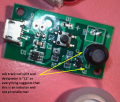
can we see the picture of the bottom side of the PCB and marking on the L1? because i suspect that L1 is just an inductor.
and if not, this would be first time i see L1 as transformer designator. also photo shown that PCB track is continuous (at least one seen on the left side). that minimizes changes of L1 being a transformer. if it gets hot, it is probably underrated.
many inductors in that form factor have low current rating.

1769192132001.png

btw if this is an inductor as i suspected, you can easy and cheap to buy it as a ready made part and rated for whatever your needs are. note that resonant current (between piezo diffuser and inductor) is much higher than current drawn from battery. so check the spec of existing inductor and find one with same inductance but for higher current and try it out.

to get most out of diffuser, it should get to resonance. so if piezo is 2.6nF and f=108kHz, then inductor should be some 820uH.

for example:
https://www.mouser.ca/ProductDetail/Coilcraft/RFB0810-821L?qs=ZYnrCdKdyedn92a/gt5IqQ==
 

du00000001

Joined Nov 10, 2020
189
can we see the picture of the bottom side of the PCB and marking on the L1? because i suspect that L1 is just an inductor.
and if not, this would be first time i see L1 as transformer designator. also photo shown that PCB track is continuous (at least one seen on the left side). that minimizes changes of L1 being a transformer. if it gets hot, it is probably underrated.
many inductors in that form factor have low current rating.

<... rest snipped ...>
Ever heard off an "ignition coil"? It's denominated a coil although in reality it's some kind of (usually split) transformer. And who knows who designed the PCB. If it's from China you can be happy that it is not called Rx or alike :)
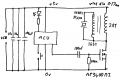
You're also missing some "split track", but the schematics in #13 show that 2 pins of the transformer are connected. And using a transformer is making sense. Also the traces to CN1 (where I suppose the transducer is to be connected) would look different when using a coil (whether in parallel or in series).
 

Thread Starter

momefilo

Joined Jan 16, 2026
15
Last edited:

Thread Starter

momefilo

Joined Jan 16, 2026
15
The design with the pull-up RL in line with the piezo transducer is BS. As you already found out RL is limiting the power to the transducer (too much). Lowering RL further would end up with a lot of power dissipation. (I doubt you need an additional electrical heater ;)(RL = 2k would still produce close to 0.6 W peak, 0.3 W on average.)

So you'd better go with a complementary emitter-follower driver stage (less powerful but also less design issues) or a totem-pole driver stage ("issue": prevent shoot-through during switching - the input of either connected to the current point "A") - the piezo attached to GND resp. the middle point of the driver stage. In both cases your existing part (2N2222 - RL) could serve as the necessary level shifter to drive the driver stage although 2 small signal transistor (60 V / 100 mA) would do as well.
Thanks for your Answer, i must first look for an example of "complementary emitter-follower driver stage" or "totem-pole driver stage" to understod what you mean
 
Top