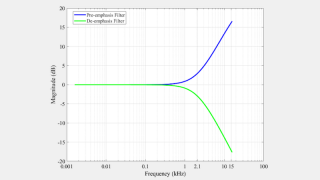
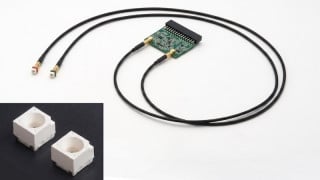
How to drive 35W 40khz Ultrasonic Piezo Ceramic Disc

Thread Starter

zaferaltun

Joined Aug 31, 2016
71
Hello

First of all, I 'm not electronical engineering expert, I 'm just dealing with it as hobbiest, mostly digitally since I 'm a software developer actualy.

I 'm trying to make an ultrasonic cleaner, I did some research and I found some options to buy and thought it could be enough such a ceramic disc below with the specs I noted from the seller's page, I want a slim design so I preferred this one:
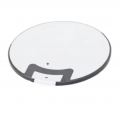
piezo-ceramic-disc.png

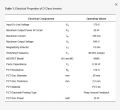
Power: 35W
Resonant frequency(KHz): 40 ± 1
Static capacitance(pF): 8500 ± 10%
Resonance impedance: less than equal 20 Ohm
Insulation resistance(2500V DC): greater than equal 100M Ohm
Material:ceramics

Short story: Can someone tell me how to drive this disc as much as simple and efficient if it is suitable for my purpose please?

Long story:

I coded an interface that can be used with a TFT display and controlled with a rotary encoder, you can select the frequency between 20khz-60khz (for different purposes maybe) and duyt cycle, time etc, everything is fine except the driving this disc.

Maybe it is too late after all that wasted time but is this ceramic disc really the right choice to make an ultrasonic cleaner? I tried to drive it with a half-bridge circuit. This was my first time with half-bridges, I had IR2113S as ready-to-go, so I tried it first, but that IC has not a dead-time settings, I was arranging the dead-time with STM32's Complementary PWM (thankfully it has) but could not succeed, the low side was working perfect but the high side not, there was a cross betwen high and low when the high side goes low and the low side goes high. The complemantary PWM output working perfect when I check with the oscilloscope by the way, but not with the circuit. I tried lots of things, playing with resistor values, making buffers, but no luck, maybe I did something wrong, I don't know. So there was no current flow as a result, no luck!

So after some research I retried with a simpler IC option, which is IR2184, you just give a PWM and it arranges the dead time, plus, you don't need a complementary PWM driving etc. I designed the circuit below, I connected a 22R 5W resistor as a load for example and I did get some current between 0.5A-1A (it depends on the resistor value of high side mosfet and it was better with a 10nF parallel cap to the pull-down resistor). When I connected the piezo, I heard some buzzing but again, there was not enough current. After I dig more, I read it needs a series inductor to resonate it as well, so I connected the inductor with piezo in series as a load, it made it better but still there was no current except a few milliamps like 10mA.
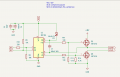
IR2184-half-bridge.png


Finally I gave up the half-bridge since I 'm not expert, I decided to drive it in less effiency but with a simpler method, which is power mosfet, L1 is around 2mH, I have still no luck with the circuit, no current!
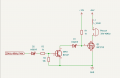
mosfet-driver.png

I tried different discs in case of may be broken etc, I tried everything except 2 things: A motor driver module like L298N and driving with a transformator. I wasted so much time, any help can work so much really.

Thank you for your patience if you read until here.
Best
 

MrChips

Joined Oct 2, 2009
34,698
A simple circuit is a 555-timer astable running at 40 kHz with 50% duty cycle.
Feed the output to the gate of Q1 MOSFET.
 

MisterBill2

Joined Jan 23, 2018
27,312
35 watts into a capacitive load at 40 KHZ may not be simple at all.
Probably a low-distortion sine wave is required.
I suggest finding service information for commercial ultrasonic cleaners of a similar specification, and using those circuits as examples of what is required. (Certainly this is a "Cheating Trick", but learning from others is a lot easier than discovering things the hard way. AND if you are not creating a product to compete in the market, patented design use should not be a legal issue.)
 

MisterBill2

Joined Jan 23, 2018
27,312
Alec is correct. THAT is why I suggested a low distortion sine wave. I did forget to add that it should have a zero voltage center value. That makes the drive circuit more complex.
 

Irving

Joined Jan 30, 2016
5,065
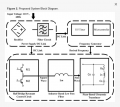
A piezo device is voltage driven not current driven. You need to create a differential voltage across it to get maximal physical deflection. If you look at a commercial piezo driver for ultrasonic cleaners you will see they are high voltage (typically 100 - 2000V), low current (<30mA) devices, and generally have a push-pull output. Digging around I found this spec for a half-bridge driver and block diagram of the system:

1753880672522.png1753880762112.png

Source: https://www.mdpi.com/2076-3417/13/12/6991


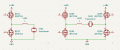
You were on the right lines with your half bridge but your output circuit was wrong as you weren't driving the device correctly. Here's how it should be done, both with a half bridge, or better with a full bridge to double the driving voltage.

1753881744024.png
 

Ian0

Joined Aug 7, 2020
13,112
Your main problem is that you have the load between the top and bottom parts of the half bridge. The two MOSFETs connect top source to bottom drain, and the load goes between there and ground, with a DC blocking capacitor.
[edit] as @Irving has just posted whilst I was typing this.
 

Thread Starter

zaferaltun

Joined Aug 31, 2016
71
A piezo device is voltage driven not current driven. You need to create a differential voltage across it to get maximal physical deflection. If you look at a commercial piezo driver for ultrasonic cleaners you will see they are high voltage (typically 100 - 2000V), low current (<30mA) devices, and generally have a push-pull output. Digging around I found this spec for a half-bridge driver and block diagram of the system:

View attachment 353374View attachment 353375

Source: https://www.mdpi.com/2076-3417/13/12/6991


You were on the right lines with your half bridge but your output circuit was wrong as you weren't driving the device correctly. Here's how it should be done, both with a half bridge, or better with a full bridge to double the driving voltage.

View attachment 353376
I don't know how to thank you, you helped so much. Actually I 'm a researcher one but sometimes you can't find the things if you don't search in the correct way and with the correct keywords, there are lots of garbage information as much as the benefit ones.

I will try both circuits and let you know if they works. After I read your saying "not current driven" and remember that I got a few milliamps (around 10) with my half-bridge test, maybe it was working but I did not get since I was expecting much more current and testing with osiloscope etc, not with a tank for example. I was hearing a buzzing sound but I did not feel the vibration on the disc, so it was not working properly right?

Thank you so much again, best regards.
 

Irving

Joined Jan 30, 2016
5,065
What is the maxmum DC voltage for your piezo? If it is less than 60V, then use a coupling capacitor with the first circuit.
The problem with buying piezo etc devices from non-mainstream online suppliers is that you often can't get full specs unless you have a model/part # on the device.
 

Thread Starter

zaferaltun

Joined Aug 31, 2016
71
What is the maxmum DC voltage for your piezo? If it is less than 60V, then use a coupling capacitor with the first circuit.
I want to use 48V for the piezo as in the schematic. So is the purpose of coupling to increase the driving volume?
 

MrChips

Joined Oct 2, 2009
34,698
Really? So how can it be effective if it does not vibrate but spreading the sound only? Does it really work?
20 to 20 kHz is commonly accepted as the range of human hearing. 40 kHz is in the ultrasonic range.

Most humans cannot sense by touch frequencies lower than 200 Hz.

Have you ever had an ultrasonic scan on your body?
There is no tactile sensation during an ultrasonic scan.

Ultrasonic cleaners work by vibrating water molecules.
 

Thread Starter

zaferaltun

Joined Aug 31, 2016
71
20 to 20 kHz is commonly accepted as the range of human hearing. 40 kHz is in the ultrasonic range.

Most humans cannot sense by touch frequencies lower than 200 Hz.

Have you ever had an ultrasonic scan on your body?
There is no tactile sensation during an ultrasonic scan.

Ultrasonic cleaners work by vibrating water molecules.
I have to try with a real tank then. Thank you for the tips, I will let you all know the results in a couple of days.
Best
 

ericgibbs

Joined Jan 29, 2010
21,419
Hi zaf,
When the disc is dry, sprinkle a little salt or sugar on the face of the flat plate, and power it up.
note any patterns.
E
 

Irving

Joined Jan 30, 2016
5,065
Ultrasonic cleaners vibrate the liquid in the tank causing cavitation and the generation of micro-bubbles - its the bubbles that do the cleaning... and the liquid isn't necessarily water.

Here's one DIYer example, build starts at 12:02
 

Parkera

Joined May 3, 2016
124
I have to try with a real tank then. Thank you for the tips, I will let you all know the results in a couple of days.
Best
I don't know what happens for sure physiologically, but every ultrasonic cleaner cautions to NOT put you hand into the cleaner when it is on. If I were to guess, you could cause air bubbles to form in your blood, which will stop your heart. Play it safe and just don't do it. EricGibbs has a good idea to check if it is working; put a bit of salt or sugar on the bottom and look for a pattern to form. Don't use too much, you really only want a thin layer of salt/sugar.
 
Hello

First of all, I 'm not electronical engineering expert, I 'm just dealing with it as hobbiest, mostly digitally since I 'm a software developer actualy.

I 'm trying to make an ultrasonic cleaner, I did some research and I found some options to buy and thought it could be enough such a ceramic disc below with the specs I noted from the seller's page, I want a slim design so I preferred this one:

View attachment 353357

Power: 35W
Resonant frequency(KHz): 40 ± 1
Static capacitance(pF): 8500 ± 10%
Resonance impedance: less than equal 20 Ohm
Insulation resistance(2500V DC): greater than equal 100M Ohm
Material:ceramics

Short story: Can someone tell me how to drive this disc as much as simple and efficient if it is suitable for my purpose please?

Long story:

I coded an interface that can be used with a TFT display and controlled with a rotary encoder, you can select the frequency between 20khz-60khz (for different purposes maybe) and duyt cycle, time etc, everything is fine except the driving this disc.

Maybe it is too late after all that wasted time but is this ceramic disc really the right choice to make an ultrasonic cleaner? I tried to drive it with a half-bridge circuit. This was my first time with half-bridges, I had IR2113S as ready-to-go, so I tried it first, but that IC has not a dead-time settings, I was arranging the dead-time with STM32's Complementary PWM (thankfully it has) but could not succeed, the low side was working perfect but the high side not, there was a cross betwen high and low when the high side goes low and the low side goes high. The complemantary PWM output working perfect when I check with the oscilloscope by the way, but not with the circuit. I tried lots of things, playing with resistor values, making buffers, but no luck, maybe I did something wrong, I don't know. So there was no current flow as a result, no luck!

So after some research I retried with a simpler IC option, which is IR2184, you just give a PWM and it arranges the dead time, plus, you don't need a complementary PWM driving etc. I designed the circuit below, I connected a 22R 5W resistor as a load for example and I did get some current between 0.5A-1A (it depends on the resistor value of high side mosfet and it was better with a 10nF parallel cap to the pull-down resistor). When I connected the piezo, I heard some buzzing but again, there was not enough current. After I dig more, I read it needs a series inductor to resonate it as well, so I connected the inductor with piezo in series as a load, it made it better but still there was no current except a few milliamps like 10mA.

View attachment 353358


Finally I gave up the half-bridge since I 'm not expert, I decided to drive it in less effiency but with a simpler method, which is power mosfet, L1 is around 2mH, I have still no luck with the circuit, no current!

View attachment 353359

I tried different discs in case of may be broken etc, I tried everything except 2 things: A motor driver module like L298N and driving with a transformator. I wasted so much time, any help can work so much really.

Thank you for your patience if you read until here.
Best
Check out the Sept/October 2021 editions of Practical Electronics - there is a high power ultrasonic project detailed - maybe useful?
 
Top