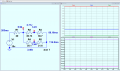
Does this quesion have a solution?

MrAl

Joined Jun 17, 2014
13,704
While not definitive, I've explored the values for R1 from 13 Ω (it's trivial to show that R1 must be no less than 12.2 Ω) up to 1 MΩ in 1 Ω steps. For each value I calculated the nominal values (to something like 14 sig figs) for the other three resistors. I then rounded those to the nearest integer value. I then determined the maximum error in the three voltages and kept only those that were no more than 5 mV. I only found one. If I only required the results to match within 10 mV, after rounding to three sig figs, there were 23 solutions.

But I can't say that this approach truly looked at all viable solutions. It rounded each resistor value independently to the nearest ohm, but it's possible that the error introduced by rounding one or two of them in one direction might have been better offset by rounding another in the "wrong" direction. It wouldn't be to hard to modify my script to fully explore the small region around each nominal solution -- I think looking at all combinations of the floor and ceiling values (so eight combinations) would likely do it. While I think it's possible that this might reveal additional solutions, I would bet against it, if I had to place a bet.

As for the question of whether stopping at 1 MΩ potentially rules out any solutions, I think a careful analysis could be done to establish an upper bound for the resistor values such that changes could no longer move the parallel combination of the network enough to have any impact of significance. I'm pretty sure that 1 MΩ is well beyond that limit, but I'm not positive. Based on a quick survey of the behavior, I think the upper bound is probably closer to 2 kΩ.
Hi,

Yes that's interesting too.
Yeah I know it is hard to be sure that a search is truly definitive so I started to look for a regular proof such as an algebraic proof.

I am not sure what you mean by an upper bound, is that for all four resistors?
The only upper bound I could find was for the sum of two of the resistors in one series string, such as R2+R3. The upper bound is positive infinite unless we allow negative values, which I do not think we should consider. That means that R2 and R3 will both be a ratio of infinity like:
R2=a*inf
R3=b*inf
and a and b are the correct ratios to still provide that 3.23 volts at the divider junction.
This places the required total parallel resistance solely on the values of R0 and R1.

The proof I started to look for, where all the resistors are whole numbers in Ohms, might look something like this...
If we have two fractions for two of the resistors:
R2=A/3 and R3=B/3
it seems we must have A and B such that they are both evenly divisible by 3. For example A=6 and B=12. If there is any deviation from that, then one of them must be non whole, and that would prove that there are no pure integer solutions.
This is what I think we run into with this problem. The expressions for R2 and R3 can not be modified once we get that far, so A and B must be related in that certain way.


As to your second post and the equation:
248·R0 - 346·R1 = 0

I am not sure that is a good way to descibe the situation because we are looking to solve for resistor values, either R0 or R1 there, and that is not a solution. A solution would be for either R1 or R0. Solving that for R1 we get:
R1=(124*R0)/173
and we see that fraction 124/173 kick in, and I think that may be key to proving there is no pure, exact integer solution.
The solutions for the other two (knowing R0) are even stranger than that. They both have the same denominator but different numerators, and the numerators are not related. I won't rule anything out just yet though.
 

MrAl

Joined Jun 17, 2014
13,704
@The Electrician
@WBahn

Hello again,

Ok I have a first postulate for this pure integer solution problem.

We have this equation for R1 from control R0:
R1=(124*R0)/173

Now do you agree that R0 must be a whole multiple of 173 in order for R1 to be a whole number as well as R0?
In other words, R0 has to be divisible by 173, so we can consider R0 to be 173*1, 173*2, etc., to 173*a where 'a' is a whole number. BTW 173 is a prime number.
For example, if R0 was 173 then R1 would be 124 Ohms.

That's a starting point I think but see what you think.
 
Last edited:

ericgibbs

Joined Jan 29, 2010
21,442
Hi,
It is a simple problem.
We know the current through the 20R and the voltages at the resistive parallel mid point junctions.
So the 203mA divides according to the ratio of the two mid point voltages.

E
EG57_ 1300.png
 
Last edited:

WBahn

Joined Mar 31, 2012
32,840
Hi,
It is a simple problem.
We know the current through the 20R and the voltages at the resistive parallel mid point junctions.
So the 203mA divides according to the ratio of the two mid point voltages.
On what basis do you only allow the current to divide according to the ratio of the two mid-point voltages? That seems completely arbitrary and there's nothing in the problem that would even suggest that this is implied, much less required.

Pick a fraction of the total current that you want going down the upper branch, from 0% to 100%, and that choice will yield unique values for all four resistors. The midpoint voltages only place constraints on the ratios of the two resistors in that branch.
 

ericgibbs

Joined Jan 29, 2010
21,442
hi, @WBahn
I suspect, the originator of the question, chose the voltages at the given Nodes in order to give a current result as a ratio of the mid point voltages.
Are you saying the posted resistor values in post #43 are incorrect, if so what numeric values do you calculate.?

E
 

wayneh

Joined Sep 9, 2010
18,104
Those values represent one solution. The plot I posted gives the relevant part of the found set. Infinite solutions.
 

WBahn

Joined Mar 31, 2012
32,840
hi, @WBahn
I suspect, the originator of the question, chose the voltages at the given Nodes in order to give a current result as a ratio of the mid point voltages.
Are you saying the posted resistor values in post #43 are incorrect, if so what numeric values do you calculate.?

E
The posted values are one of the infinite number of possible correct answers.

I just don't see where the assumption that the voltages at those nodes indicate a particular constraint on how the current splits is particularly reasonable or, perhaps more accurately, any more (or less) valid than any other assumption. Other more-or-less reasonable assumptions might be that the current splits equally down the two branches, or that R0=R2, R0=R3, R1=R2, R2=R3, Come to think of it, that might actually be a good way to give essentially the same problem to a class but have multiple variants to discourage/catch cheaters.

If I were making the problem, I would have chosen standard E12 values for all of the resistors. Since the one given resistor value is at least from the E24 series, I might suspect that the other four would be also. But, then again, I also know that many people that write EE textbooks don't even know about the existence of preferred resistor values (sad, but true), so that's a weak suspicion.

I think it's reasonably safe to say that the TS's due date has likely passed. If I look for integer value resistances (in ohms), then I get resistances, in order, of 105 Ω, 75 Ω, 16 Ω, and 19 Ω. These produce the stated voltages to the given level of significance.
 

MrAl

Joined Jun 17, 2014
13,704
The posted values are one of the infinite number of possible correct answers.

I just don't see where the assumption that the voltages at those nodes indicate a particular constraint on how the current splits is particularly reasonable or, perhaps more accurately, any more (or less) valid than any other assumption. Other more-or-less reasonable assumptions might be that the current splits equally down the two branches, or that R0=R2, R0=R3, R1=R2, R2=R3, Come to think of it, that might actually be a good way to give essentially the same problem to a class but have multiple variants to discourage/catch cheaters.

If I were making the problem, I would have chosen standard E12 values for all of the resistors. Since the one given resistor value is at least from the E24 series, I might suspect that the other four would be also. But, then again, I also know that many people that write EE textbooks don't even know about the existence of preferred resistor values (sad, but true), so that's a weak suspicion.

I think it's reasonably safe to say that the TS's due date has likely passed. If I look for integer value resistances (in ohms), then I get resistances, in order, of 105 Ω, 75 Ω, 16 Ω, and 19 Ω. These produce the stated voltages to the given level of significance.
Hi again,

I was hoping you would comment on post #42 as to the validity of that claim because if it is not correct then everything else after that fails. I'll try to present the entire proof here though so it's all in one post.

Postulate 1
Given this solution for R1 with control R0:
R1=(124*R0)/173
both R0 and R1 must be positive whole numbers.
With R0 whole and positive, it must be a multiple of the prime173 in order for R1 to be whole and positive.
Thus R0 must be 173 times a whole number 'a':
R0=173*a

Postulate 2
(a) Given two numbers A and B, with functions A=fA(a) and B=fB(a), with parameter 'a' whole and positive.
(b) If A and B are both whole and positive due to the parameter a, then the sum A+B must be whole and positive.
(c) Just because the sum A+B *must* be whole and positive with A and B whole and positive, it does not mean that A and B *must* both be whole and positive.

Postulate 3
(a) If we can show that there is only one whole number solution for 'a' that creates a whole number for the sum A+B, yet A and B themselves do not come out whole, then the lack of a pure whole number solution is proved.
(b) If the above does in fact create both A and B whole with just one solution for 'a', then the final test is to see if the required total parallel resistance of the two series strings is met. If it is not met, the lack of a pure whole number solution is proved.

It looks like I can find a single solution for 'a' in the above that produces a whole number sum A+B, but both A and B do not come out whole (part 3a above). Thus I believe there is no pure whole number solution.

If you care to examine this proof and see if you can find any problems please do so.
Since there has been a long time since the original thread starter has returned, I can provide more details about the above functions fA(a) and fB(a) which stem from the circuit itself.
 
Last edited:

MrAl

Joined Jun 17, 2014
13,704
Hi,
It is a simple problem.
We know the current through the 20R and the voltages at the resistive parallel mid point junctions.
So the 203mA divides according to the ratio of the two mid point voltages.

E
View attachment 307789
Hi there Eric,

We also started looking for specific solutions that could meet other criteria such as pure whole number solutions for the resistors, given in Ohms. We also looked for approximate whole number solutions.

I think I found a proof that there is no pure whole number solution but you can take a look and see what you can find too.
 

ericgibbs

Joined Jan 29, 2010
21,442
Hi @MrAl,
I would say the resistor values I have posted are close enough when using two decimal place calculations.
The posted circuit satisfies all the posted current and voltage values stated in the original question

I am waiting to see what my fellow posters give as actual resistor values, say within one or two decimal places.

E
 

MrAl

Joined Jun 17, 2014
13,704
Hi @MrAl,
I would say the resistor values I have posted are close enough when using two decimal place calculations.
The posted circuit satisfies all the posted current and voltage values stated in the original question

I am waiting to see what my fellow posters give as actual resistor values, say within one or two decimal places.

E
@WBahn
@The Electrician

Hi there Eric,

Yes that should be interesting too.
It's good to look for approximate solutions and the equations below should help that also.

Here are the solutions I found using R0 as control:
[R1=(124*R0)/173, R2=(2710*R0)/(203*R0-3460), R3=(3230*R0)/(203*R0-3460)]

If we enumerate the right hand side of those three we can call them e1, e2, and e3 respectively in the same order.

THE TESTS (note we do not have to assign a value to R0 to do these tests, R0 drops out naturally):

5.94*e1/(e1+R0)=2.48 (true)
5.94*e3/(e3+e2)=3.23 (true)
(e1+R0) in parallel with (e2+e3)=5940/203 (true, and 5940/203 is the required total parallel resistance of the two strings)

Since all three are true, those equations are correct.

The proof that there is no pure positive whole integer solution is:
Since R0 has to be a multiple of 173 we can replace R0 with 173*a, where 'a' is whole also. Next form the sum:
Sum=e2+e3
and this sum *must* be whole, and can only be whole when a=4, that's the only solution.
Now if we plug that 4 into e2 and e3 separately, we do not get whole numbers for both,
therefore there can be no whole number solution. Note e2 and e3 must both be whole because they are just the resistance values for R2 and R3, but since they do not come out whole with the one and only solution for 'a', there can be no whole number solution.

This looks correct but feel free to look it over and see if you can find a fault.
 
Last edited:

BobTPH

Joined Jun 5, 2013
11,515
Would someone please close this thread. The correct answer to the question was given in post. #2: Yes, there is a solution. Eventually we got the more informative answer that there are infinitely many solutions. Everything after that has been irrelevant.
 

WBahn

Joined Mar 31, 2012
32,840
Hi @MrAl,
I would say the resistor values I have posted are close enough when using two decimal place calculations.
The posted circuit satisfies all the posted current and voltage values stated in the original question

I am waiting to see what my fellow posters give as actual resistor values, say within one or two decimal places.

E
A couple of different sets have been posted:

The closest to an integer solution that I see is at R0 = 35Ω where R1, R2 and R3 calculate to 25.09, 26.02 and 31.01 Ω respectively.
His approach was to look for sets of resistances that solve the circuit when R0 is forced to be an integer and minimizing the amount by which the nominal value of the other three differ from integers.

Bringing these to integer values and then solving for the voltages almost produces matches to the three-sig figs in the diagram (instead of 2.48 V for one of them, you get 2.49 V).

If I look for integer value resistances (in ohms), then I get resistances, in order, of 105 Ω, 75 Ω, 16 Ω, and 19 Ω. These produce the stated voltages to the given level of significance.
This was done a bit differently, where R1 was stepped through and the nominal resistors were rounded to the nearest integer and then the resulting voltages determined, with the goal being to get the minimum error between the three annoted voltages.

With the information provided by the TS, namely just three constraints, there are in infinite number of solutions and these three happen to be "preferred" according to some arbitrarily chosen fourth constraint.
 

WBahn

Joined Mar 31, 2012
32,840
Would someone please close this thread. The correct answer to the question was given in post. #2: Yes, there is a solution. Eventually we got the more informative answer that there are infinitely many solutions. Everything after that has been irrelevant.
If the TS wants the thread closed, they can request it. Other members are free to unwatch it.
 
@WBahn
@The Electrician

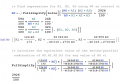
(e1+R0) in parallel with (e2+e3)=5940/203 (true, and 5940/203 is the required total parallel resistance of the two strings)

Since all three are true, those equations are correct.
But the parallel combination result (5940/203) is not (exactly) true unless you round the calculated result to 4 digits.
Is this okay with you that you have to round results to the number of digits shown in post #1? I thought you were not counting a solution as good unless you got exact calculated results.

It's possible to carry your method a little further and get an exact result also for the parallel combination:

Problem Approx.png
 
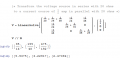
His approach was to look for sets of resistances that solve the circuit when R0 is forced to be an integer and minimizing the amount by which the nominal value of the other three differ from integers.

Bringing these to integer values and then solving for the voltages almost produces matches to the three-sig figs in the diagram (instead of 2.48 V for one of them, you get 2.49 V).
I get a rounded value of 2.47 V instead of 2.48 V.

Problem volts.png
 

WBahn

Joined Mar 31, 2012
32,840
I get a rounded value of 2.47 V instead of 2.48 V.

View attachment 307857
The numbers I got from a spreadsheet was:

If I use values for R0 to R1 of 35 Ω, 25 Ω, 26 Ω, and 31 Ω, I get the three voltages being 5.973700 V, 3.229167 V, and 2.4873958 V. That last one just barely misses the mark as it rounds to 2.49 V.
Unfortunately, I never saved the spreadsheet and my machine updated during the night, so it's gone.

However, I can see what happened. Notice that the first two results have six decimal places reported and the third has seven. So, if I speculate that it's a matter of fat-fingering when I typed the values into the spreadsheet and that I put an extraneous '8' in there, then I would have had 2.473958 V, which matches your result. I didn't catch it because, quite coincidentally, the result was an error of the same magnitude, which is all my spreadsheet reported.

Thanks for spotting it.
 

wayneh

Joined Sep 9, 2010
18,104
I still don't understand the fascination with integers, but to put this to bed I
1. Calculated precise values for R1, R2, and R3 for a list of integer R0 values ranging from 18 to 260.
2. Each of the calculated R1, R2 and R3 values were then rounded to an integer and
3. The three reference voltages were back-calculated and then
4. Compared (by summing the squared residual errors) to the given values.

In the range of R0 tested, the minimum error - caused by rounding R1-3 to integers - was given by R0=35, R1=25, R2=26, R3=31. This is the same solution I gave in #30 by just eyeballing the list. Turns out it was indeed the best. The voltages at this solution calculate to 3.2305, 2.4750, and 5.9380. Sum of squared residual errors = 2.92x10^-5

The solution proposed by @WBahn was 105, 75, 16, 19, which gives a sum of squares = 1.5x10^-4.

The other lowest-error solutions are:
25, 18, 42, 50 4.65x10^-5
104, 75, 16, 19 1.1x10^-4
 
Last edited:
3. The three reference voltages were back-calculated and then

The voltages at this solution calculate to 3.2305, 2.4750, and 5.9380.
Did you get these voltages by setting R0,R1,R2,R3 to 35,25,26,31 in the circuit of post #1 and then solving the circuit for the 3 voltages? Is this what you mean by "back-calculated"?

If that's what you did, you have incorrect values for the voltages. See post #56 and #57
 

WBahn

Joined Mar 31, 2012
32,840
I still don't understand the fascination with integers, but to put this to bed I
1. Calculated precise values for R1, R2, and R3 for a list of integer R0 values ranging from 18 to 260.
2. Each of the calculated R1, R2 and R3 values were then rounded to an integer and
3. The three reference voltages were back-calculated and then
4. Compared (by summing the squared residual errors) to the given values.

In the range of R0 tested, the minimum error - caused by rounding R1-3 to integers - was given by R0=35, R1=25, R2=26, R3=31. This is the same solution I gave in #30 by just eyeballing the list. Turns out it was indeed the best. The voltages at this solution calculate to 3.2305, 2.4750, and 5.9380. Sum of squared residual errors = 2.92x10^-5

The solution proposed by @WBahn was 105, 75, 16, 19, which gives a sum of squares = 1.5x10^-4.

The other lowest-error solutions are:
25, 18, 42, 50 4.65x10^-5
104, 75, 16, 19 1.1x10^-4
The fascination with integer values just because their integers is, indeed, a bit perplexing. Focusing on integer values based on the hypothesis that the original circuit that the problem writer devised probably used integer value resistors is probably a reasonable hypothesis. I would have liked the assumption that the writer used standard resistor values to hold water, but there is no indication that that was the case.

I think you might need to look at how you did the analysis, because I don't agree with the numbers you got. I'm guessing the use of intermediate results that are using the nominal resistor values???

Here are the results I get by sweeping R1 from 13 Ω to 1 MΩ, keeping results that resulted in a maximum error in any one of the three voltages not exceeding 10 mV:

Personally, I prefer RMS error as a more meaningful way to express overall error.

Code:
   R0   R1   R2   R3   Err_max     V1        V2        V3     sum(err^2)  rms(err)
(  18,  13, 222, 264 ) 0.9905 ( 5.930095, 3.221286, 2.486814 ) 2.205e-04   0.0086
(  21,  15,  72,  86 ) 0.5786 ( 5.944816, 3.235786, 2.477007 ) 6.563e-05   0.0047
(  25,  18,  42,  50 ) 0.7981 ( 5.943510, 3.230168, 2.487981 ) 7.604e-05   0.0050
(  35,  25,  26,  31 ) 0.6042 ( 5.937500, 3.229167, 2.473958 ) 4.345e-05   0.0038
(  36,  26,  25,  30 ) 0.9565 ( 5.930435, 3.234783, 2.486957 ) 1.628e-04   0.0074
( 102,  73,  16,  19 ) 0.9661 ( 5.932203, 3.220339, 2.474576 ) 1.835e-04   0.0078
( 103,  74,  16,  19 ) 0.7192 ( 5.936751, 3.222808, 2.482032 ) 6.641e-05   0.0047
( 105,  75,  16,  19 ) 0.3585 ( 5.943396, 3.226415, 2.476415 ) 3.724e-05   0.0035
( 106,  76,  16,  19 ) 0.7712 ( 5.947712, 3.228758, 2.483660 ) 7.442e-05   0.0050
( 146, 105,  15,  18 ) 0.7894 ( 5.932106, 3.235694, 2.481558 ) 9.716e-05   0.0057
( 148, 106,  15,  18 ) 0.7502 ( 5.935420, 3.237502, 2.476986 ) 8.634e-05   0.0054
( 149, 107,  15,  18 ) 0.8684 ( 5.937588, 3.238684, 2.481726 ) 8.421e-05   0.0053
 
Top