Displaying 2 Different things on 1 Pair of Seven Segments

Thread Starter

ro169

Joined Oct 10, 2014
62
I have a question about displaying 2 different sets of data on the same set of of seven segments.

Basically I have signals coming in from 4 BCD's going to the same pair of seven segments. 2 of the BCD's will be on during 1 period and subsequently switched off when the 2nd pair are switched on. What I would like to know is, would the output from the pair of BCD's that's on affect the BCD's that's off since both pairs are connected to the same point to be be displayed on the same pair of seven segments? Would the current split and affect the extent to which the seven segs. are illuminated?

If this is the case would it be more effective to use OR gates so that the signals do not meet at the same point or would using diodes to limit the direction of current flow be better? This would only be necessary should the answer to the questions in the above paragraph be 'Yes'.

Bear in mind that I need be consider cost and PCB space.
 

DickCappels

Joined Aug 21, 2008
10,661
A schematic diagram would probably help, but going from my interpretation of your description, you want to have the outputs of two BCD decoders in parallel and switch one or the other decoder off and let the other one drive the display.Right so far?

Which devices in particular are you planning to put in parallel (part numberss)? In many cases the output voltage cannot exceed VDD (or VCC) by more than a few hundred millivolts.
 

Thread Starter

ro169

Joined Oct 10, 2014
62
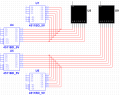
I hope this image helps clarify
Basically I have signals coming in from 4 BCD's going to the same pair of seven segments.
Initially U4 and U5 are on and subsequently switched off when U6 and U7 are switched on.


BCD.png
 

DickCappels

Joined Aug 21, 2008
10,661
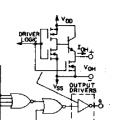
You might be able to get away with it if your power supply is 5 volts or lower. And I said might. With a much higher power supply voltage, you run the risk of turning on the device that you want to have off thereby making it possible if not probable that there the two drivers will "fight" with one-another, which could affect operation and reliability. The reason for the guess of 5 volts or lower possibly being ok is that 5V is probably less than the voltage to break down the NPN transistor's Emitter-Base junction in reverse plus forward bias the Base-Collector junction.

The '4026's display enable input appears to only blank the display and does not disconnect its output.
outputstage.png
Operating a part outside of the manufacturer's specified parameters runs a risk of problems with reliability or operation. If this is a one-off and you can tolerate the risk, why not?

It would be far better to use a multiplexer to multiplex the input signals to the decoder/driver (fewer parts to add and they don't need to be able to drive an LED).
 

Thread Starter

ro169

Joined Oct 10, 2014
62
Ok thank you so much for your insight.

I'm currently working on a project in which no devices which can be self programmed are allowed.
thanks.
 

djsfantasi

Joined Apr 11, 2010
9,237
Take a look at a 74HC157; it's a quad 2 to 1 multiplexor. You'll need two, one for each 7 segment display. One signal, the select input, will choose which BCD output to use.

This is what @DickCappels suggested.
 
Last edited:

JWHassler

Joined Sep 25, 2013
308
Take a look at a 74HC157; it's a quad 2 to 1 multiplexor. You'll need two, one for each 7 segment display. One signal, the select input, will choose which BCD output to use.

This is what @DickCappels suggested.
I agree that the multiplexing should be done on the incoming signals: the 4511 data-sheet has an output-multiplexing example way at the end and it would put a big hurt on your BOM.

"no devices which can be self programmed are allowed" is a kind of homework-y sounding restriction.
Does an OTP (one-time-programmable) device make the cut?
 

AnalogKid

Joined Aug 1, 2013
12,044
If you change to common anode displays, then all segment drivers can be open collector transistors. In this way there can't be any driver conflicts where one is pulling up and one is pulling down, trying to short out the power supply, and you don't need the additional complexity of mux chips. If you don't want to wire up a bunch of discrete transistors, ULN2003's get you 7 open collector drivers in one package.

Or, stick with common cathode displays and drive them through small signal diodes like 1N914 or 1N4148. You'll have to adjust the current limiting resistors to account for the additional diode voltage drop.

ak
 

Thread Starter

ro169

Joined Oct 10, 2014
62
If you change to common anode displays, then all segment drivers can be open collector transistors. In this way there can't be any driver conflicts where one is pulling up and one is pulling down, trying to short out the power supply, and you don't need the additional complexity of mux chips. If you don't want to wire up a bunch of discrete transistors, ULN2003's get you 7 open collector drivers in one package.
ak
I've opted to change to common anode displays as the 2 different signals are:
1. 2 4543 BCD's
2. 1 adc (7117)

I had actually thought that I'd have to multiplex in order to switch between each of the 14 inputs to the 7 segments from the 2 BCD's and 1 ADC.
Is there a simpler way to implementing this circuit than multiplexing? (As this would require 3 quad 2-1 Multiplexers to handle these signals)
 

Thread Starter

ro169

Joined Oct 10, 2014
62
You need to multiplex the outputs of the display drivers.
One way of doing this is to use tri-state octal drivers such as 74HC244 that have output enable pins.

http://www.nxp.com/documents/data_sheet/74HC_HCT244.pdf
ICL7107 will interface directly to common anode LED displays. No multiplexing is required.
I'm confused.
MrChips you've suggested multiplexing to switch between the signals from 2 different display drivers.
Now you say it isn't necessary?
 
Last edited:

Thread Starter

ro169

Joined Oct 10, 2014
62
I should clarify again:

The 2 different signals are:
1. 2 4543 BCD's
2. 1 adc (7117)
As in there are 2 seven seg displays displaying information from different drivers at different times. 1 of the drivers being 2 BCDs, and the other being an ADC. My question is about switching between these different drivers. Would there be simpler way to do so than multiplexing? (Seven segment displays are CA)

The reason I ask is each seven seg requires, well, 7 inputs. seeing as there are 2 segments that means 14 inputs >> As in there are 14 inputs from 1 driver source and 14 from another and I need to mulplex to switch between these inputs. However using quad 2-1 multiplexers means 4 multiplexers to support 14 inputs from each source!

Thanks.
 
Last edited:

MrChips

Joined Oct 2, 2009
34,628
I'm confused.
MrChips you've suggested multiplexing to switch between the signals from 2 different display drivers.
Now you say it isn't necessary?
That's ok. It easy to be confused.

In your original post you had two BCD values, that is 8 connections. So that is 8 connections from unit A multiplexed with another 8 connections from unit B going to a single pair of 4511 BCD-to-7-segment decoders.

If you want to switch to ICL7117 ADC, it outputs 21 connections directly to three 7-segment LED displays. It would not make much sense to try to use two ICL7117 interfaced to a single display unit.

I would consider alternative solutions.
 

MrChips

Joined Oct 2, 2009
34,628
You have to back up your project for the moment.

1) What are the two parameters you wish to measure? What are alternative ways of obtaining these measurements?

2) Is it essential to have one shared display? Why two independent displays are undesirable?
 
Top