Diode circuit with current source - help

Status
Not open for further replies.

Thread Starter

linhvn

Joined Nov 6, 2024
297
First.
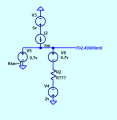
You know that both diodes have the same forward volt drop, which is 0.7V.
You know that both anodes are connected together.
What do you know about their cathode voltages?
Left one connected with ground 0V, right one connected with a resistor
 

panic mode

Joined Oct 10, 2011
4,990
voltage source = provides fixed voltage, regardless of load (current can change)
current source = provides fixed current, regardless of load (voltage can change)
but he somehow assumes current source is a short circuit.

the question was about sizing resistor so that current is split equally between two diodes. since the top side of the diodes (anodes) is common, and diodes are the same, the only way for current to be equal is to have the other end of each diode is also at the same potential (GND).

since current source only guarantees current but not voltage, we can use the current value, but we must calculate the voltage across it.
 

ericgibbs

Joined Jan 29, 2010
21,442
No one is asking you to calculate to that accuracy.
I was trying to make the point, it is +0.7v on the Anode of the right side Diode
NOT,
I think when a source 5v go across a diode 0.7v, voltage drops down to 4.3V before going to a next component.
 

Thread Starter

linhvn

Joined Nov 6, 2024
297
No one is asking you to calculate to that accuracy.
I was trying to make the point, it is +0.7v on the Anode of the right side Diode
NOT,
I think when a source 5v go across a diode 0.7v, voltage drops down to 4.3V before going to a next component.
oh, yes, I dont understand your question, it is right, voltage across the right diode is always 0.7V, it is natural, but what do you mean next?
 

panic mode

Joined Oct 10, 2011
4,990
so Vb must be 0V (same potential as GND) to have both diodes share current equally.
once you know that value, it is easy to find what the resistor value is... R=2V/2.5mA = 800 Ohm.

1747145973430.png
 

Thread Starter

linhvn

Joined Nov 6, 2024
297
you do not get the exact value...(not yet). for now you have to use info given. and you are told to use Vd = 0.7V (close approximation to 702mV)
yes, I dont understand your points, I know that voltage across a silic diode is 0.7V and 0.7V is locked, it is natural.
 

Thread Starter

linhvn

Joined Nov 6, 2024
297
That is not correct. If Va is 5V, the voltage across D1 is 5V. (and it will fail immediately)
I meant the voltage of a diode itself remains 0.7V whatever the voltage source goes through it. A voltage source goes through a diode loses 0.7V that is what i meant.
 

panic mode

Joined Oct 10, 2011
4,990
nad this 0.7V is value you are told to use (it is an approximation, not exact value). but i have not seen your post that is deducing Va correctly. i was trying to show you that it cannot be 5V. that would destroy the diode. now that you know (hopefully) how to get Va and Vb, you should be able to come to same result, it is not 2.5k that you had previously.
 

Thread Starter

linhvn

Joined Nov 6, 2024
297
nad this 0.7V is value you are told to use (it is an approximation, not exact value). but i have not seen your post that is deducing Va correctly. i was trying to show you that it cannot be 5V. that would destroy the diode. now that you know (hopefully) how to get Va and Vb, you should be able to come to same result, it is not 2.5k that you had previously.
I know it is not 5V because the current source in that 5V branch, how does that current source affect to the voltage Va?
 
Status
Not open for further replies.
Top