Current-limiting diode during short circuit

Thread Starter

Oliver Brown

Joined Feb 11, 2025
5
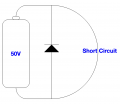
Hi, recently I have a question about fast recovery diode. My native language is not English ,so the sentences describing the problem might be a might strange. Yesterday, I conducted a short circuit testing. Then I find that my fast recovery diode of circuit board was damaged. Now , I feel confused . Why is the diode damaged? Below is the schematic diagram I drew myself. Personally, I think when a battery short circuits, the current should flow from the positive terminal to the negative terminal. Only when the path is disconnected will there be a reverse electromotive force that enables this diode to conduct. 屏幕截图 2025-06-25 151802.pngIs my way of thinking correct?

 

Attachments

Alec_t

Joined Sep 17, 2013
15,101
What load did you have attached?
What was the battery voltage?
What was the reverse voltage rating of your diode?
Are you sure you had the diode connected with the correct polarity?
 

Thread Starter

Oliver Brown

Joined Feb 11, 2025
5
What load did you have attached?
What was the battery voltage?
What was the reverse voltage rating of your diode?
Are you sure you had the diode connected with the correct polarity?
The short-circuit test of the battery's positive and negative terminals was conducted without applying a load.
The voltage of this battery is 50 volts.
Maximum Recurrent Peak Reverse Voltage is 1000V.
This diode is correctly polarized as a reverse-blocking diode.
 

Papabravo

Joined Feb 24, 2006
22,058
It is a mistake to think that diodes will "limit" current. They can and will conduct large currents that will damage or destroy them. A series resistor is required to limit the current. This is a common practice working with Light Emitting Diodes.
 

BobTPH

Joined Jun 5, 2013
11,463
That diode is wired to short the battery if it is connected wrong. The only way it limits current is by melting.
 

MisterBill2

Joined Jan 23, 2018
27,165
Without exception, the use of a diode for reverse polarity protection requires a fuse in series with the power source connection. Neglecting to include a means to limit the reverse current is at best "poorly advised", to use polite words.
Of course the protection diode MUST be capable of surviving the current required to trigger the fuse-clearing action.
 

Tonyr1084

Joined Sep 24, 2015
9,744
This is a short circuit.
Screenshot 2025-06-25 at 7.49.24 AM.png
No current will flow through the diode. It might as well not even be there.
Only when the path is disconnected will there be a reverse electromotive force that enables this diode to conduct.
If you break the short circuit there will be no reverse electromotive force or "Back EMF". You'll only get BEMF if you have an inductive load. To know how much current is flowing you need to know what that load is. A resistive load will have no BEMF. IF this were an inductive load then when the voltage is cut the magnetic field of the load will break down and produce the BEMF. It would be very short lived but at a much higher voltage. That voltage would depend on the load itself.
 

BobTPH

Joined Jun 5, 2013
11,463
IF this were an inductive load then when the voltage is cut the magnetic field of the load will break down and produce the BEMF. It would be very short lived but at a much higher voltage. That voltage would depend on the load itself.
No. The diode here is correctly positioned to suppress the BEMF. The voltage will go no higher than the diode forward voltage at the current that was flowing when power was removed, typically 0.6 to 1.0V
 

Tonyr1084

Joined Sep 24, 2015
9,744
The diode here is correctly positioned to suppress the BEMF
Yes, I know that. But there's no inductive load in my drawing. Just a dead short.

The amount of current flowing through this dead short will depend on the battery's internal resistance. Voltage divided by the internal resistance will dictate how much current will flow. Without knowing the internal resistance we can't know what current flows through the short circuit. If there's an inductive load then we need to know what that is in order to determine all the other factors.

The TS said English is not his first language, so perhaps he's used the wrong term.
 

BobTPH

Joined Jun 5, 2013
11,463
I was taking issue with the statement that I quoted, which starts with IF.

You said (if there was an inductive load) the BEMF would produce a high voltage, it would not with the diode in the circuit.
 

Tonyr1084

Joined Sep 24, 2015
9,744
I was taking issue with the statement that I quoted, which starts with IF.

You said (if there was an inductive load) the BEMF would produce a high voltage, it would not with the diode in the circuit.
OK, that makes sense. I have to agree, an inductive load would (without the diode) produce a high inductive kickback or BEMF. The diode is there to quench that blast. I think we were on different pages. Hopefully now we agree.
 

Thread Starter

Oliver Brown

Joined Feb 11, 2025
5
This is a short circuit.
View attachment 351714
No current will flow through the diode. It might as well not even be there.

If you break the short circuit there will be no reverse electromotive force or "Back EMF". You'll only get BEMF if you have an inductive load. To know how much current is flowing you need to know what that load is. A resistive load will have no BEMF. IF this were an inductive load then when the voltage is cut the magnetic field of the load will break down and produce the BEMF. It would be very short lived but at a much higher voltage. That voltage would depend on the load itself.
The presence of parasitic inductance on the circuit can also cause reverse electromotive force, right?
 

boostbuck

Joined Oct 5, 2017
1,034
Perhaps you can describe what you did to perform a 'short circuit test' as it is unclear what the diode is protecting.

As you show it, the only protection the diode will offer is to either - clamp reverse EMF from any inductance in the load circuit, or - short reverse voltages supplied by the load or misconnected battery (but without current limiting in place so likely destructive).
 
Top