Facebook
 Google
 GitHub
 Linkedin

I need to drive a 650nm cheap 5mW laser diode.
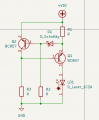
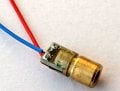 It seems to have a current limiting resistor in series, but the laser still got damaged. I powered it directly from an 18650 at 4V and it was working fine. I left it on for an hour or so, but it was in a 3D-printed shell that I had made to position it. After this, the output of the diode became faint, even at the same voltage. I guess the plastic shell I made contained the heat the diode produced and let it runaway, I have no idea if such a small diode can even do that. I have connected a bare diode without the plastic shell to another 18650 and let it run for nearly 12 hours now, the voltage across the battery has dropped about 0.2 volts, but the diode's output doesn't look like it has changed. I will try to do the same with the shell and report back. I found a constant current circuit as in the image below, and I have a few questions:
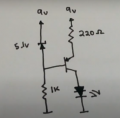
1. Is this how the circuit works? The Zener diode provides a near-constant voltage, and as the resistance is fixed, the current flowing through the base of the transistor must be fixed; thus, the current flowing to the laser diode must also be fixed. Correct me if I'm wrong.
2. If it works as I think it does, then I can just change the resistances to fix the constant current. I also want this to run on 18650s, so the supply voltage would be around 4V, and I got 3.3V zener diodes. Will it work that way?
The reason to power the laser at all is to make a laser obstacle course with like 25 lasers. It only needs to work for a day, but I don't want my diodes to fry. If this circuit seems necessary then I will have to cook up 25 of these, which I think I can do. But I also want to know if this is overkill or useless.
I know this is one of the longer reads, Thanks much in advance to anyone who responds.
It seems to have a current limiting resistor in series, but the laser still got damaged. I powered it directly from an 18650 at 4V and it was working fine. I left it on for an hour or so, but it was in a 3D-printed shell that I had made to position it. After this, the output of the diode became faint, even at the same voltage. I guess the plastic shell I made contained the heat the diode produced and let it runaway, I have no idea if such a small diode can even do that. I have connected a bare diode without the plastic shell to another 18650 and let it run for nearly 12 hours now, the voltage across the battery has dropped about 0.2 volts, but the diode's output doesn't look like it has changed. I will try to do the same with the shell and report back. I found a constant current circuit as in the image below, and I have a few questions:1. Is this how the circuit works? The Zener diode provides a near-constant voltage, and as the resistance is fixed, the current flowing through the base of the transistor must be fixed; thus, the current flowing to the laser diode must also be fixed. Correct me if I'm wrong.
2. If it works as I think it does, then I can just change the resistances to fix the constant current. I also want this to run on 18650s, so the supply voltage would be around 4V, and I got 3.3V zener diodes. Will it work that way?
The reason to power the laser at all is to make a laser obstacle course with like 25 lasers. It only needs to work for a day, but I don't want my diodes to fry. If this circuit seems necessary then I will have to cook up 25 of these, which I think I can do. But I also want to know if this is overkill or useless.
I know this is one of the longer reads, Thanks much in advance to anyone who responds.