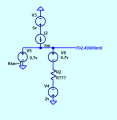
Left one connected with ground 0V, right one connected with a resistorFirst.
You know that both diodes have the same forward volt drop, which is 0.7V.
You know that both anodes are connected together.
What do you know about their cathode voltages?
Left one connected with ground 0V, right one connected with a resistorFirst.
You know that both diodes have the same forward volt drop, which is 0.7V.
You know that both anodes are connected together.
What do you know about their cathode voltages?
so what do you think Va should be? is it still 5V?Still 0.7v diode lock voltage across it.
I think when a source 5v go across a diode 0.7v, voltage drops down to 4.3V before going to a next component.so what do you think Va should be? is it still 5V?
hi lin,I think when a source 5v go across a diode 0.7v, voltage drops down to 4.3V before going to a next component.
Yes, what is the matter?hi lin,
BUT the left side diode clamps the voltage to 0.7v.
E
There is a tension drop across the current source.Yes, what is the matter?
You mean Va= 702.49mV, how can I do hand calculation to get that?
you do not get the exact value...(not yet). for now you have to use info given. and you are told to use Vd = 0.7V (close approximation to 702mV)You mean Va= 702.49mV, how can I do hand calculation to get that?
oh, yes, I dont understand your question, it is right, voltage across the right diode is always 0.7V, it is natural, but what do you mean next?No one is asking you to calculate to that accuracy.
I was trying to make the point, it is +0.7v on the Anode of the right side Diode
NOT,
I think when a source 5v go across a diode 0.7v, voltage drops down to 4.3V before going to a next component.
yes, I dont understand your points, I know that voltage across a silic diode is 0.7V and 0.7V is locked, it is natural.you do not get the exact value...(not yet). for now you have to use info given. and you are told to use Vd = 0.7V (close approximation to 702mV)
That is not correct. If Va is 5V, the voltage across D1 is 5V. (and it will fail immediately)yes, I dont understand your points, I know that voltage across a silic diode is 0.7V and 0.7V is locked, it is natural.
I meant the voltage of a diode itself remains 0.7V whatever the voltage source goes through it. A voltage source goes through a diode loses 0.7V that is what i meant.That is not correct. If Va is 5V, the voltage across D1 is 5V. (and it will fail immediately)
I know it is not 5V because the current source in that 5V branch, how does that current source affect to the voltage Va?nad this 0.7V is value you are told to use (it is an approximation, not exact value). but i have not seen your post that is deducing Va correctly. i was trying to show you that it cannot be 5V. that would destroy the diode. now that you know (hopefully) how to get Va and Vb, you should be able to come to same result, it is not 2.5k that you had previously.