Differential Amplifier

Thread Starter

fady.moawad

Joined Dec 24, 2024
28
Hello all , i was trying to make a differential amplifier , but i dont get how can i calculate the current on R1 and R2

I apply Ohm's law which says IC1=(VCC-VC)/R1 and IC2=(VCC-VC)/R2 but i cant proceed cus i dont have VC?


Vc can be defined in this way, iEmitter=ib+ic so ic=iemitter-ib in a differential amplifier ibase is basically 0 no? cus its tied to gnd? but the iemitter?
 

LvW

Joined Jun 13, 2013
2,027
From the given values (in blue) it follows that the current Ie through R5 is Ie=2mA
Does this help?
 

Thread Starter

fady.moawad

Joined Dec 24, 2024
28
From the given values (in blue) it follows that the current Ie through R5 is Ie=2mA
Does this help?
I know what ur trying to do , basically by calculating Itail u find other values easily, but how can i proceed in another way? like the way i explained before? , like if it was ur first time viewing this circuit basically. without knowing this thing about the Itail , how can u obtain the IC1 and IC2?
 

ericgibbs

Joined Jan 29, 2010
21,442
hi fady,
If Q1 and Q2 Bases are connected to 0V and the lower end of R5, 10k is connected to -20.7V, what is the current through R5?

Also the Collector load resistor values are equal, you should be able to calculate both of the Collectors currents and voltages
E
 

LvW

Joined Jun 13, 2013
2,027
I know what ur trying to do , basically by calculating Itail u find other values easily, but how can i proceed in another way? like the way i explained before? , like if it was ur first time viewing this circuit basically. without knowing this thing about the Itail , how can u obtain the IC1 and IC2?
I know (I guess) that the base potential is app. zero.
Hence, the potential at the common emitter is (must be assumed to be) app. Ve= -0.7V.

For finding the current I5 for this (non-ideal) current source you must know the voltage Vcc1 and the value for R5.
I5=[Vcc-(-0.7)]/R5
There is no other method for finding the currents I1=I2=I5/2.
This is because the necessary voltage Ve=-0.7V is determined by the product I5*R5 and Vcc1 only.
 

Thread Starter

fady.moawad

Joined Dec 24, 2024
28
hi fady,
If Q1 and Q2 Bases are connected to 0V and the lower end of R5, 10k is connected to -20.7V, what is the current through R5?

Also the Collector load resistor values are equal, you should be able to calculate both of the Collectors currents and voltages
E
From base to emitter there is a diode forward biased (anode to base) and cathode to emitter, to have this forward biased the drop of -0.7v will be on the emitter, so in total -20.7v. current will flow from higher potentional (base) from to lower potentional (emitter), so -20.7v/10k. Now since the emitter are connected in common this means they are basically in parallel so they got same potentional on them, but this means that the current will be divided by same amount (since resistor is in common) that means that on transistor Q1 there will be flowing half of the current from base to emitter , and same thing for the transistor Q2, is this correct this way i understood? thanks
 

Thread Starter

fady.moawad

Joined Dec 24, 2024
28
No. Think about what you are saying. You are saying that the current into the base is 0 because one side of it is tied to ground. What if the emitter is at -10V, is the base current zero?
yeah sorry, i explained it now again the way i got it
 

LvW

Joined Jun 13, 2013
2,027
From base to emitter there is a diode forward biased (anode to base) and cathode to emitter, to have this forward biased the drop of -0.7v will be on the emitter, so in total -20.7v. current will flow from higher potentional (base) from to lower potentional (emitter), so -20.7v/10k.
:::::::::::::::::::::::::::::::::::::::::::::::::
No - the current through R5 is determined by the voltage across R5. That means: The potential DIFFERENZ between the two nodes.
As I wrote (post#9) : I5=[Vcc-(-0.7)]/R5 = (-20.7+0.7)/R5=-2mA.
 

Thread Starter

fady.moawad

Joined Dec 24, 2024
28
No - the current through R5 is determined by the voltage across R5. That means: The potential DIFFERENZ between the two nodes.
As I wrote (post#9) : I5=[Vcc-(-0.7)]/R5 = (-20.7+0.7)/R5=-2mA.
the fact that the base is at -0.7 is an assumption right?
 

LvW

Joined Jun 13, 2013
2,027
the fact that the base is at -0.7 is an assumption right?
Yes - this is OK unless we know better.
But you should realize that the influence of this assumption on the current is negligible because the voltage across R5 will be very small: (20,7-0.7)=20 in comparison with (20,7-0.65)=20.05.

These uncertainties are very small in comparison to parts tolerances.
 

LvW

Joined Jun 13, 2013
2,027
@Bordodynov
Please, allow me to give you a little hint:
In your message #16 you show two different simulations. It would be very helpful for the reader if you could briefly explain what the difference is and what insights can be gained from it (evaluation of simulation results).
 

Bordodynov

Joined May 20, 2015
3,431
LvW,
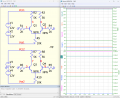
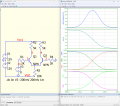
Thank you. Explanation to message #16: the first circuit is the original one, without connecting voltage sources to a common point, which in my opinion is not correct. The second scheme has fixed this situation. The upper diagram shows the voltage and current of the emitter resistor. In the lower diagram for the corrected scheme. The modes in this case are normal.
1737975288648.png
 

LvW

Joined Jun 13, 2013
2,027
LvW,
Thank you. Explanation to message #16: the first circuit is the original one, without connecting voltage sources to a common point, which in my opinion is not correct. The second scheme has fixed this situation. The upper diagram shows the voltage and current of the emitter resistor. In the lower diagram for the corrected scheme. The modes in this case are normal.
Thank you.
I really have tried to find the difference between the circuits in post#16 - without sucess.
I didn`t notice the missing ground symbol.
Now it is clear.
 
Top