Facebook
 Google
 GitHub
 Linkedin

https://virtual-labs.github.io/exp-mathematical-operations-iitr/images/image4.png The difference or subtraction is the function(A-B)trying to make a differential amplifier
What is not shown is how to derive a B potential. The circuit below can be a source for an analog differential measurement using op amp.
Since 2 voltage potentials are needed it is possible to use the VCC however a potentiometer can form a voltage divider to give both A and B.
Alternatively we can use regulated Voltage supply and a reference voltage. Keep in mind that your first voltage subtractor will likely have
percentage error. With a realistic expectation in mind it is understood that a highly accurate differential measuring circuit has
special high tolerance parts and compensation.
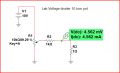
In the circuit simulation below V1 or A is 10V and output is B in green, the op-amp differential circuit above the VCC is +15Vdc
The most critical part of the circuit below is the 1.000 Ω resistor. The statement is true that without an accurate VC how can you succeed?
The small errors, burden voltage, op amp offset should be measured and listed at a given temperature if accuracy is necessary.
I have also seen various resistance bridge circuits some using a length of nichrome wire that were fairly accurate.
In the end it was not very practical. These type of difference bridges use a null meter. With an op amp the offset adjustment is an improvement.
A number accuracy like 0.004562V for example is very accurate. If you find a 0.9970Ω resistor and add 0.003Ω for R3 you will approach
a lower percentage error but not compared to a very expensive meter, higher resolution measurement has much to do with technique.
Last edited: