Design AM transceiver system

Thread Starter

Bahadir06

Joined Mar 21, 2025
1
Hello, I am working on my Design AM transceiver system project. In this project, we are prohibited from using other integrated circuits except for the 555 integrated circuit. In this case, how can I do signal modulation and demodulation without using opamps and similar integrated circuits?
 

sparky 1

Joined Nov 3, 2018
1,218
A transmitter having Amplitude Modulation, a mixer combines the carrier wave with an audio wave.
The radio frequency oscillator uses a transistor and followed by an amplifier.
A receiver is a resonant circuit that includes an antenna coupled to an amplifier.
the signal demodulates or picks off the audio and is amplified to a speaker.

As an RF signal source 555 harmonics can be useful in constructing a fixed frequency AM transceiver.
Understanding filter affects and modulation could get finicky. It would take careful plan step by step.
 
Last edited:

crutschow

Joined Mar 14, 2008
38,316
Okay, here's a head-start:

Simple Transmitter Suggestion from the basics--

Generate a square-wave low frequency RF with a 555 (550KHz is the low end of the AM band in the USA).

Run that through a transistor common-emitter switch and vary the collector load resistor voltage with the modulating signal, using another transistor, to generate the AM modulation of the square-wave.
(AM modulating the square-wave is much easier than trying to modulate a sine-wave.)

Run that through a band-pass filter to remove the modulation frequency and the square-wave harmonics to provide an RF sinewave signal.
A 2 or 3 pole Sallen-Key filter should work for the low-pass filtering and a single-pole passive filter should work for the high-pass filter.
A gain-of-one op amp is typically used for a Sallen-Key filter, but an emitter-follower will also work.

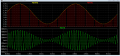
Edit: Below is the output from the sim of the basic circuit functions proposed above:
The yellow trace is the audio modulation, the red trace is the modulated square-wave into the band-pass filter, and the green trace is the filter output.
(The frequencies shown are just to demonstrate the technique and are not necessarily representative of the frequencies you will use.)

The design of the circuit is left as an exercise for the reader, which may involve added linear amplifiers for the modulation signal if from a microphone, and the output RF to give a detectable signal by the receiver.

1742598915921.png
 
Last edited:

BobTPH

Joined Jun 5, 2013
11,463
I believe that meets Mencken's criteria, but not mine. ;)

That will modulate the duty-cycle to give PWM, but not the amplitude (the TS wants AM).
You are correct. That would modulate the frequency. (As well as amplitude depending on where the output is taken.)
 
Top