Facebook
 Google
 GitHub
 Linkedin

This one is actually easier than #10.Oh yeh sorry forgot about that.
Hopefully it should be good. Corresponds with the answer the lecturer got, which is always a good sign.
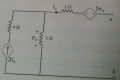
Vin = Va - Vb
Iin = ix
Rth = Vin/Iin
The current in the 1 Ω resistor is ix + 3·ix = 4·ix
The voltage across the 1 Ω resistor is therefore simply Vx = (1 Ω)·(4·ix).
The voltage across a-b is Vin = Vx + ix·(1 Ω) + 5·Vx = 6·Vx + ix·(1 Ω)
Therefore, Vin = 6·(1 Ω)·(4·Ii) + (1 Ω)·(Iin) = (25 Ω)·Iin
Thus Rth = 25 Ω
If you imagine applying a 1 A current source between a-b, you can actually walk out that the voltage across it is 25 V pretty easily by inspection. The current in the 1 Ω resistor has to be 4 A, meaning that the voltage across it is 4 V. There is another 1 V across the series 1 Ω resistor. Then there is 20 V (5 · 4 V) across the VCVS. The total is therefore 25 V.