Facebook
 Google
 GitHub
 Linkedin
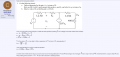
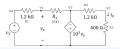
Stuck on this homework problem:
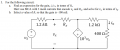
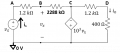
So far I've used mesh current analysis to create the three equations (treating \( V_x \) as a voltage source that creates three meshes):
A: \( -v_{x}+(1.2k)i_{A}+v_{x}=0 \)
B: \( -v_{x}+R_{x}i_{B}+10^{3}v_{x}=0 \)
C: \( 10^{3}v_{x}+(1.6k)i_{C}=0 \)
\( i_{C} \) is the same as \( i_{0} \), so I was able to find an expression for \( i_{0} \) in terms of \( v_{x} \) using equation C:
\( i_{0}=\frac{-10^{3}v_{x}}{1.6k}=\frac{-v_{x}}{1.6} \)
I then used equations A and B to create the equation:
\( v_{s}=(1.2k)i_{A}+R_{x}i_{B} + 10^{3}v_{x} \)
It is here where I think that I'm stuck, as I don't know how to find equivalencies for \( i_{A} \) and \( i_{B} \) that will give me a final gain \( \frac{i_{0}}{v_{s}} \) that is only in terms of \( R_{x} \). I think that there is a way to relate \( i_{A} \) and \( i_{B} \) by making some current \( i_{x}=i_{A}-i_{B} \), but I don't see how to actually proceed.
So far I've used mesh current analysis to create the three equations (treating \( V_x \) as a voltage source that creates three meshes):
A: \( -v_{x}+(1.2k)i_{A}+v_{x}=0 \)
B: \( -v_{x}+R_{x}i_{B}+10^{3}v_{x}=0 \)
C: \( 10^{3}v_{x}+(1.6k)i_{C}=0 \)
\( i_{C} \) is the same as \( i_{0} \), so I was able to find an expression for \( i_{0} \) in terms of \( v_{x} \) using equation C:
\( i_{0}=\frac{-10^{3}v_{x}}{1.6k}=\frac{-v_{x}}{1.6} \)
I then used equations A and B to create the equation:
\( v_{s}=(1.2k)i_{A}+R_{x}i_{B} + 10^{3}v_{x} \)
It is here where I think that I'm stuck, as I don't know how to find equivalencies for \( i_{A} \) and \( i_{B} \) that will give me a final gain \( \frac{i_{0}}{v_{s}} \) that is only in terms of \( R_{x} \). I think that there is a way to relate \( i_{A} \) and \( i_{B} \) by making some current \( i_{x}=i_{A}-i_{B} \), but I don't see how to actually proceed.