Dependent only sources - Thevenin eq.

WBahn

Joined Mar 31, 2012
32,874
Oh yeh sorry forgot about that.

Hopefully it should be good. Corresponds with the answer the lecturer got, which is always a good sign.
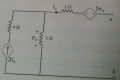
This one is actually easier than #10.

upload_2017-4-14_11-34-51.png

Vin = Va - Vb
Iin = ix

Rth = Vin/Iin

The current in the 1 Ω resistor is ix + 3·ix = 4·ix

The voltage across the 1 Ω resistor is therefore simply Vx = (1 Ω)·(4·ix).

The voltage across a-b is Vin = Vx + ix·(1 Ω) + 5·Vx = 6·Vx + ix·(1 Ω)

Therefore, Vin = 6·(1 Ω)·(4·Ii) + (1 Ω)·(Iin) = (25 Ω)·Iin

Thus Rth = 25 Ω

If you imagine applying a 1 A current source between a-b, you can actually walk out that the voltage across it is 25 V pretty easily by inspection. The current in the 1 Ω resistor has to be 4 A, meaning that the voltage across it is 4 V. There is another 1 V across the series 1 Ω resistor. Then there is 20 V (5 · 4 V) across the VCVS. The total is therefore 25 V.
 

Thread Starter

KevinEamon

Joined Apr 9, 2017
284
Very nice I'm on to transient responses now. Having an issue with one, ill post it up. The voltage is like u(-t) something??? Wt.... Anyways ill post it up as I say
 

WBahn

Joined Mar 31, 2012
32,874
Please start a different thread for the new problem -- keeping one problem per thread minimizes the chaos that results from people responding to different problems in the same thread.
 
hey...I'm a student too.

I was wondering if there is a wire with current flowing through it and no resistor element , does that mean current won't flow through the 1 ohm resistor? The first thought that comes to my head is "current chooses the path of least resistance". Maybe since it's being supplied by dependent source, that doesnt apply? I wish there was a way for use to understand the behavior of dependent sources...it seems so magical right now.
 

WBahn

Joined Mar 31, 2012
32,874
hey...I'm a student too.

I was wondering if there is a wire with current flowing through it and no resistor element , does that mean current won't flow through the 1 ohm resistor? The first thought that comes to my head is "current chooses the path of least resistance". Maybe since it's being supplied by dependent source, that doesnt apply? I wish there was a way for use to understand the behavior of dependent sources...it seems so magical right now.
A wire where? What 1 Ω resistor? Are you talking about the one of the problems in this thread?

There's nothing magical about a dependent source. It is merely an adjustable source of either current or voltage whose output value is determined by some parameter in the circuit.
 

MrAl

Joined Jun 17, 2014
13,708
Hi,

A dependent source enters into the analysis as a voltage times a constant like K*v1. Here, v1 would be a voltage that appears somewhere in the circuit. For a constant voltage say E1 we would see this enter as simply E1, as in E1/R1, and if this was a dependent source then that E1 would change to E1=K*v1 where K is usually given. So if K=5 then E1=5*v1, so instead of writing the equation with E1 we write it with 5*v1 where E1 would have gone.

"Current chooses the path of least resistance" isnt really entirely true. That's only when one resistance is zero and the other is non zero. When both resistances are non zero, then we have to use what is called "current division". You are probably familiar with voltage division where we have two resistors in series and the center voltage is the source voltage divided by some factor determined by the two resistors R1 and R2. Well, current division is like that but now the current divides between the two resistors.
Voltage division: Vcc*R2/(R1+R2) with one end of R2 connected to ground.

With current division there are two paths the current can take so we have two possibilities:
current through R1=Icc*Rp/R1=Icc*R2/(R1+R2)
current through R2=Icc*Rp/R2=Icc*R1/(R1+R2)
where Rp=R1 in parallel with R2=R1*R2/(R1+R2)
Note that in the first form above if we calculate the parallel resistance we use R1 in the denominator, but if we just sum the two R1+R2 we must use R2 in the numerator which is the 'opposite' resistor value.
Of course if only one resistor is zero then we have all the current through that one.
If both resistors are zero, then we can take the limit as R2 goes toward R1, and we get Icc/2 for both currents. So with both resistances equal to zero half the current goes through each one.

Voltage division really has two solutions too but we usually just want to know the voltage across R2 which is the resistor with one end connected to ground.
 

WBahn

Joined Mar 31, 2012
32,874
Hi,

A dependent source enters into the analysis as a voltage times a constant like K*v1. Here, v1 would be a voltage that appears somewhere in the circuit. For a constant voltage say E1 we would see this enter as simply E1, as in E1/R1, and if this was a dependent source then that E1 would change to E1=K*v1 where K is usually given. So if K=5 then E1=5*v1, so instead of writing the equation with E1 we write it with 5*v1 where E1 would have gone.
That describes just one of the four principle types of dependent sources. But the general notion that underlies all four is at least implied.

With current division there are two paths the current can take so we have two possibilities:
current through R1=Icc*Rp/R1=Icc*R2/(R1+R2)
current through R2=Icc*Rp/R2=Icc*R1/(R1+R2)
where Rp=R1 in parallel with R2=R1*R2/(R1+R2)
Note that in the first form above if we calculate the parallel resistance we use R1 in the denominator, but if we just sum the two R1+R2 we must use R2 in the numerator which is the 'opposite' resistor value.
Of course if only one resistor is zero then we have all the current through that one.
If both resistors are zero, then we can take the limit as R2 goes toward R1, and we get Icc/2 for both currents. So with both resistances equal to zero half the current goes through each one.
There's no basis for that last claim, either mathematically or in practice. If both resistances are zero then the amount of current that flows in each is indeterminate -- meaning that we have to rely on something else that determines the sharing ratio. Consider two superconducting wires in parallel -- in general they will not share the current equally. To make that really obvious, wrap each of them into a coil (i.e., a magnet) and then the inductance determines the sharing ratio. Then consider that even single, straight wires have inductance.
 

MrAl

Joined Jun 17, 2014
13,708
That describes just one of the four principle types of dependent sources. But the general notion that underlies all four is at least implied.


There's no basis for that last claim, either mathematically or in practice. If both resistances are zero then the amount of current that flows in each is indeterminate -- meaning that we have to rely on something else that determines the sharing ratio. Consider two superconducting wires in parallel -- in general they will not share the current equally. To make that really obvious, wrap each of them into a coil (i.e., a magnet) and then the inductance determines the sharing ratio. Then consider that even single, straight wires have inductance.

Hi,

Yes i had shown one such dependent source.

When talking about two zero ohm resistors in parallel, we are talking about two zero ohm resistors in parallel, not two coils, two capacitors, two dinosaur bones, etc. :)
Now in practice this is going to be different because we dont have two zero ohm wires, but in theory, if we stick to the theory of resistors and not some aggregate of components, then the theory is very simple because we start and end with resistors.
Starting with the current in R1:
iR1=is*R2/(R1+R2)
and the current in R2:
iR2=is*R1/(R1+R2)

if both resistors are the same then we have R2=R1 so we get:
iR1=is*R1/(R1+R1)=is*1/2
and we also have R1=R2 so we get:
iR2=is*R2/(R2+R2)=is*1/2

Now lets see what happens when we start with iR1 and make both resistors 2 ohms:
iR1=is*2/(2+2)=is*2/4=is/2

now decrease both to 1 ohms:
iR1=is*1/(1+1)=is*1/2

now decrease both to 0.1 ohms:
iR1=is*0.1/(0.1+0.1)=is*1/2

now decrease both to 0.01ohms:
iR1=is*0.01/(0.01+0.01)=is*1/2

now to 1e-9 ohms:
iR1=is*1e-9/(1e-9+1e-9)=is*1/2

now down to 1e-99 ohms:
iR1=is*1e-99/(1e-99+1e-99)=is*1/2

Now if there is a difference in the two resistances, then they fail the place where we set them equal to each other, so if there are any other influences then all bets are off.

There is no such thing as zero ohms anyway if we want to get particular, because the current flow is a result of a statistical average that is gonig to vary a little over time, so one wire might conduct 1+1e-12 amps for a given 1us period while the other conducts just 1 amp but then the next microsecond interval the second wire might conduct 1+1e-12 amps while the first conducts just 1 amp. So they would take turns so to speak, but the average would be 1/2 of the total current for each unless there was some huge flaw in the wires.

Obviously if there was an external field that influences the current and it is closer to one wire than the other, then that will change things also. But again that means we are not just talking pure resistances because we have other things working in the circuit too.

Probably the most important point is that if we allow other influences to affect the experiment then that will be true for resistances other than zero too, so if we throw out the theory for zero ohm wires we have to throw it out for many other resistances too.

I'll be happy to see your counter argument of course, but when we limit the theory we are using we limit the theory we are using so i cant see how this could change very much if any.
 

WBahn

Joined Mar 31, 2012
32,874
How does having two 0 Ω resistors in parallel in which one carries 1 A and the other carries 1000 A violate KVL, KCL, or any other law?

Using a limit process implies that these resistors became zero resistance by starting at some non-zero value with no current in them and then having their resistance lowered to zero exactly in lock step. What is the justification for this being the only way that two zero ohm resistors could be placed in parallel? What if current is flowing in one zero ohm resistor and then a second is added in parallel with it? Why would half of the current transfer to the other?
 

MrAl

Joined Jun 17, 2014
13,708
How does having two 0 Ω resistors in parallel in which one carries 1 A and the other carries 1000 A violate KVL, KCL, or any other law?

Using a limit process implies that these resistors became zero resistance by starting at some non-zero value with no current in them and then having their resistance lowered to zero exactly in lock step. What is the justification for this being the only way that two zero ohm resistors could be placed in parallel? What if current is flowing in one zero ohm resistor and then a second is added in parallel with it? Why would half of the current transfer to the other?
Hi,

Yes you could make the point that since one is zero then it can carry much more current than the other which is also zero, but we know that's not the way things work in reality because we always have some resistance and even if not there will be statistical differences that will average out. However, to work this out we would again have to go outside of the simple resistive current divider expression, which means we have to bring in some more advanced theories.

If we bring one resistor down from 2 ohms to 1 ohm and the other from 2 ohms to 1.5 ohms such that more current flows in one than the other, then we violate the premise that both resistors are the same value.

Two diodes in parallel are an interesting case because if one heats up a little more than the other then the current isnt shared equally. But here we have to go to a more advanced theory to figure it out. If we stick to the basic idea that they are both the same then they share the current nearly equally. Does this work out in real life? Not always, but if we put the dies close enough together than it works fairly well.

So it sounds to me like you want to say the following:
For two zero ohm 'resistors' in parallel we can not know how much current each one conducts, but for two resistors of value 1e-12 ohms (one pico-ohm) we can know and we can also know for two of value 1e-999 ohms.

I guess the real problem with this discussion is that there is no such thing as a zero ohm resistor. If there was, then it would no longer be a 'resistor'.
 

WBahn

Joined Mar 31, 2012
32,874
You have to decide if you are going to work with zero ohm resistors or with resistors that are just close to zero ohm. You chastised me for pointing out that even straight wires have inductance and that, in the real world case of superconductors, things like parasitic inductance become dominating factors. Yet when I stick to your perfect zero ohm resistors with nothing else contaminating the mix and show two cases that do not have them sharing the current equally you choose to assert that all real resistors are going to have some non-zero resistance. Make up your mind!

You then want them to have some small, non-zero resistance and invoke statistical variations in the current, but then insist at the same time that they are perfectly identical in terms of resistance. On what basis can you possibly claim that this is a reasonable or in any way worthwhile model? Long before you ever get close to 1e-999 ohms your "statistical variations" are going to result in those two resistors being orders of magnitude apart.
 

MrAl

Joined Jun 17, 2014
13,708
Hi,

Well see this gets tacky because we cant find a common ground on which to base the discussion.

My main point is that if we talk about resistors only then we have to follow that set of rules, but if we bring in other theories about nature then we can show that even two 1 ohm resistors dont share the current equally. This combined with the fact that it seems unreasonable to think that a zero ohm resistor should not be handled differently than a resistor with a very small 1e-99 value for example. It starts to depend on other things yes, which i think was your point. In real life if we soldered two very low ohm resistors together in parallel the solder job would greatly influence how the two shared the current.

If it makes you happy i guess i can agree that as the value of the two resistances goes down, the dependence on external conditions increases. In the limit, this would mean that once they reach zero then ONLY the external influences tell us how they share the current.
There is the simpler view though that any two resistors of equal value in parallel share the current equally. That means resistors of value 1e-999 share the current equally. So we have the two theories at odds, but one theory is a simpler view that's all.

I can also agree that maybe stating that two zero ohm 'resistors' share the current equally is a little too simplistic because it leads to these kinds of philosophical discords.

This happens when one person believes that a situation should be handled one way while the other thinks it should be handled another way. Look at some other discussions like this. My favorite, or maybe my least favorite, is what exactly a 'hole' is (a hole in the ground say, not the solid state 'hole'). Some people argue that there is no such thing as a hole in the ground because there is nothing there, while others argue that we often transcend exact material nature by thinking of operation things as being real nouns.
 
Top