Dependent only sources - Thevenin eq.

Thread Starter

KevinEamon

Joined Apr 9, 2017
284
Ok I've looked through what I've written. There's no "original" voltage values there. Any voltages are a product of the Voltage / resistor = current values.

That's how I've been taught to do nodal analysis?

What do I know about V1 V3? hmmm k - there's a current of ix between them.
Also on the lower half of the circuit - there's a current of ix being halved between them.
 

Thread Starter

KevinEamon

Joined Apr 9, 2017
284
Hmmm... ok I think that would be a node. Anything else....? maybe that they are in series with each other. There's no resistance... I remember something about infinite current there, though i'm not sure it's relevant in this case.

That's all I can think of. Apologies I'm only a lil 1st year undergrad. I have no idea, what you and the other instructor are discussing (for example).
 

xxxyyyba

Joined Aug 7, 2012
289
circ1.png
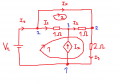
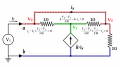
This is your circuit. It is crucial here to note that end points of wire (where current ix is) are in fact one same node (2). This circuit has n=3 nodes and m=5 branches between nodes. You can write n-1=2 equations using KCL and m-(n-1)-1=2 equations using KVL. Please write KCL equations for nodes 2 and 3 and KVL for loops 1 and 2 and post it here.
 

WBahn

Joined Mar 31, 2012
32,883
Hmmm... ok I think that would be a node. Anything else....? maybe that they are in series with each other. There's no resistance... I remember something about infinite current there, though i'm not sure it's relevant in this case.

That's all I can think of. Apologies I'm only a lil 1st year undergrad. I have no idea, what you and the other instructor are discussing (for example).
Since there can't be any voltage drop across a (ideal) wire, the voltages at any two points connected by a wire must be the same. So V1 = V3. There's your final equation. With that, you have four equations in four unknowns and can solve for V3 which (numerically) is the Thevenin resistance.

Once you've done that we can look at other approaches that are much better and, hopefully, make a bit more sense.
 

Thread Starter

KevinEamon

Joined Apr 9, 2017
284
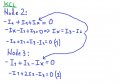
Ok here's what I've got. I wasn't sure how to define V2.
I've defined it here as the left V2. But as I look at the right V2 I see that has all the other currents currents coming in/out as well...

Hmmm so it could be defined -
KCL at V2
it + i2 + ix = i1 + ix + i3

I wasn't sure how to define ix and it
in terms of voltage / resistance

Apart from that my attempt is attached
 

Attachments

xxxyyyba

Joined Aug 7, 2012
289
Ok here's what I've got. I wasn't sure how to define V2.
I've defined it here as the left V2. But as I look at the right V2 I see that has all the other currents currents coming in/out as well...

Hmmm so it could be defined -
KCL at V2
it + i2 + ix = i1 + ix + i3

I wasn't sure how to define ix and it
in terms of voltage / resistance

Apart from that my attempt is attached
That is point - you should find relation between currents at both ends of wire.
You shouldn't define ix and it in terms of voltage / resistance if you want to solve circuit using KCL and KVL method. I will help you a little bit:

circ2.png

You have four unknows: I1, I2 , I3 and It (essentially you only need It because you want to find Rth=Vt/It). You have two equations. You need two more equations and you will have system of 4 equations with 4 unknows.
PS: Once you master different circuit analysis methods (most practical is nodal analysis method in my opinion) you will never come in situation to don't know what to do or even where to start. No matter how complex circuit is, you will be able to write equations for that circuit with almost no thinking :) I want to say there is systematic way to solve any circuit just by following rules for specific circuit analysis method you choose.
 
Last edited:

RBR1317

Joined Nov 13, 2010
715
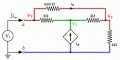
I also believe that nodal analysis is the most practical method for solving any non-trivial problem. But an essential part of the practicality is color-coding the nodes. This problem #10 is fairly simple when color-coded, having only two nodes (plus the ground node). However, it does have an unusual twist - it is necessary to determine the current flowing from one part of a node to another part of the same node; therefore, the node is split, the current flowing between the halves is noted and a separate node equation written for each half. But the color of the node halves are kept the same to indicate the node voltage is identical for each half. (Also, I find it simpler and less error prone to use the convention that current leaving the node is positive.)
Thevenin_C1.png
 

MrAl

Joined Jun 17, 2014
13,709
Is it possible for circuit #10 to even exist except by violating the rule for current division?
Hi,

I dont seem to have a problem with this circuit either. I dont see any violation of any rule or anything like that. The current in the very top 'wire' determines the current source ix current, and part of that current decreases the current in the top 'wire' where ix is sensed (the ix current arrow).

If you still have a problem, simply insert a 0.001 ohm resistor in that top 'wire' so the sense wire has some impedance, then do the analysis again expecting results that are only slightly different from the true values. I think it will become clear this circuit isnt too much of a problem it just looks weird :)
 

Attachments

xxxyyyba

Joined Aug 7, 2012
289
KevinEamon, what do you think, where two more equations come from? We already used KCL and wrote n-1=3-1=2 equations. It is time now to use KVL to get rest of equations.
For loop 1 we have:
Vt-1Ohm*I1-1Ohm*I2-2Ohm*I3=0 -> I1+I2+2I3=Vt ...(3)
For loop 2 we have:
1ohm*I2+1Ohm*I1=0 -> I1+I2=0 ... (4)

Now you have system of four equations with four unknows:

I1-I2+I3-It=0
-I1+2I2-I3=0
I1+I2+2I3=Vt
I1+I2=0

Please solve this system and write here what you get for It.
 
Last edited:

MrAl

Joined Jun 17, 2014
13,709
Hi,

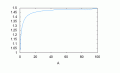
I wanted to look at this circuit again to see if it ever became 'unreal' so by making the current source gain variable i can see if there is any strange value for that gain that can cause some sort of problem with this circuit. The graph is a graph of the circuit gain when the gain A of the current source is varied between 0 to 100, and when A goes to +infinity the voltage 'gain' of the circuit flatlines to 3/2 volts and does not go any higher. Graph attached.
So for example with Vin=1 the output can be from 1v to 1.5v with a gain A from 0 to +infinity. For reference, the gain A of the original problem was 1.
 

Attachments

RBR1317

Joined Nov 13, 2010
715
I dont seem to have a problem with this circuit either. I dont see any violation of any rule or anything like that.
My only problem was with finding the open-circuit voltage, because there wasn't any! You might say that's obvious, but at the time it wasn't all that obvious to me.
 

WBahn

Joined Mar 31, 2012
32,883
The sanity check is that the open circuit voltage for any circuit that doesn't have an independent source (even it that's just an external signal applied to a port) better be zero. If it's not, then the circuit is probably not determinate (I can't say that that is absolutely the case, because someone might be able to come up with a kooky counterexample).
 

MrAl

Joined Jun 17, 2014
13,709
What output? How are you defining "circuit gain"?

Hi,

I had assumed that the only missing voltage was V3 so that could be called the output when looking at the current source as having a variable gain itself. So the circuit gain in this case is V3/Vin.

But, ALAS! I did find a problem with this circuit, but only for a certain current source gain. If we allow for negative gains then when the gain for the current source is -2 the voltage V3 has to go to either plus infinity or minus infinity depending on which side we approach that -2 from. So for negative gains for the current source we could have very high or very low V3 voltages. Of course this goes beyond the original goal of this exercise.

You could check this over to see what you get. The current gain here is the multiplier of the sense current ix, so with A=3 we have the current source current IX=ix*3 for example where lower case ix is the sense current.
 

WBahn

Joined Mar 31, 2012
32,883
Hi,

I had assumed that the only missing voltage was V3 so that could be called the output when looking at the current source as having a variable gain itself. So the circuit gain in this case is V3/Vin.
Okay... V3 is just an internal node, so it wasn't at all obvious that you were considering this the "output" -- and it still isn't obvious what the "gain" from the input to this node tells us.

It would possibly be more meaningful to look at the input resistance as a function of the CCCS gain.

I might take a look at that and see if it shows an issue with any particular gain values as well. But without thinking about it much, I wouldn't be too surprised if negative gains caused problems as this might lead to some kind of positive feedback process.
 

MrAl

Joined Jun 17, 2014
13,709
Okay... V3 is just an internal node, so it wasn't at all obvious that you were considering this the "output" -- and it still isn't obvious what the "gain" from the input to this node tells us.

It would possibly be more meaningful to look at the input resistance as a function of the CCCS gain.

I might take a look at that and see if it shows an issue with any particular gain values as well. But without thinking about it much, I wouldn't be too surprised if negative gains caused problems as this might lead to some kind of positive feedback process.
Hi,

Yeah now that you mention it, it's like any other feedback system more or less. What was surprising to me was that there was only one negative gain that showed this problem and that was minus 2. If i use a gain like -1.99999999999 or -2.00000000001 (or something like that) i was seeing V3 up in the (plus or minus) teravolts :)

It's also a little interesting that when the current source gain is very very high (infinite) the current in the sense wire goes to zero. So it ends up looking like an op amp circuit.
 

WBahn

Joined Mar 31, 2012
32,883
Hi,

Yeah now that you mention it, it's like any other feedback system more or less. What was surprising to me was that there was only one negative gain that showed this problem and that was minus 2. If i use a gain like -1.99999999999 or -2.00000000001 (or something like that) i was seeing V3 up in the (plus or minus) teravolts :)

It's also a little interesting that when the current source gain is very very high (infinite) the current in the sense wire goes to zero. So it ends up looking like an op amp circuit.
If the coefficient on the CCCS is infinite, then the only possible finite solution is for ix to be identically equal to zero, meaning that both the sense wire and the dependent source are open circuits. However, while at first glance this looks like the result is a 4 Ω equivalent resistor, that would put all of the current through the two 1 Ω resistors which would put a voltage across the sense wire, which is inconsistent with no current in it. To have no current in the sense wire, the input voltage must appear across the 2 Ω resistor. But the current in the 2 Ω resistor must come through the right hand 1 Ω resistor, which will raise it up above the input voltage, resulting in the same amount of current flowing to the left through the left hand 1 Ω resistor. Since this current has nowhere to go except into the input source, the actual equivalent resistance is -2 Ω. Notice that even though ix is zero, the output of the CCCS is twice the current in the 2 Ω resistor. This is merely a case of zero times infinity, which is mathematically indeterminate, working out to a finite value in the limit.

If the coefficient is zero, then ix can be anything and the CCCS will be an open. This makes the circuit equivalent to a +2 Ω resistor.

Presumably there is a value of the coefficient between 0 and infinity for which the equivalent resistance looks like an open circuit. This would require that the current in the 2 Ω resistor to be split evening between ix and the current in the right hand 1 Ω resistor so that these currents cancel at the input side, thus requiring the input voltage source to output nothing. This means that the CCCS is outputting twice whatever ix is, so at a coefficient of 2 the equivalent resistance is infinite.

Just as there is a value of the coefficient for which the equivalent resistance is infinite, there is probably one at which it is zero. This would require ix to be infinite, which will also result in an infinite voltage across the CCCS (so that it can produce an appropriate infinite current in the two 1 Ω resistors. Since it will have zero input resistance, the voltage across the input will be 0 V and there will be no current flowing in the 2 Ω resistor. That means that ix has to flow into the right hand 1 Ω resistor and, by symmetry, ix also flows into the center node from the left hand 1 Ω resistor. The result is that the current in the CCCS is twice the current in ix, but flowing in the opposite direction. Thus the coefficient is -2.

So the input resistance will be positive and finite between a coefficient of -2 to +2. It will be zero at -2 and infinite at +2. The input resistance will be negative outside of those limits.

Since the voltage across the top of the T formed by the CCCS and the two horizontal resistors is zero, all the matters is the ratio of those two resistors (the magnitude is masked by the current source that is effectively in series with them). Thus, the value of the input resistance depends only on the CCCS gain, the right-most resistor (the 2 Ω resistor), and the ratio of the two horizontal resistors.
 
Top