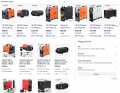
From what I can glean, this is a motor home space heater that uses diesel fuel and operates from 12VDC.
TS wants to connect this to 240VAC mains using a 12VDC power supply hence no drain on battery.
What about the problems of having the fire, the carbon monoxide and the stink inside the motor home?
The furnace in my home does not have those problems.
Since mains electricity is available, why not use a safe electric heater?
What about the problems of having the fire, the carbon monoxide and the stink inside the motor home?
The furnace in my home does not have those problems.
Since mains electricity is available, why not use a safe electric heater?
Amazon and eBay are not the problem, badly designed and built supplies are.
You should look at a Meanwell supply, and it doesn't matter where you buy it so long as it is a real one. On eBay, you could potentially save money buying a used one.
Another route is the surplus market, brands like Delta and Power One are top quality industrial grade supplies that can sometimes be a bargain. One thing that makes it a little hard for you is the 12V requirement. 12V supplies are very desirable making them generally more expensive on the surplus market.
The general answer is a NEMA enclosure that has enough room to work inside. If this will be mounted outdoors you will need one with a suitable rating for outdoors and damp locations. You also need to consider heat.
You can use a simple vents and cooling fan approach if the enclosure will be in a protected location, but if it has to be placed outdoors, the best route is probably a metal enclosure with the supply mounted directly to one face of the enclosure in intimate contact to have the enclosure act as a heat sink.
An ordinary laminated or toroidal transformer plus rectifier and smoothing capacitor will do the job. If the unit is designed to run off a 12V battery, it won't be too fussy about voltage, ripple etc.
I suspect it works like the kerosene heaters used by construction workers in cold climates. Simply atomizes the fuel, mixes it with air, and burns it, blowing the heated air into the room. Seems a bit dangerous CO wise.
An ordinary laminated or toroidal transformer plus rectifier and smoothing capacitor will do the job. If the unit is designed to run off a 12V battery, it won't be too fussy about voltage, ripple etc.
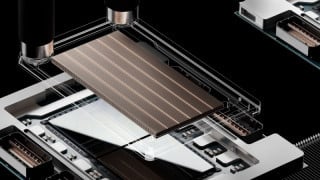
There is a control board that manages starting and stopping the diesel burner and fan, as well as monitoring the housing temperature for safety. The electronics don't look very complicated but the might be more sensitive to supply parameters than you'd expect.
A car has a long exhaust pipe leading the CO away from people.
My home has a tall chimney.
The diesel heaters produce deadly CO without an exhaust pipe or chimney.
In @MrChips 's picture in post #37, isn't the heat exchanger the device that looks like a silencer, and the device that looks like a coffee-machine pump the atomiser?
A car has a long exhaust pipe leading the CO away from people.
My home has a tall chimney.
The diesel heaters produce deadly CO without an exhaust pipe or chimney.
Yeah, mine too. However, I know a Marine friend who owns a very old home with a "Pre-WWII" furnace. The natural gas flame is directly in the air stream. No venting whatsoever. She's financially struggling so she can't afford a new furnace, even though someone's going to say 'She can't NOT afford it.' And I agree. However, without the funds she's not going to get there. A few of our friends have pooled some money together to help but it's no where near enough. In her home there's also Asbestos to be managed properly.
Thought about GoFundMe but I've learned that what's donated comes with an income tax bill that can be a big surprise at tax time. I've reached out to the local news channel that from time to time they like to give away to someone in the community who is deserving. She's definitely deserving. She's helped MANY Vets get their paperwork done with the DAV (Disabled American Vets). Both working for DAV and on her own time. She's been a valuable resource for many Vets with PTSD and other psychological conditions and yet we can't find suitable help for her.
Sorry for the tirade. Back on topic. There have been a lot of good points made regarding exhaust gas management. I believe it's been said before but if not - we need a very clear picture of what we're trying to accomplish. Till then you're going to find comments all over the board.
Money to pay for a new furnace and a new air conditioner?
The Canadian Government helped me pay for a high efficiency furnace and air conditioner. They also payed entirely for a new high efficiency refrigerator, a Smart thermostat and additional insulation in the attic.
My government also pays for all my medications, doctors and occasional operations.
@Audioguru again Thanks. Don't know why I didn't think of that before.
Anyone else who may have a comment or suggestion regarding my OFF TOPIC comment, please PM me. I don't want to hijack this thread for my purposes. Thank you.
Never have I seen so many people spewing off without a clue of what they're talking about. A five second search for "8kw diesel heater" shows exactly what the TS is talking about.
If you don't understand what the question is about, you have a few options:
● Say nothing and don't prove your ignorance
● Ask for more information
● Spend literally a few seconds searching on the terms in the question to see if it clarifies anything.
Three forum pages of rubbish might have been saved, and the TS concluding this site is worthless.
Never have I seen so many people spewing off without a clue of what they're talking about. A five second search for "8kw diesel heater" shows exactly what the TS is talking about.
If you don't understand what the question is about, you have a few options:
● Say nothing and don't prove your ignorance
● Ask for more information
● Spend literally a few seconds searching on the terms in the question to see if it clarifies anything.
Three forum pages of rubbish might have been saved, and the TS concluding this site is worthless.
Sorry, I have to disagree with your analysis of the situation.
I asked for clarification. TS has been rather scant on information. If TS wants to conclude this site is worthless then that is his prerogative.
For starters, TS should have told us the make and model of the unit.
We still don't know what is the role of the 12VDC power supply.
I guess you're too (insert your choice of adjectives here – you might not appreciate mine) to click the link I posted. Diesel heaters are not a great mystery. The willfull ignorance here is amazing at times.
I guess you're too (insert your choice of adjectives here – you might not appreciate mine) to click the link I posted. Diesel heaters are not a great mystery. The willfull ignorance here is amazing at times.
Granted, I am ignorant as to what is a diesel heater. I had to look it up. I know what is diesel fuel. I know what is a heater. "Diesel heater" is not in my lexicon.
Every TS (thread starter) should have the courtesy to state up front the make and model of any unit that needs our attention if they desire our assistance. Time and again we have to ask for make and model. A link to the device/specifications/schematic would be even nicer so that we don't have to look it up.
The first link for 8kW diesel heater was an ad from Amazon who also do not know how it works. The second link is from Vevor who says, "It Runs Quietly" and "The Exhaust Pipe Must Be Outdoors".
Clearly chandler does not know that there are also fuel heaters for diesel engines, as well as glow plug heaters that are part of some diesel engines. Each one quite different from a diesel-burning heater, which, by the way, I would never use.
So before spewing venom about those who are conversant with other systems that are more correctly named "diesel heaters", chandler should consider that others may know things that chandler has never been aware existed. Not only do many others have a vastly broader amount of experience, some of us also avoid amazon as much as we can. And some of us avoid following links that others post.

 Facebook
 Google
 GitHub
 Linkedin